
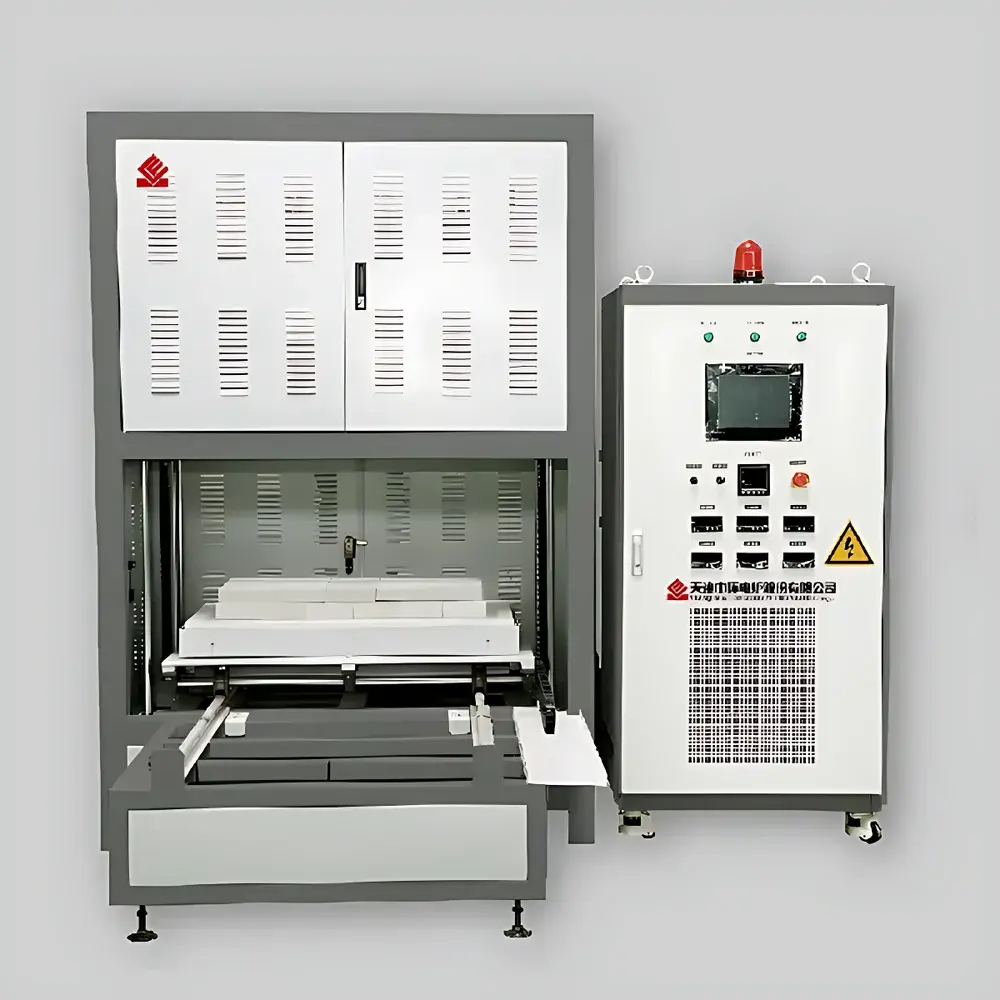
ZHONGHUAN FURNACE ZHX-220173M High-Temperature Box-Type Muffle Furnace (1700 °C)
| Brand | ZHONGHUAN FURNACE |
|---|---|
| Origin | Tianjin, China |
| Model | ZHX-220173M / ZHX-Y220173M |
| Type | Box-Type Muffle Furnace |
| Max. Operating Temperature | 1700 °C |
| Temperature Control Accuracy | ±1 °C |
| Rated Power | 54 kW |
| Heating Element | Silicon Molybdenum (MoSi₂) Rods |
| Internal Chamber Dimensions | 600 × 600 × 600 mm (L × W × H) |
| Cooling | Intelligent Surface Temperature Management with Auto-Activated Exhaust Fan (triggered at ≥50 °C surface temp) |
| Safety Features | Door-Interlocked Power Cut-off, Over-Temperature Protection, Earth-Leakage Circuit Interruption |
| Control Interface | RS-485 Port for PC Integration |
| Programmability | Up to 40-Step Ramp/Soak Profiles (with Imported Controller) |
Overview
The ZHONGHUAN FURNACE ZHX-220173M is a high-precision, industrial-grade box-type muffle furnace engineered for sustained operation at temperatures up to 1700 °C. Designed for rigorous laboratory and R&D environments—including ceramic sintering, advanced material synthesis, ash content analysis (per ASTM E1755, ISO 1171), and high-temperature calcination—the furnace employs MoSi₂ heating elements mounted in a double-layer insulated chamber. Its thermal architecture integrates multi-zone air-gap insulation and reflective ceramic fiber linings to minimize radial heat loss while maintaining uniform temperature distribution across the 600 mm × 600 mm × 600 mm working volume. The furnace operates on three-phase 380 V AC power (54 kW nominal load), delivering stable thermal profiles under continuous duty cycles. Unlike conventional resistance furnaces, the ZHX-220173M incorporates real-time thermal inertia compensation algorithms within its control firmware, enabling precise tracking of setpoints even during rapid ramp phases or transient load changes.
Key Features
- Intelligent Surface Thermal Management: Integrated thermal sensors monitor external casing temperature; exhaust fans activate automatically when surface temperature exceeds 50 °C, ensuring operator safety and structural integrity of adjacent lab equipment.
- Triple-Layer Safety Architecture: Includes mechanical door interlock (instant power cutoff upon opening), independent over-temperature cutout (hardware-level relay bypassing controller), and residual-current device (RCD) protection compliant with IEC 61000-4-5 surge immunity standards.
- Advanced PID-Fuzzy Hybrid Control: Combines classical proportional-integral-derivative regulation with adaptive fuzzy logic for improved overshoot suppression and faster stabilization—especially critical during soak phases above 1400 °C.
- Current-Limiting & Soft-Start Circuitry: Limits inrush current during startup and step-load transitions, extending MoSi₂ rod service life by reducing thermal shock and protecting facility wiring infrastructure from peak current stress.
- RS-485 Modbus RTU Interface: Enables centralized monitoring and control of up to 200 units via dedicated SCADA software; supports timestamped event logging, alarm history export (CSV/Excel), and remote parameter adjustment—all traceable for GLP/GMP audit compliance.
Sample Compatibility & Compliance
The ZHX-220173M accommodates standard crucibles (alumina, silicon carbide, platinum) and refractory boats up to 550 mm in length. Its muffle design isolates samples from direct radiant exposure and combustion byproducts, making it suitable for oxidation-sensitive processes such as catalyst activation, rare-earth oxide processing, and inert-atmosphere pre-firing (when used with optional gas purge kits). The furnace meets CE marking requirements for electrical safety (EN 61000-6-3, EN 61000-6-4) and complies with key testing standards including ASTM C20 (bulk density), ISO 5660-1 (fire performance), and USP heavy metal residue determination protocols. All controllers support 21 CFR Part 11–compliant electronic signatures and audit trails when deployed with validated software configurations.
Software & Data Management
The optional PC-based control suite provides full lifecycle data governance: real-time multi-channel temperature visualization (chamber, thermocouple reference junction, surface sensor), automated generation of calibration certificates (NIST-traceable), and customizable report templates aligned with ISO/IEC 17025 documentation requirements. Historical data is stored locally in encrypted binary format with SHA-256 checksum verification and can be exported with embedded metadata (operator ID, batch number, ambient conditions). The touchscreen HMI offers bilingual UI switching (English/Chinese), configurable alarm thresholds, and password-protected access levels for administrator, technician, and operator roles—supporting role-based accountability in regulated environments.
Applications
- Ceramic and refractory manufacturing: Sintering of zirconia, silicon nitride, and alumina-based composites.
- Metallurgical research: Heat treatment of superalloys, phase transformation studies, and TGA coupling for kinetic modeling.
- Environmental testing: Determination of loss-on-ignition (LOI) in soil and sediment per EPA Method 9081B.
- Pharmaceutical development: Residual solvent removal from active pharmaceutical ingredients (APIs) under controlled oxidative atmospheres.
- Aerospace materials: Pre-oxidation of CMC components and thermal cycling validation of thermal barrier coatings.
FAQ
What thermocouple type is recommended for 1700 °C operation?
Type B (Platinum/Rhodium 30–6% vs. 6%) thermocouples are factory-installed and certified for continuous use up to 1700 °C; calibration certificates are provided with each unit.
Can this furnace operate under inert or reducing atmospheres?
Yes—optional quartz or alumina tube inserts with flanged gas inlet/outlet ports enable N₂, Ar, or H₂/N₂ mixtures; maximum flow rate: 5 L/min at 1 bar gauge pressure.
Is the controller firmware upgradeable in the field?
Yes—firmware updates are delivered via USB stick and retain all user-defined programs and calibration offsets without reset.
What is the typical service interval for MoSi₂ heating elements?
Under proper operating conditions (no thermal shock, no volatile halogen exposure), expected lifetime exceeds 2,000 hours at 1700 °C with periodic resistance monitoring.
Does the system support integration into LabVantage or Thermo Fisher SampleManager LIMS?
Yes—via OPC UA or custom API wrapper; validated interface modules available upon request for 21 CFR Part 11–compliant data ingestion.



