
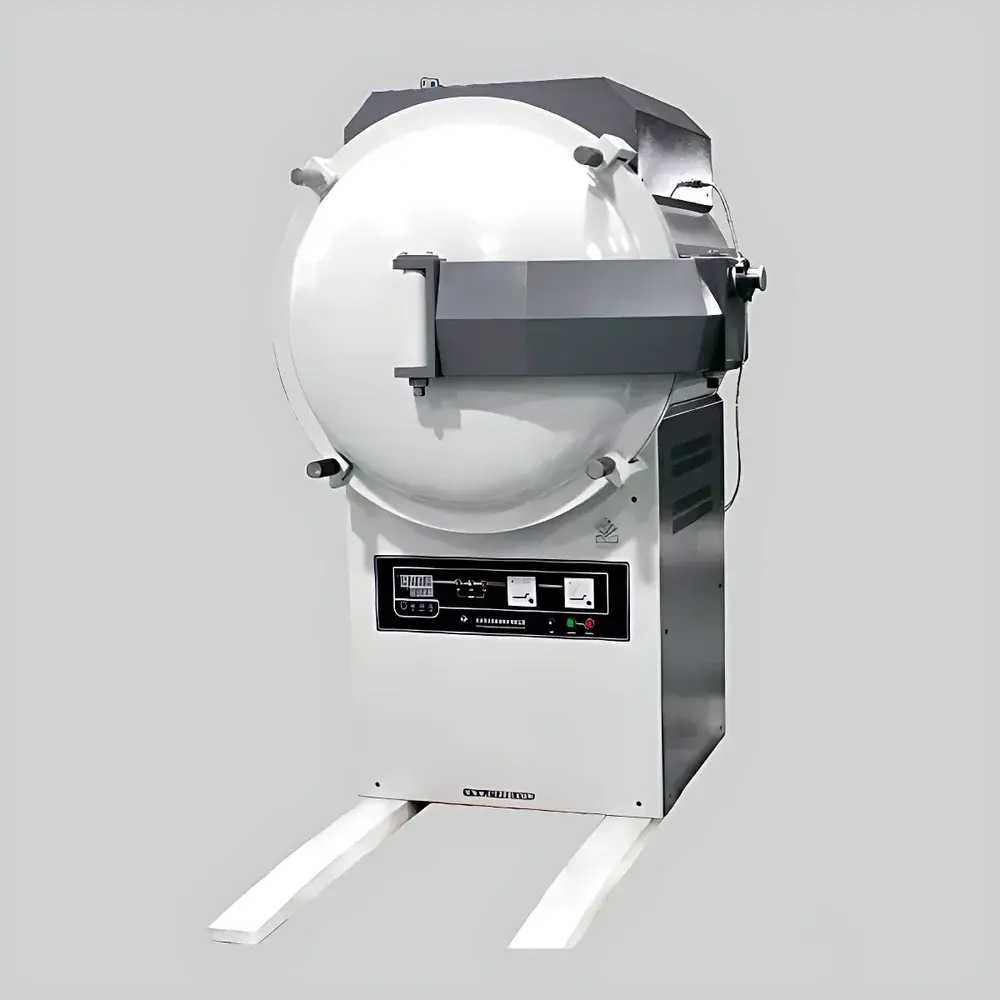
ZHONGHUAN FURNACE ZHX Series 1600°C High-Temperature Vacuum & Atmosphere Box-Type Resistance Furnace
| Brand | ZHONGHUAN FURNACE |
|---|---|
| Origin | Tianjin, China |
| Model | ZHX-1600VAC |
| Instrument Type | Box Furnace |
| Max Temperature | 1600°C |
| Temperature Control Accuracy | ±1°C |
| Max Power | 1 kW |
| Heating Rate to Max Temp | <40 min |
| Heating Element | Silicon Molybdenum (MoSi₂) Rods |
| Internal Chamber Dimensions | 600 × 1400 × 600 mm |
| Chamber Material | Polycrystalline Mullite Fiber (Vacuum-Formed) |
| Sealing Technology | Rectangular O-Ring Vacuum Seal |
| Cooling System | Surface-Temperature-Triggered External Air-Cooling Fan (Activated at ≥50°C) |
| Control System | AI-PID with Self-Tuning & Programmable Ramp/Soak Profiles |
| Programmable Segments | 50 (Domestic Controller) / 40 (Imported Controller) |
| Communication Interface | RS-485 for PC Integration |
| Compliance | Designed for GLP-compliant thermal processing environments |
Overview
The ZHONGHUAN FURNACE ZHX Series 1600°C High-Temperature Vacuum & Atmosphere Box-Type Resistance Furnace is an engineered solution for controlled thermal processing under inert, reducing, oxidizing, or high-vacuum conditions. Built upon a robust cylindrical vacuum chamber architecture fabricated entirely from corrosion-resistant stainless steel, the furnace employs resistive heating via high-stability silicon molybdenum (MoSi₂) rods—rated for continuous operation up to 1700°C surface temperature—ensuring long-term thermal reliability and minimal element degradation. Its vacuum-formed polycrystalline mullite fiber insulation delivers exceptional thermal efficiency, reducing energy consumption by approximately 50% compared to conventional refractory brick linings while maintaining superior temperature uniformity across the 600 × 1400 × 600 mm working zone. The furnace operates as a batch-type unit, supporting precise thermal cycles required in materials synthesis, sintering, annealing, ashing, and high-temperature reaction studies.
Key Features
- Cylindrical vacuum chamber design with rectangular-section elastomeric O-ring sealing system, enabling ultimate vacuum levels suitable for low-pressure (<10⁻³ Pa) and controlled-atmosphere applications.
- Vacuum-formed polycrystalline mullite fiber insulation—low thermal conductivity, high structural integrity at elevated temperatures, and excellent thermal shock resistance.
- Intelligent temperature control system featuring AI-based PID algorithm with auto-tuning capability, supporting up to 50 programmable ramp-hold segments for complex thermal profiles.
- Surface-temperature-responsive forced-air cooling system: external fans activate automatically when outer casing temperature reaches or exceeds 50°C, enhancing operator safety and extending structural component service life.
- Modular gas interface with quick-connect clamp fittings—eliminates flanged connections, minimizing installation-induced mechanical stress and potential leakage points.
- RS-485 serial interface standard-equipped for integration into centralized laboratory automation networks; supports remote monitoring, real-time data logging, and synchronized multi-furnace operation (up to 200 units).
Sample Compatibility & Compliance
The ZHX furnace accommodates diverse sample forms—including crucibles (alumina, quartz, graphite), ceramic boats, metal trays, and custom fixtures—within its spacious internal cavity. Its vacuum and atmosphere compatibility enables processing of oxygen-sensitive alloys, battery cathode precursors, rare-earth phosphors, and semiconductor precursors without oxidation or contamination. The system meets fundamental requirements for GLP and GMP-aligned thermal validation protocols. While not pre-certified to specific regulatory standards, its programmable controller supports audit-trail-capable operation when paired with compliant software platforms, and its thermal performance aligns with ASTM E220 (Standard Test Method for Calibration of Thermocouples by Comparison Techniques) and ISO 9001 calibration traceability expectations. Vacuum integrity verification may be performed using calibrated Pirani or capacitance manometers per ISO 27893.
Software & Data Management
The furnace integrates seamlessly with optional PC-based control software via RS-485 communication. This platform enables full remote supervision—including real-time temperature curve visualization, historical trend analysis, alarm event logging, and exportable CSV/PDF reporting. Multi-unit fleet management is supported, allowing synchronized program deployment, time-stamped data archival, and deviation alerting. All control actions—including setpoint changes, segment modifications, and emergency shutdowns—are timestamped and logged with user identification (where authentication is enabled), satisfying basic 21 CFR Part 11 data integrity prerequisites when deployed within validated IT infrastructure. Optional color touchscreen interface provides intuitive access to instrument status, graphical process representation (real-time curve, bar chart, tabular data), and configurable alarm thresholds.
Applications
This furnace serves critical roles across academic research, industrial R&D, and quality control laboratories. Typical use cases include: sintering of advanced ceramics (e.g., SiC, AlN, ZrO₂); heat treatment of Ni-based superalloys and Ti alloys under argon or hydrogen atmospheres; thermal decomposition and calcination of metal-organic frameworks (MOFs); ash content determination per AOAC 923.03; solid-state synthesis of cathode materials (e.g., NMC, LFP); vacuum brazing of precision components; and high-temperature stability testing of thermal barrier coatings. Its rapid heating rate (<40 minutes to 1600°C) and tight thermal uniformity support reproducible kinetic studies and accelerated process development.
FAQ
What vacuum level can this furnace achieve?
With appropriate vacuum pumping equipment (e.g., turbomolecular pump backed by dry scroll pump), the ZHX series typically achieves base pressures below 1×10⁻³ Pa. Ultimate vacuum performance depends on pump selection, chamber conditioning, and seal integrity.
Can it operate under reactive gas atmospheres such as H₂ or NH₃?
Yes—when equipped with compatible gas mass flow controllers and leak-tested piping, the furnace supports safe operation under reducing (H₂), inert (Ar, N₂), or mildly reactive (NH₃) atmospheres up to 0.1 MPa gauge pressure.
Is the temperature uniformity specified across the working zone?
While no single published value is provided, the vacuum-formed mullite fiber insulation and symmetrical MoSi₂ rod layout yield typical axial/radial uniformity of ±5°C at 1600°C, verified per ASTM C1040 practices.
Does the system support third-party SCADA integration?
Yes—via Modbus RTU over RS-485, the furnace can interface with common industrial SCADA systems (e.g., Ignition, WinCC, LabVIEW) using standard register mapping documentation supplied with the controller.
What maintenance intervals are recommended for heating elements and insulation?
Silicon molybdenum rods require visual inspection every 200 operational hours above 1200°C; replacement is typically needed after 1,500–2,000 cumulative hours at 1600°C. Insulation integrity should be assessed annually or after any thermal shock event.



