
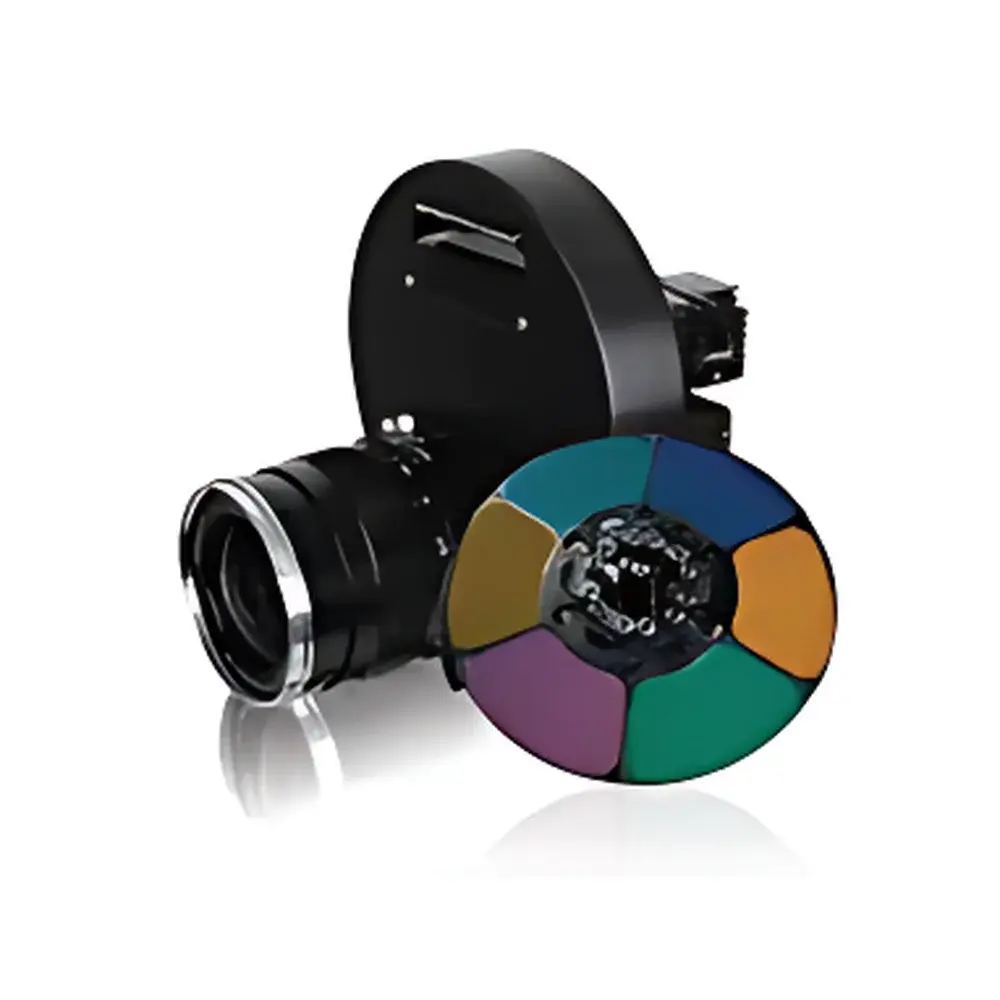
Pixelteq SpectraCAM SWIR Short-Wave Infrared Multispectral Imaging Camera
| Origin | USA |
|---|---|
| Manufacturer Type | Authorized Distributor |
| Origin Category | Imported |
| Model | SpectraCAM SWIR |
| Pricing | Available Upon Request |
| Spectral Range | 500–1700 nm |
| Number of Spectral Bands | 6 simultaneous channels |
| Frame Rate | Up to 30 fps (full-frame) |
| Spatial Resolution | 640 × 512 pixels |
| Sensor Type | High-sensitivity InGaAs focal plane array (FPA) |
| Output Interface | 14-bit CameraLink |
| Calibration Features | Integrated Automatic Gain Control (AGC) and Non-Uniformity Correction (NUC) |
| Filter Configuration | Interchangeable spectral filter wheel |
Overview
The Pixelteq SpectraCAM SWIR is a high-performance short-wave infrared (SWIR) multispectral imaging camera engineered for quantitative, real-time spectral analysis across the 500–1700 nm range. Unlike conventional broadband or RGB imaging systems, the SpectraCAM SWIR implements a mechanically actuated filter wheel architecture—derived from Pixelteq’s proven SpectroCAM platform—to deliver six precisely defined spectral bands per acquisition cycle. This design enables true snapshot-capable multispectral data capture without temporal misregistration, making it suitable for dynamic scenes involving moving targets, industrial process monitoring, or rapid material classification. The system leverages a thermoelectrically cooled indium gallium arsenide (InGaAs) focal plane array with native sensitivity spanning visible (VIS), near-infrared (NIR), and short-wave infrared (SWIR) regions—eliminating the need for multiple sensor heads or complex optical splitting schemes. Its full-frame readout capability at up to 30 fps ensures temporal fidelity critical for applications such as agricultural phenotyping, pharmaceutical tablet coating uniformity assessment, or defense-related surveillance under low-illumination conditions.
Key Features
- Simultaneous acquisition of six user-selectable spectral bands within a single 500–1700 nm window, configurable via interchangeable interference filters mounted on a precision stepper-motor-driven filter wheel
- 640 × 512 pixel InGaAs sensor with 14-bit digitization and calibrated radiometric response, supporting both relative reflectance and absolute irradiance measurement modes
- Real-time onboard non-uniformity correction (NUC) and automatic gain control (AGC), enabling stable image quality across varying illumination intensities—from daylight to moonlight-level ambient conditions
- CameraLink interface compliant with Base Configuration standards, facilitating seamless integration into existing machine vision platforms and real-time processing pipelines
- Ruggedized aluminum housing with passive thermal management, rated for continuous operation in ambient temperatures ranging from 0 °C to 45 °C
- Factory-calibrated spectral transmission profiles provided for each installed filter set, traceable to NIST-traceable reference sources
Sample Compatibility & Compliance
The SpectraCAM SWIR supports non-contact, label-free spectral interrogation of diverse sample types—including biological tissues, polymer films, semiconductor wafers, food products, and painted or coated surfaces—without requiring sample preparation or destructive sampling. Its SWIR sensitivity enables detection of overtone and combination bands associated with C–H, O–H, and N–H molecular vibrations, supporting compositional analysis aligned with ASTM E131 and ISO 18351 standards for spectroscopic imaging. The device meets CE marking requirements for electromagnetic compatibility (EMC Directive 2014/30/EU) and low-voltage safety (LVD Directive 2014/35/EU). While not intrinsically certified for hazardous locations, its design accommodates integration into Class I, Division 2 environments when deployed with appropriate enclosure solutions.
Software & Data Management
The camera operates with Pixelteq’s SpectraView acquisition and analysis suite, which provides intuitive band selection, real-time false-color rendering, region-of-interest (ROI) spectral extraction, and export of calibrated hyperspectral datacubes in ENVI-compatible BIL format. For regulated environments, optional software modules support audit trail logging, user access controls, and electronic signatures compliant with FDA 21 CFR Part 11 requirements. Raw image streams are timestamped with microsecond resolution and synchronized via TTL trigger input/output ports—enabling precise coordination with external light sources, motion stages, or analytical instrumentation. All calibration metadata—including exposure time, sensor temperature, filter position, and NUC frame index—is embedded directly into image headers using standardized EXIF and TIFF tags.
Applications
- Agricultural remote sensing: Crop health assessment via water stress indices (e.g., NDWI, WI) and nitrogen content estimation using SWIR-based vegetation indices
- Pharmaceutical quality control: Quantitative mapping of active pharmaceutical ingredient (API) distribution and excipient homogeneity in tablet coatings
- Recycling sorting: Discrimination of black plastics (e.g., ABS vs. PS) and polymer blends based on distinct SWIR absorption features
- Art conservation: Subsurface pigment identification and underdrawing visualization beneath varnish layers
- Defense and security: Covert surveillance under starlight illumination and camouflage detection through spectral signature anomalies
- Industrial inspection: Detection of moisture ingress in composite materials, delamination in laminated glass, or thermal defects in photovoltaic cells
FAQ
What spectral filters are included by default with the SpectraCAM SWIR?
Standard configurations include six narrowband filters centered at 650 nm, 850 nm, 940 nm, 1050 nm, 1350 nm, and 1650 nm—each with ≤10 nm full-width-at-half-maximum (FWHM) bandwidth. Custom filter sets can be specified during order placement.
Is the camera compatible with third-party frame grabbers?
Yes—the CameraLink interface conforms to the ANSI/VITA 1.0 standard and is interoperable with all major vendors’ Base-configuration frame grabbers, including those from Teledyne DALSA, BitFlow, and Euresys.
Does the system support radiometric calibration?
Yes—each unit ships with a factory-generated radiometric calibration file derived from measurements against a NIST-traceable tungsten-halogen source; users may perform field recalibration using optional integrating sphere accessories.
Can the filter wheel be operated remotely via software command?
Yes—SpectraView and the public SDK provide programmable control over filter positioning, dwell time, and sequencing logic, enabling automated spectral acquisition protocols.
What is the operating temperature range for the InGaAs sensor?
The thermoelectric cooler maintains the FPA at −5 °C ± 1 °C across ambient temperatures from 0 °C to 45 °C, ensuring stable dark current performance and minimizing thermal drift in quantitative measurements.




