
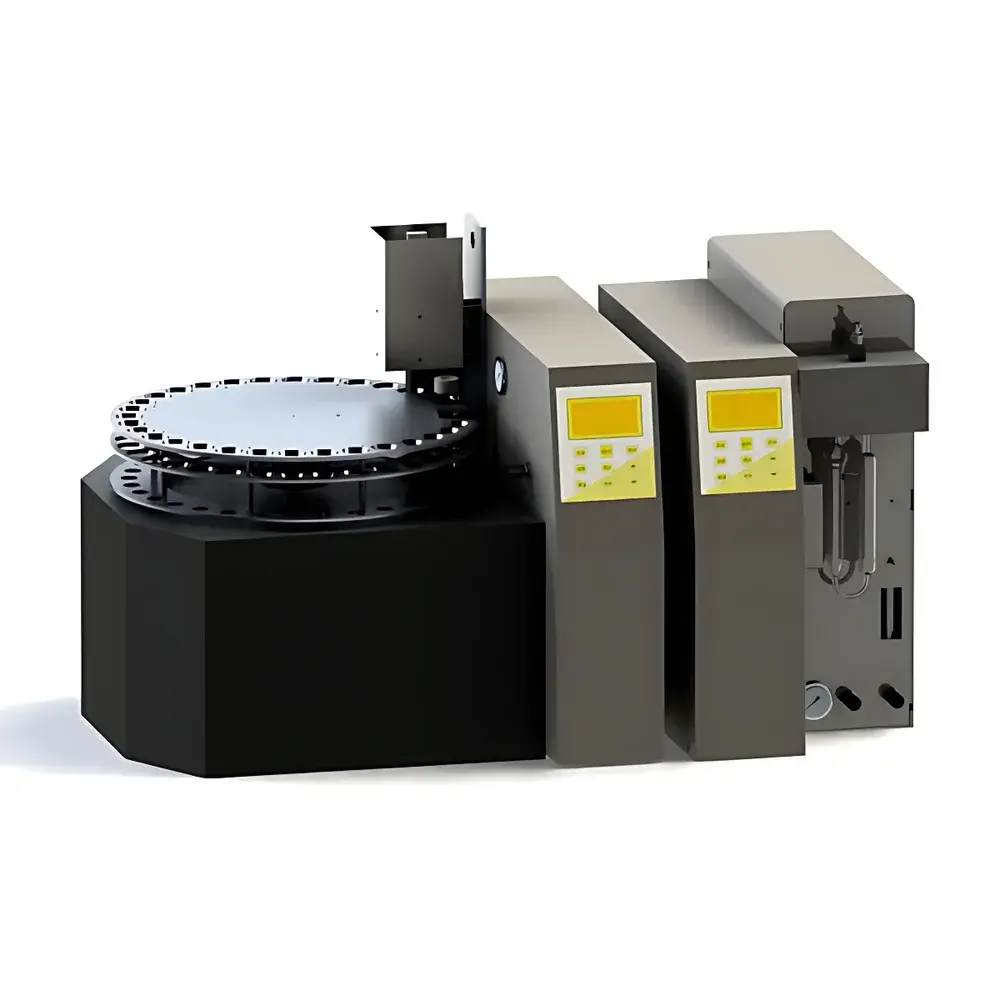
Zhonghui Pu PT-3+ALS30 Automated Solid/Liquid Purge and Trap Sampler
| Brand | Zhonghui Pu |
|---|---|
| Origin | Beijing, China |
| Manufacturer Type | Direct Manufacturer |
| Instrument Category | Domestic (China-Made) |
| Model | PT-3+ALS30 |
| Sample Tray Capacity | 30 positions |
| Trap Temperature Range | Ambient to 450 °C (during purge, desorption, and conditioning) |
| Sample Heating Temperature (Purge Zone) | Ambient to 100 °C |
| Sample Vial Cooling Temperature | Ambient +1 °C |
| Thermal Control Accuracy | ±1 °C |
| Desorption Heating Rate | >50 °C/s up to 350 °C |
| Rapid Cool-down Rate | >300 °C/min (200 °C → 50 °C in ≤50 s) |
| Water Removal Trap Temp Range | Ambient +1 °C to 240 °C |
| Transfer Line & 6-Port Valve Temp Range | Ambient to 200 °C (optional up to 330 °C) |
| Foam Suppressor Temp Range | Ambient to 200 °C |
| Liquid Sample Volume | 1–25 mL |
| Solid Sample Reconstitution Volume | 1–25 mL |
| Max Power Consumption | 1000 W peak |
Overview
The Zhonghui Pu PT-3+ALS30 is a fully automated solid/liquid purge and trap (P&T) sampling system engineered for high-throughput, regulatory-compliant volatile organic compound (VOC) analysis in environmental laboratories. It operates on the principle of dynamic headspace extraction: inert gas purges VOCs from aqueous or solid-phase samples into a thermally desorbable trap, where analytes are concentrated, water vapor is selectively removed, and the enriched analytes are subsequently thermally desorbed and transferred directly to a gas chromatograph (GC) or GC–mass spectrometer (GC–MS). Designed to meet stringent U.S. EPA Method 502.2, 524.2, 524.4, 8260D, and 8270E requirements—and fully compatible with Chinese national standards including HJ 639-2012, HJ 686-2014, HJ 788-2016, HJ 605-2011, HJ 893-2017, HJ 977-2018, HJ 1020-2019, and GB/T 5750.8-2006—the PT-3+ALS30 delivers reproducible, low-level detection (sub-ng/L in water; sub-µg/kg in soil) without manual intervention. Its architecture integrates precise thermal control, inert flow-path engineering, and motor-driven actuation—eliminating reliance on external compressed air or nitrogen for valve switching or syringe motion—thereby enhancing operational safety, method robustness, and long-term maintenance predictability.
Key Features
- 30-position autosampler tray with programmable vial indexing, enabling unattended batch processing of water, sediment, soil, and sludge matrices.
- Independent temperature control across all critical zones: purge heater (ambient–100 °C), trap (ambient–450 °C), water removal module (ambient+1 °C–240 °C), transfer line and 6-port valve (ambient–200 °C, optional 330 °C), and foam suppressor (ambient–200 °C).
- High-speed thermal cycling: trap heating rate >50 °C/s to 350 °C; rapid cool-down >300 °C/min—ensuring sharp desorption bands and minimal carryover.
- Integrated foam suppression module with real-time bubble detection and mechanical disruption, preventing column contamination and pressure fluctuations during purge.
- Entire fluidic path—including sample loop, injection needle, transfer lines, and trap fittings—constructed from high-inertness, silanized stainless steel or fused silica tubing with proprietary deactivation treatment to minimize adsorption and memory effects.
- Programmable liquid handling: automated spiking (internal standard addition), reconstitution (solid sample dilution), and post-run cleaning using chilled water, heated water, or methanol—configurable per method step.
- Motor-driven precision syringe pump (not pneumatic) for accurate 1–25 mL liquid aspiration and solid-phase water addition—reproducibility ±0.5% RSD over 100 injections.
- Heated 6-port valve housed within the main thermal enclosure—eliminating cold spots and ensuring quantitative transfer of thermally labile compounds.
- Onboard method library with preloaded EPA- and HJ-compliant sequences; user-editable parameters stored in non-volatile memory with timestamped versioning.
- RS-232 interface for bidirectional communication with third-party GC data systems (e.g., Thermo Chromeleon, Agilent OpenLab, Waters Empower), supporting full remote method launch, status polling, and fault logging.
Sample Compatibility & Compliance
The PT-3+ALS30 supports direct analysis of raw water (groundwater, surface water, wastewater), preserved soil cores, dried sediments, and homogenized sludges. For solid matrices, the system performs automated water addition, mixing, and headspace equilibration prior to purge—fully compliant with HJ 605-2011 (VOCs in soils) and HJ 1020-2019 (volatile halogenated hydrocarbons in solid waste). All thermal zones maintain ±1 °C stability per ASTM E2705 and ISO/IEC 17025 calibration traceability guidelines. The instrument’s firmware supports audit-trail-enabled operation per FDA 21 CFR Part 11 when integrated with validated LIMS or chromatography data systems—recording user logins, method changes, run start/stop times, temperature deviations, and error events. Mechanical fault detection logic includes stall-sensing motors, end-of-travel verification, and real-time pressure monitoring at the trap inlet—triggering automatic shutdown and diagnostic alerts before hardware damage occurs.
Software & Data Management
Control is executed via an embedded 7-inch resistive touchscreen with localized English UI (no Chinese characters), supporting method creation through guided workflow wizards. Each method defines thermal ramp profiles, gas flow rates (N₂ or He, 20–50 mL/min), purge duration (5–30 min), bake-out conditions, and cleaning cycles. All run logs—including temperature setpoints vs. actuals, valve actuation timestamps, syringe position feedback, and alarm history—are written to internal flash storage in CSV format and exportable via USB. Remote operation is supported via ASCII command protocol over RS-232, enabling seamless integration into laboratory automation frameworks (e.g., Hamilton STAR, Tecan Freedom EVO). No proprietary software license or dongle is required; configuration files are human-readable and editable in standard text editors.
Applications
- Regulatory compliance testing for trihalomethanes (THMs), benzene, toluene, ethylbenzene, xylenes (BTEX), vinyl chloride, chloroform, and 1,4-dioxane in drinking water per EPA 524.4 and HJ 639-2012.
- Soil and sediment screening for petroleum hydrocarbons (C2–C12), chlorinated solvents (PCE, TCE), and pesticides under HJ 686-2014 and HJ 788-2016.
- Wastewater influent/effluent monitoring per HJ 893-2017, including semi-volatiles requiring extended purge times.
- Method development for emerging contaminants such as PFAS precursors, nitrosamines, and oxygenated VOCs—leveraging the trap’s 450 °C maximum desorption temperature and modular sorbent cartridge compatibility (Tenax TA, Carbopack B/C, Carboxen 1000, etc.).
- Multi-laboratory round-robin studies requiring inter-instrument comparability—enabled by identical thermal profiles, timing logic, and flow control algorithms as Tekmar Atomx, OI 4550, and CDS 7000 series instruments.
FAQ
Does the PT-3+ALS30 support both aqueous and solid sample types in a single sequence?
Yes. The system automatically detects vial type (liquid or solid) via barcode or positional metadata and executes appropriate protocols—including water addition, vortex mixing, and extended equilibration—for solids prior to purge initiation.
What trap sorbents are compatible with the system?
All industry-standard packed-bed traps (e.g., 1/4″ OD × 3.5″ length) are supported. Common configurations include dual-bed Tenax TA/Carbopack B, Carboxen 1000/Carbopack B, or custom-packed beds for targeted analyte classes.
Is method validation documentation provided?
Yes. Factory-installed IQ/OQ protocols—including temperature mapping reports, flow calibration certificates, carryover testing results (<0.05% for chloroform), and RS-232 communication verification—are supplied with each unit.
Can the system be integrated into a GLP/GMP environment?
Yes. With proper configuration of external audit trail software and electronic signature controls, the PT-3+ALS30 meets ALCOA+ data integrity principles and supports 21 CFR Part 11 compliance when used in conjunction with validated chromatography data systems.
What maintenance intervals are recommended?
Trap bake-out after every 10 runs; transfer line cleaning every 50 runs; foam suppressor inspection every 200 runs; full thermal zone calibration annually or after any major component replacement.





