
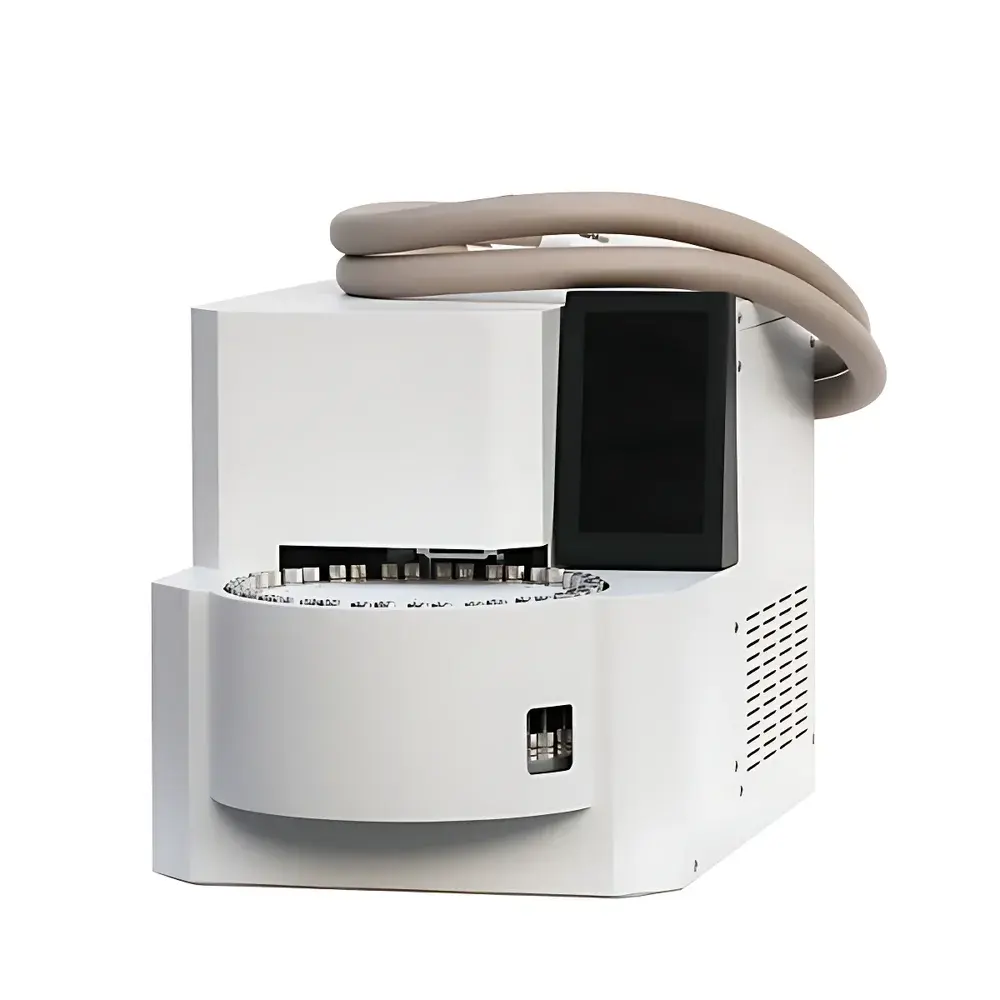
Zhonghuipu JX-20D PRO Fully Automated Dual-Channel Secondary Thermal Desorber
| Brand | Zhonghuipu |
|---|---|
| Origin | Beijing, China |
| Manufacturer Type | Direct Manufacturer |
| Instrument Type | Secondary Thermal Desorber |
| Automation Level | Fully Automated |
| Primary Desorption Temperature Range | 40–400 °C |
| Secondary Desorption (Cold Trap) Temperature Range | −35 °C to 450 °C |
| Valve Heating Range | 40–240 °C, Accuracy: ±1 °C |
| Transfer Line Heating Range | 40–240 °C, Accuracy: ±1 °C |
| Cold Trap Cooling Range | −35 °C to Ambient |
| Temperature Control Accuracy | ±1 °C |
| Sample Tray Capacity | Dual 20-position (40 total) |
Overview
The Zhonghuipu JX-20D PRO is a fully automated, dual-channel secondary thermal desorber engineered for high-throughput, trace-level volatile organic compound (VOC) analysis in environmental and indoor air monitoring applications. It operates on the principle of two-stage thermal desorption: first, analytes are thermally released from sorbent tubes under controlled inert gas flow (primary desorption); second, the evolved vapors are cryo-focused in a thermoelectrically cooled trap (−35 °C), followed by rapid flash-heating (>70 °C/s) and transfer to the gas chromatograph (GC) or GC–MS inlet. This architecture ensures quantitative recovery of light VOCs (e.g., benzene, toluene, ethylbenzene, xylenes—BTEX), semi-volatiles (e.g., naphthalene, chlorobenzenes), and polar compounds (e.g., methanol, acetaldehyde) with minimal breakthrough or degradation. Designed for compliance-driven laboratories, the JX-20D PRO supports method-defined workflows aligned with ISO 16000-6, ASTM D6196, US EPA TO-17, and Chinese national standards including GB/T 18883–2022, GB 50325–2020, HJ 583–2010, HJ 644–2013, and HJ 734–2014.
Key Features
- Dual independent 20-position sample trays (40 total), enabling true parallel processing — one channel can desorb while the other loads/unloads, maximizing instrument uptime and throughput.
- High-precision temperature control across all critical zones: primary furnace (±1 °C), valve oven (±1 °C), transfer line (±1 °C), and cold trap (±1 °C), ensuring method reproducibility and retention time stability.
- Thermoelectric (Peltier) cooling system achieves −35 °C cold trap temperature without liquid nitrogen or mechanical compressors — reducing operational cost, noise, and infrastructure requirements.
- Ultra-clean, inert sample pathway: all internal gas lines are electropolished, Siltek®/Sulfinert®-treated 316 stainless steel; PTFE-sealed fittings and heated zones eliminate adsorption, carryover, and memory effects.
- Patented stainless-steel tapered sampling needle with side-port geometry enhances septum life (>500 injections per septum) while maintaining mechanical robustness and precise depth control.
- Integrated diagnostic and maintenance mode: real-time motor position monitoring, pressure leak detection, and self-diagnostics enable rapid troubleshooting and GLP-compliant preventive maintenance logging.
- 7-inch capacitive touchscreen interface with intuitive workflow navigation, method storage (≥100 protocols), and audit-trail-enabled operation logs compliant with FDA 21 CFR Part 11 requirements when paired with validated LIMS/GC software.
Sample Compatibility & Compliance
The JX-20D PRO accepts standard 1/4″ OD × 3.5″ stainless steel or glass sorbent tubes (e.g., Tenax TA, Carbopack B/C, Carboxen 1000, or multi-bed configurations). Its programmable parameters support full method flexibility: primary desorption time (0–60 min), secondary desorption ramp rate (>70 °C/s), trap hold time (0–10 min), simulated sampling duration (0–60 min), and flow-controlled sampling (0–200 mL/min). The system meets ISO/IEC 17025 calibration traceability requirements when used with NIST-traceable reference standards. It is validated for use in accredited environmental testing labs performing compliance testing per CNAS-CL01 and CMA certification scopes.
Software & Data Management
Controlled via embedded firmware with optional PC-based software (Windows 10/11 compatible), the JX-20D PRO supports bidirectional communication with major GC and GC–MS platforms (Agilent, Thermo Fisher, Shimadzu, PerkinElmer). It reads GC ready/status signals and triggers synchronized injection, eliminating manual timing errors. All method parameters, run logs, error codes, and temperature profiles are timestamped and exportable as CSV or XML. Audit trail functionality records user ID, action type, timestamp, and parameter changes — supporting 21 CFR Part 11 electronic record integrity and GxP-aligned data governance. Raw desorption event data can be imported into chromatographic data systems (CDS) such as OpenLab CDS, Chromeleon, or MassHunter for integrated reporting.
Applications
- Indoor air quality (IAQ) assessment per GB/T 18883–2022 and ISO 16000-6 — quantification of formaldehyde, TVOC, and target VOCs in residential/commercial buildings.
- Building material emission testing (e.g., carpets, adhesives, particleboard) following GB 50325–2020 and ASTM D5116.
- Ambient air monitoring networks using passive or active sampling per HJ 583–2010 and HJ 644–2013.
- Workplace exposure evaluation for OSHA-PEL or ACGIH-TLV compounds in industrial hygiene labs.
- Method development and validation for emerging contaminants (e.g., siloxanes, fluorotelomer alcohols) requiring ultra-low detection limits and thermal stability.
FAQ
Does the JX-20D PRO support unattended overnight operation?
Yes — its dual-channel architecture, automated tube handling, and built-in fault recovery allow continuous 24/7 batch runs with up to 40 samples per sequence.
Can it be integrated with legacy GC systems lacking digital I/O?
Yes — optional TTL-level trigger modules provide hardware synchronization for older GC models without Ethernet or RS-232 interfaces.
What is the typical RSD for low-level benzene quantitation?
≤2.5% (n = 6) at 0.05 µg on tube, measured against certified EPA TO-17 reference standards under optimized desorption conditions.
Is the cold trap temperature affected by ambient lab conditions?
The −35 °C minimum is achievable at ambient temperatures ≤25 °C; performance degrades gradually above 30 °C due to Peltier efficiency limits — climate-controlled lab environments are recommended for maximum sensitivity.
Are consumables proprietary or industry-standard?
All sorbent tubes, septa, and O-rings are commercially available off-the-shelf items meeting ASTM D6196 specifications; no vendor-locked components are required.




