
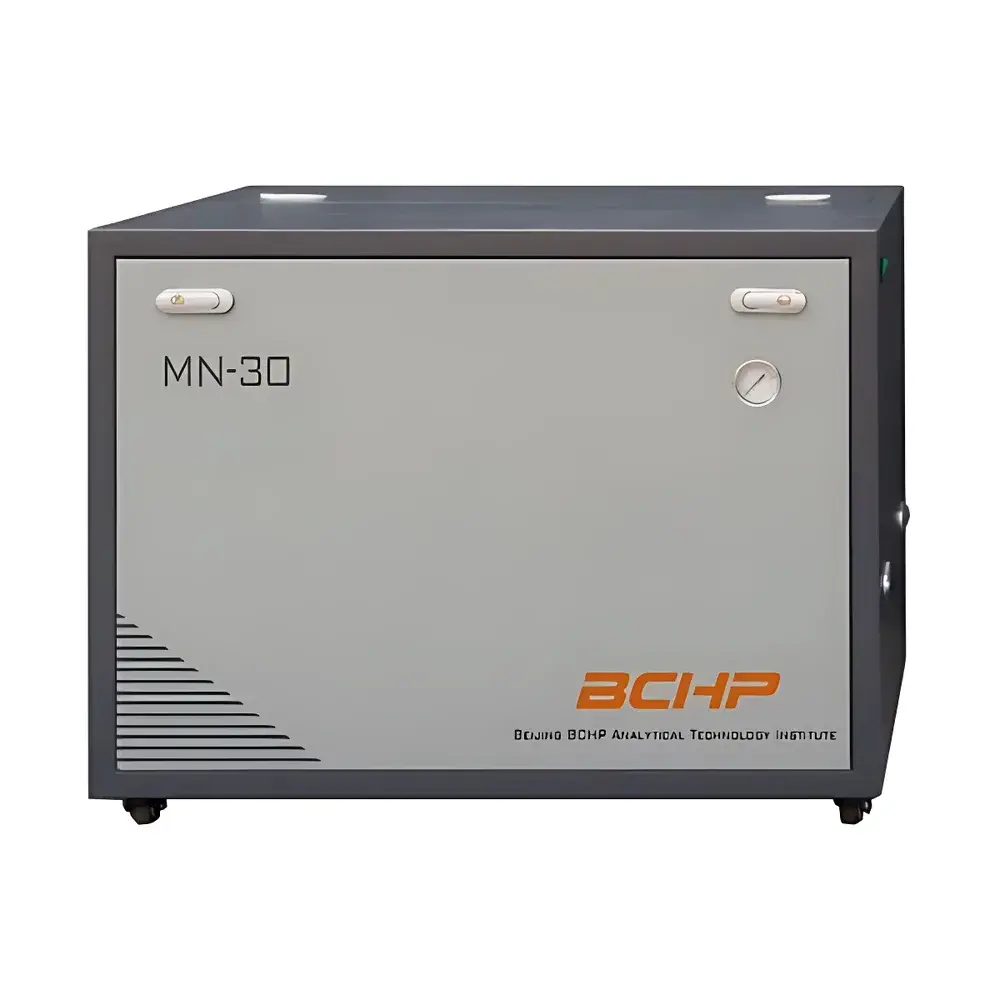
Zhonghuipu MN-30 Nitrogen Generator
| Brand | Zhonghuipu |
|---|---|
| Origin | Beijing, China |
| Manufacturer Type | Direct Manufacturer |
| Product Category | Domestic |
| Model | MN-30 |
| Instrument Type | Nitrogen Generator |
| Nitrogen Generation Principle | Hollow Fiber Membrane Separation |
| Output Flow Rate | >30 L/min |
| Output Pressure Range | 0–60 psi (continuously adjustable) |
| Nitrogen Purity | Up to 99.5% |
| Dew Point | ≤ −55 °C |
| Particulate Filtration | <0.01 µm |
| Oil Aerosol Content | <0.003 mg/m³ |
| Phthalate-Free | Yes |
| Operating Ambient | 5–40 °C, RH <80% (non-condensing) |
| Electrical Requirement | 220 V / 50 Hz, 1.5 kW |
| Dimensions (L×W×H) | 900 × 600 × 750 mm |
| Weight | ~110 kg |
Overview
The Zhonghuipu MN-30 Nitrogen Generator is an integrated, on-demand gas supply system engineered for continuous, high-purity nitrogen production in analytical laboratories, chromatography suites, and industrial process environments. It employs proven hollow fiber membrane separation technology to extract nitrogen from compressed ambient air—eliminating reliance on high-pressure cylinders or liquid nitrogen dewars. The core separation mechanism relies on differential permeation rates of oxygen, water vapor, and carbon dioxide through selective polymer membranes, enabling rapid diffusion of these faster-permeating gases while retaining nitrogen as the primary product stream. This physical separation method ensures stable output without consumable reagents or chemical regeneration cycles. Designed for ISO Class 4–5 clean air requirements, the MN-30 delivers nitrogen with ≤−55 °C dew point, <0.01 µm particulate retention, and oil aerosol levels below 0.003 mg/m³—meeting stringent specifications for GC carrier gas, LC-MS purge gas, inert blanketing, and sample preparation workflows.
Key Features
- Integrated dual-stage compression: Equipped with two Thomas high-efficiency, oil-free scroll compressors—ensuring consistent inlet pressure and extended service life without lubricant contamination risk.
- Four-stage precision filtration: Sequential coalescing, activated carbon, desiccant, and ultra-fine particulate filters remove moisture, hydrocarbons, particulates, and trace volatiles prior to membrane entry.
- Imported high-flux hollow fiber membrane module: Sourced from a Tier-1 global supplier; optimized for long-term flux stability, low pressure drop, and resistance to fouling under variable load conditions.
- Intelligent monitoring system: Real-time status display of inlet pressure, outlet pressure, flow rate, and filter service intervals; audible/visual alerts for scheduled maintenance and critical fault conditions.
- Low-noise engineering: Acoustic isolation enclosures for compressors, vibration-damping mounts, and sound-absorbing internal lining reduce operational noise to <58 dB(A) at 1 m distance.
- Mobility and footprint efficiency: Compact monolithic chassis with industrial-grade casters enables repositioning across lab zones without disassembly; no external air dryer or buffer tank required.
- Robust mechanical construction: Aluminum alloy pressure vessels, ASME-certified safety relief valves, and corrosion-resistant internal piping ensure compliance with PED 2014/68/EU and local pressure equipment regulations.
Sample Compatibility & Compliance
The MN-30 is compatible with all standard laboratory nitrogen-dependent instrumentation—including gas chromatographs (GC, GC-MS), liquid chromatography-mass spectrometers (LC-MS), elemental analyzers, glove boxes, and thermal desorption units. Its output meets ASTM D6350-22 specifications for nitrogen used in analytical carrier gas applications and aligns with ISO 8573-1:2010 Class 2.2.1 for compressed air quality (adapted for nitrogen purity verification). While not certified to FDA 21 CFR Part 11 out-of-the-box, its digital interface supports integration into validated environments via external audit trail logging systems. The unit conforms to IEC 61000-6-3 (EMC emission) and IEC 61000-6-2 (immunity) standards, and carries CE marking for safe operation within the European Economic Area.
Software & Data Management
The MN-30 operates as a standalone hardware platform with embedded microcontroller-based logic—no PC software or driver installation is required. All operational parameters are accessible via a backlit LCD panel with intuitive menu navigation. For facilities requiring centralized monitoring, optional RS-485 Modbus RTU output enables integration into building management systems (BMS) or SCADA platforms. Event logs—including compressor runtime, filter usage hours, and pressure deviation events—are stored locally for up to 12 months and can be exported via USB interface for GLP/GMP documentation purposes. Audit trails support traceability for QA/QC review per ISO/IEC 17025 clause 7.9.
Applications
- Carrier gas supply for capillary GC and GC-MS systems requiring stable, low-moisture nitrogen streams
- Purge and trap, headspace, and thermal desorption applications where oxygen-free inerting is critical
- Blanketing of sensitive reagents, solvents, or biological samples during storage or transfer
- Supply of instrument-grade nitrogen for FTIR, Raman, and XRD sample chambers
- Supporting nitrogen-driven pneumatic controls in automated sample handling and robotic workcells
- On-site generation for pharmaceutical stability testing chambers per ICH Q1 guidelines
FAQ
What is the expected service life of the hollow fiber membrane module?
Under recommended operating conditions (inlet dew point <−20 °C, oil-free feed air), the membrane stack is rated for ≥15,000 hours of continuous operation before performance degradation exceeds 10% of initial nitrogen recovery efficiency.
Can the MN-30 be connected to multiple instruments simultaneously?
Yes—provided total demand remains within the rated flow capacity (>30 L/min at specified pressure and purity). A properly sized distribution manifold with individual pressure regulators is recommended for multi-point deployment.
Does the generator require external cooling or ventilation?
No active cooling is needed; however, ambient airflow around the unit must be unobstructed. Minimum clearance of 150 mm on all sides and above is advised to maintain inlet air temperature within 5–40 °C.
How often must filters be replaced?
Pre-filters: every 3,000–4,000 operating hours; coalescing and activated carbon stages: every 6,000 hours; final particulate filter: every 12,000 hours—or sooner if pressure differential exceeds 0.3 bar across the stage.
Is the nitrogen output suitable for use in food-grade or pharmaceutical manufacturing?
The MN-30 meets purity and cleanliness thresholds for many non-sterile pharmaceutical processes (e.g., API drying, packaging inerting); however, formal validation per USP or EP 2.6.27 requires site-specific IQ/OQ/PQ protocols and periodic residual solvent testing.



