
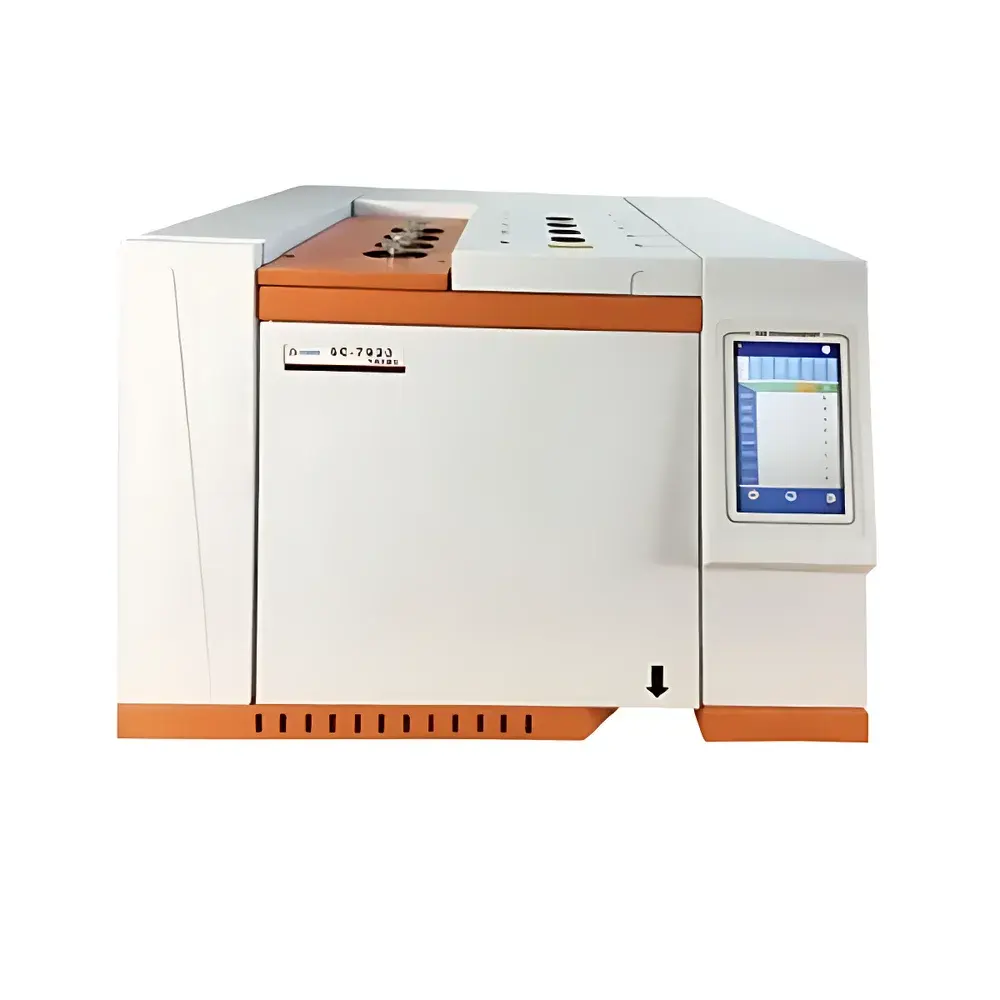
Zhongjiao Jinyuan GC7920 Fully Automated Gas Chromatography System
| Brand | Zhongjiao Jinyuan |
|---|---|
| Origin | Beijing, China |
| Manufacturer Type | OEM Manufacturer |
| Regional Origin | Domestic (China) |
| Model | GC7920 |
| Pricing | Upon Request |
Overview
The Zhongjiao Jinyuan GC7920 Fully Automated Gas Chromatography System is a modular, high-performance analytical platform engineered for precision separation and quantitative analysis of volatile and semi-volatile organic compounds. Based on classical gas chromatographic principles—carrier gas-driven solute partitioning between a mobile phase (inert gas) and a stationary phase (capillary or packed column)—the GC7920 delivers robust reproducibility across diverse application domains including academic research, petrochemical quality control, environmental contaminant profiling (e.g., VOCs, PAHs, organochlorines), and regulatory-compliant method development. Its tri-compartment architecture isolates the oven, detector module, and electronic control unit to minimize thermal crosstalk and enhance long-term baseline stability. Designed for adaptability, the system supports seamless integration into GLP- and GMP-aligned workflows through hardware modularity and software traceability features.
Key Features
- Multi-inlet configuration flexibility: Supports single packed-column, single capillary, dual-capillary, and packed-plus-capillary inlet systems—enabling method-specific optimization without hardware replacement.
- Expandable inlet compatibility: Interfaces with headspace samplers, thermal desorption units, and programmable temperature vaporizers (PTVs) for solid, liquid, and gaseous sample introduction.
- Oven chamber with industrial-grade thermal management: 300 × 280 × 180 mm internal volume accommodates up to five columns and four valves (standard), scalable to seven columns and five valves for complex multidimensional GC (MDGC) or heart-cutting configurations.
- High-fidelity temperature control: Maximum oven temperature of 450 °C; ramp rate up to 80 °C/min; temperature stability ±0.1 °C; 16-step programmable temperature gradients with <0.1 °C control accuracy.
- Intelligent rear-door cooling system: Enables rapid oven cooldown to near-ambient conditions (<5 min from 450 °C to 50 °C), reducing cycle time and improving throughput in high-sample-volume labs.
- Proprietary logarithmic amplifier circuitry: Dynamically adjusts gain across signal amplitudes—enhancing detection sensitivity for trace analytes while preventing saturation during high-concentration injections.
- Modular detector architecture: Detector modules (TCD, FID, ECD, FPD, NPD) feature plug-and-play electrical and gas connections, enabling field-upgradable configurations without recalibration or downtime.
Sample Compatibility & Compliance
The GC7920 accommodates a broad range of sample matrices—including aqueous extracts, hydrocarbon fractions, air canister samples, soil headspace vapors, and polymer leachates—when paired with appropriate inlet and column selection. It supports method validation per ASTM D3612 (petroleum hydrocarbons), ISO 10385 (environmental VOCs), USP (chromatographic separations), and EPA Methods 502.2, 608, and 8081B. The system’s hardware design meets IEC 61010-1 safety requirements for laboratory equipment. Optional audit-trail-enabled software packages facilitate compliance with FDA 21 CFR Part 11 for electronic records and signatures in regulated environments.
Software & Data Management
Control and data acquisition are managed via a Windows-based chromatography data system (CDS) supporting real-time monitoring, peak integration with customizable baselines, retention time locking, and library search (NIST/EPA/Wiley). Raw data files comply with ANDI/NetCDF format standards. The CDS includes built-in tools for calibration curve generation (linear, quadratic, weighted), system suitability assessment (tailing factor, resolution, RSD), and report templating aligned with ISO/IEC 17025 documentation requirements. Data integrity safeguards include user-level access control, electronic signatures, and immutable audit trails for all acquisition, processing, and export events.
Applications
- Academic research: Reaction monitoring, catalyst evaluation, polymer degradation product identification.
- Petrochemical QA/QC: Hydrocarbon group-type analysis (HTA), sulfur speciation, benzene/toluene/xylenes (BTX) quantification in gasoline.
- Environmental testing: Pesticide residue screening (organophosphates, organochlorines), chlorinated solvent profiling in groundwater, dioxin/furan congener analysis (with HRMS coupling).
- Pharmaceutical impurity profiling: Residual solvent testing per ICH Q3C guidelines.
- Food & flavor analysis: Volatile aroma compound characterization, adulteration detection (e.g., olive oil authenticity).
FAQ
Can the GC7920 operate multiple detectors simultaneously?
Yes—the system supports concurrent installation and independent operation of up to three detectors (e.g., FID + TCD + ECD), each with dedicated gas flow control and signal processing channels.
Is method transfer possible from legacy GC platforms?
Yes—retention time locking and column dimension normalization algorithms allow direct migration of methods from Agilent, Shimadzu, or Thermo platforms with minimal re-optimization.
What column types are compatible?
The GC7920 accepts standard 0.1–0.53 mm ID fused-silica capillary columns and stainless-steel/aluminum packed columns (up to 6 mm OD), with universal ferrule-based inlet fittings.
Does the system support unattended overnight operation?
Yes—integrated autosampler compatibility (optional), power-fail recovery logic, and automated leak-check routines ensure stable 24/7 operation in core facility environments.
Are service and calibration support services available internationally?
Zhongjiao Jinyuan partners with certified third-party service providers in North America, Europe, and APAC regions for on-site maintenance, performance verification (PV), and IQ/OQ documentation support.
Related Products




