
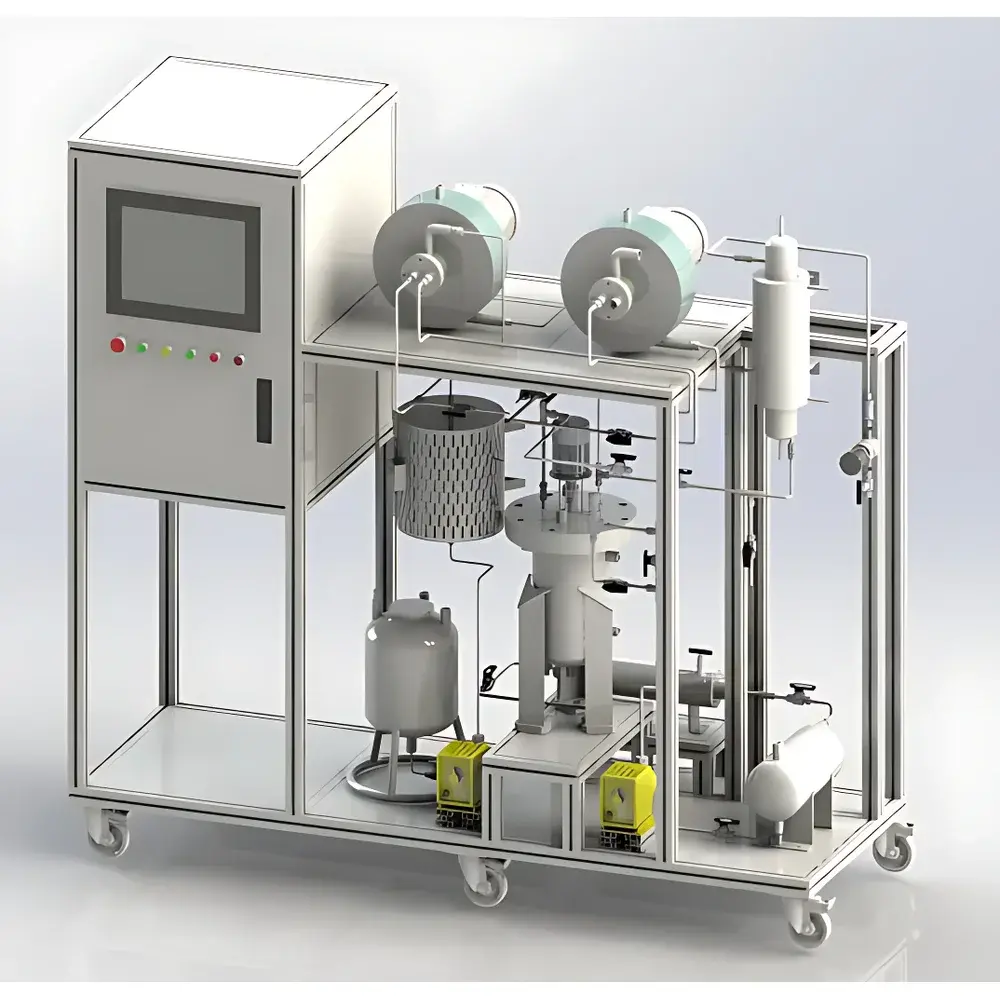
Zhongjiaojinyuan CEL Microscale Catalytic Evaluation Reactor System
| Brand | Zhongjiaojinyuan |
|---|---|
| Origin | Beijing, China |
| Manufacturer Type | Direct Manufacturer |
| Origin Category | Domestic (China-made) |
| Model | CEL |
| Pricing | Upon Request |
Overview
The Zhongjiaojinyuan CEL Microscale Catalytic Evaluation Reactor System is a precision-engineered bench-scale fixed-bed reactor platform designed for quantitative kinetic and performance assessment of heterogeneous catalysts under controlled temperature, pressure, and feed conditions. Based on continuous-flow plug-flow reactor (PFR) principles, the system enables rigorous evaluation of catalytic activity, selectivity, stability, and deactivation behavior across gas-phase, liquid-phase, and trickle-bed reaction regimes. It supports isothermal and gradient-temperature operation up to 600 °C, with independent thermal zoning for vaporization, reaction, and post-reaction conditioning—ensuring accurate decoupling of mass transfer, heat transfer, and intrinsic kinetics. The system adheres to fundamental reactor engineering standards and is routinely deployed in R&D laboratories conducting catalyst screening, formulation optimization, and process intensification studies aligned with ASTM D3241, ISO 10722, and IUPAC-recommended kinetic testing protocols.
Key Features
- Modular, open-frame mechanical architecture minimizing dead volume while enabling rapid reconfiguration for varying catalyst bed geometries (0–5 mL or 5–10 mL loading capacity), maintaining constant catalyst height-to-diameter ratio across reactor tube changes.
- Dual-mode control interface: fully integrated PC-based automation (via industrial PLC and SCADA-compatible software) coexisting with manual override capability for operational flexibility and method development transparency.
- Multi-tiered safety architecture: three-level pressure/temperature monitoring—(1) programmable high/low limit alarms, (2) high-limit emergency response (e.g., automatic venting, pump shutdown), and (3) hardware-independent emergency stop triggering full system isolation.
- Reaction core constructed from ASTM A240 316 stainless steel; equipped with interchangeable isothermal jackets (custom inner diameters) to ensure radial temperature uniformity across varying reactor tube sizes.
- Integrated pre-vaporization buffer zone with independent heating (up to 400 °C) and minimized transfer distance to reactor inlet—mitigating recondensation and ensuring consistent vapor-phase feed composition.
- High-pressure, high-temperature gas–liquid separator with level-controlled automated discharge via differential pressure transmitter and pneumatic control valve—enabling stable phase separation without pressure drop across sampling cycles.
Sample Compatibility & Compliance
The CEL system accommodates solid catalysts (powders, extrudates, pellets, monoliths), liquid feeds (hydrocarbons, oxygenates, aqueous solutions), and gaseous reactants (H₂, CO, CO₂, NH₃, hydrocarbons, inert carriers). It supports hydrogenation, hydrodesulfurization (HDS), hydrodeoxygenation (HDO), Fischer–Tropsch synthesis, oxidation, and cracking evaluations. All wetted components comply with ASME B31.3 process piping standards. Pressure containment meets PED 2014/68/EU requirements for Category II equipment. Temperature controllers are NIST-traceable and calibrated per ISO/IEC 17025. Optional integration with GC or MS analyzers allows full compliance with EPA Method 8260D and ASTM D7214 for product speciation and quantification.
Software & Data Management
The embedded control software provides real-time visualization of 32+ process variables (temperature profiles, flow rates, pressures, valve positions), with synchronized timestamped logging at user-defined intervals (100 ms–5 min resolution). Data export supports CSV, Excel, and HDF5 formats. Audit trail functionality complies with FDA 21 CFR Part 11 requirements—including electronic signatures, user role-based access control, and immutable change history. Raw sensor data is stored locally with optional cloud backup (AWS S3 or on-premise NAS). Batch reporting templates support GLP/GMP documentation workflows, including catalyst lot traceability, calibration logs, and deviation records.
Applications
- Catalyst ranking and comparative activity screening under industrially relevant conditions (e.g., 1–100 bar, 150–550 °C).
- Accelerated aging and lifetime assessment via time-on-stream (TOS) experiments with periodic sampling and regeneration cycles.
- Kinetic parameter estimation (apparent activation energy, reaction orders) using steady-state and transient-response methodologies.
- Process validation for pilot-scale scale-up—generating design data for P&ID development and HAZOP input.
- Teaching laboratory use for chemical engineering unit operations courses, emphasizing reactor design, mass/energy balances, and safety interlock logic.
FAQ
What catalyst forms can be tested in the CEL system?
Powdered catalysts, cylindrical extrudates (1–5 mm diameter), spherical pellets, and structured monoliths (with custom fixture adapters) are supported. Catalyst bed void fraction and particle size distribution are accounted for in backpressure and pressure-drop calculations.
Is the system compatible with corrosive feedstocks such as H₂S or Cl-containing compounds?
Yes—when specified during ordering, wetted parts (reactor tube, valves, fittings) can be upgraded to Hastelloy C-276 or Inconel 625 per ASTM A240/A479. Standard 316SS is suitable for low-sulfur feeds and short-duration exposure.
Can the system operate in recycle mode or with online product analysis?
Recycle operation requires external loop integration (not included standard); however, the system’s six-port sampling valves and heated transfer lines (up to 250 °C) are fully compatible with in-line GC/MS interfaces and FTIR gas cells.
What maintenance intervals are recommended for long-term reliability?
Calibration of mass flow controllers and temperature sensors every 6 months; inspection of high-pressure seals and valve seats annually; full system leak test (helium sniffer) before each new catalyst campaign.
Does Zhongjiaojinyuan provide application support for method development?
Yes—comprehensive technical documentation, SOP templates, and remote application engineering support are included with purchase; on-site startup assistance and catalyst testing protocol co-development are available as optional services.



