
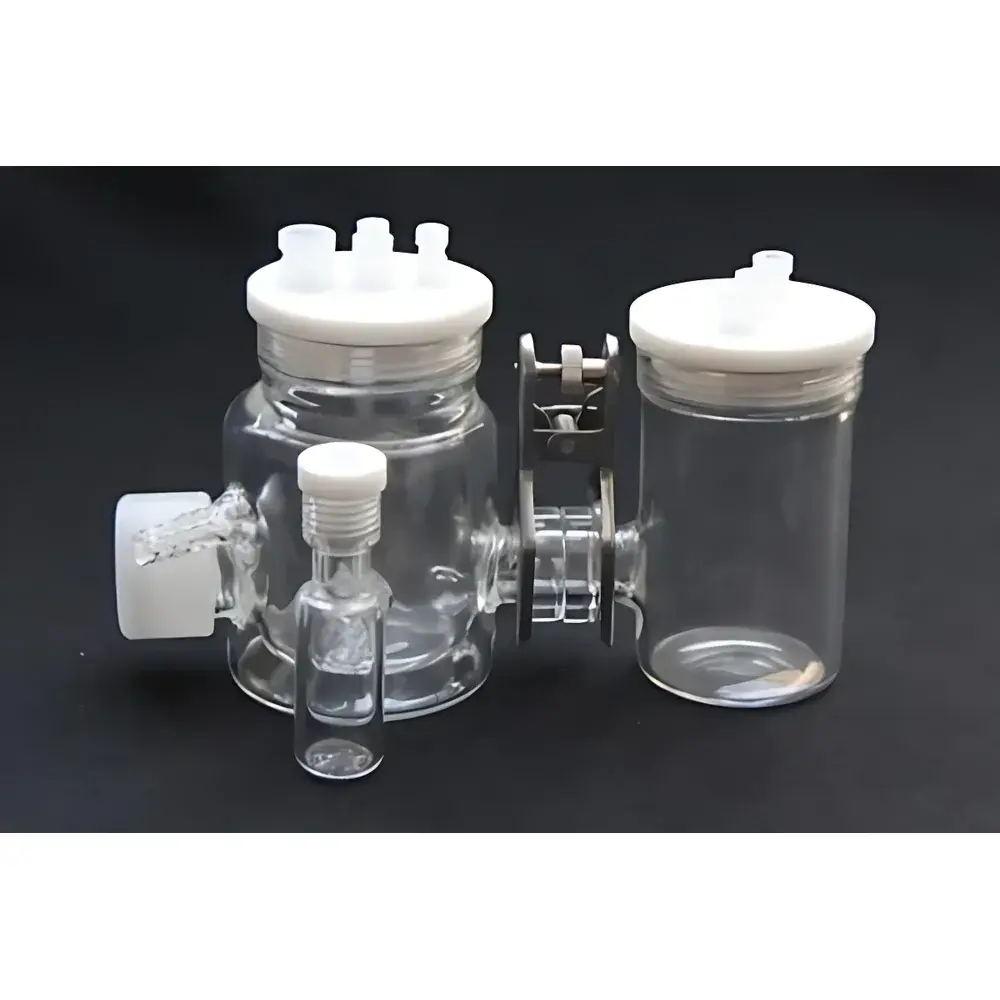
Zhongjiaojinyuan PECK10S Triple-Port Temperature-Controlled Photoelectrochemical Cell (Sealed H-Type)
| Brand | Zhongjiaojinyuan |
|---|---|
| Origin | Beijing, China |
| Manufacturer Type | Direct Manufacturer |
| Product Category | Domestic |
| Model | PECK10S |
| Unit Price | USD 1,420 (approx.) |
| Component Type | Optical & Electrochemical Cell Assembly |
| Cell Volume | 50 mL |
| Construction | Borosilicate Glass Body |
| Top Cap Material | PTFE |
| Optical Window | Fused Silica (24 mm Ø) |
| Electrode Configuration | Dual Working/Counter Compartments Isolated by Ion-Exchange Membrane or Fritted Glass Disc |
| Reference Electrode Compartment | Dedicated Small Auxiliary Chamber |
| Temperature Control | Double-Jacketed Water Bath Interface (Compatible with LX/HX Series Circulating Chillers) |
| Standard Electrodes | Pt Wire Counter Electrode, Ag/AgCl Reference Electrode, Pt Electrode Holder for Working Electrode |
| Customization Options | Adjustable Electrode Port Diameter/Quantity, Optional Cell Volumes (100 mL / 150 mL), User-Supplied Membrane Integration |
Overview
The Zhongjiaojinyuan PECK10S is a precision-engineered, triple-port, temperature-controlled photoelectrochemical (PEC) cell designed for rigorous electrochemical and photoelectrochemical investigations under controlled thermal and optical conditions. Its sealed H-type configuration physically separates the anodic and cathodic compartments—enabling independent electrolyte composition, pH control, and redox environment management—while maintaining galvanic continuity via an ion-selective membrane or sintered glass frit. The cell operates on the fundamental principle of interfacial charge transfer across semiconductor–electrolyte junctions under illumination, making it suitable for quantifying photocurrent onset potentials, incident photon-to-current efficiency (IPCE), stability under prolonged irradiation, and reaction kinetics in heterogeneous photocatalytic systems. The fused silica optical window (24 mm diameter, UV-VIS transparent, λ = 190–2500 nm) ensures high transmission for monochromatic or broadband irradiation from xenon, LED, or laser sources. Its double-jacketed borosilicate glass body allows precise thermal regulation (±0.2 °C stability typical when paired with external circulating chillers), critical for eliminating thermal drift in kinetic measurements and stabilizing surface adsorption equilibria.
Key Features
- Borosilicate glass cell body with chemical resistance to aqueous electrolytes, organic solvents (e.g., acetonitrile, methanol), and mild acidic/basic media (pH 1–13)
- Triple-port design: two large-diameter ports for working and counter electrodes, one dedicated small port for reference electrode insertion—minimizing liquid junction potential errors
- PTFE sealing caps with integrated O-ring grooves ensure gas-tight operation for anaerobic or inert-atmosphere experiments (N₂, Ar purging compatible)
- Interchangeable isolation interface: supports user-installed anion/cation exchange membranes (e.g., Nafion®, Fumasep®) or sintered glass frits (porosity grade G3/G4) for tailored ionic transport control
- Modular electrode mounting: threaded electrode holders accommodate standard 6 mm OD rods; custom port diameters (4–8 mm) available upon request to fit specialized photoanodes (e.g., TiO₂ nanotube arrays, BiVO₄ films on FTO)
- Double-jacketed thermal interface compatible with LX-series (±0.1 °C) or HX-series (−20 °C to +80 °C) recirculating chillers—enabling Arrhenius analysis and long-term stability testing
Sample Compatibility & Compliance
The PECK10S accommodates solid-state photoelectrodes (e.g., metal oxide thin films on conductive substrates), suspended nanoparticle slurries (TiO₂, g-C₃N₄), and molecular catalysts dissolved in aqueous or non-aqueous electrolytes (0.1 M Na₂SO₄, 0.5 M LiClO₄ in propylene carbonate). Its geometry conforms to standard three-electrode electrochemical cell conventions defined in ASTM D1193 (reagent water specifications) and ISO 17025-accredited lab practices. While not certified to IEC 61000-4 electromagnetic compatibility standards, its passive glass/PTFE construction eliminates stray capacitance and grounding artifacts—ensuring signal fidelity during low-current (<100 nA) chronoamperometric measurements. All materials comply with REACH Annex XIV restrictions and are free of SVHC substances above threshold concentrations.
Software & Data Management
The PECK10S is hardware-agnostic and fully interoperable with industry-standard potentiostats (BioLogic SP-300, Gamry Interface 5000E, CHI 760E) and data acquisition systems. When used with potentiostats supporting GLP-compliant firmware (e.g., BioLogic EC-Lab v11+), experimental metadata—including temperature setpoint, illumination intensity (measured via calibrated Si photodiode), and electrode positioning—is embedded in raw .mpt or .gamry files. Audit trails, electronic signatures, and 21 CFR Part 11–compliant user access logs are enforced at the instrument control layer—not within the cell itself—ensuring traceability without compromising mechanical simplicity.
Applications
- Photoelectrochemical water splitting performance evaluation (OER/HER overpotentials, Faradaic efficiency)
- Stability assessment of perovskite-based photoanodes under operational bias and illumination (J–t decay profiling)
- Electrocatalyst screening for CO₂ reduction under visible-light irradiation
- Charge transfer resistance mapping via electrochemical impedance spectroscopy (EIS) across illuminated/dark states
- In situ UV-Vis absorption monitoring of surface intermediates during photocorrosion studies
- Development of tandem PEC cells requiring compartmentalized redox mediators (e.g., Fe²⁺/Fe³⁺ and I⁻/I₃⁻ couples)
FAQ
Can the PECK10S be used under vacuum or positive pressure?
No—it is designed for ambient-pressure, liquid-phase operation only. Vacuum or pressurized configurations require custom flange integration and are not supported out-of-the-box.
Is the fused silica window AR-coated?
Standard configuration uses uncoated UV-grade fused silica. Anti-reflection coating (R < 0.5% @ 300–800 nm) is available as a factory option (lead time +10 business days).
What is the maximum recommended operating temperature?
The glass body is rated to 80 °C continuous; however, PTFE cap integrity degrades above 65 °C. For elevated-temperature studies, fluorinated ethylene propylene (FEP) caps are offered as an alternative.
Does the cell include a built-in light shutter or intensity modulator?
No—light control is external. Users integrate mechanical shutters (e.g., Thorlabs SH1) or programmable LED drivers upstream of the optical path.
Can I replace the Ag/AgCl reference electrode with a saturated calomel electrode (SCE)?
Yes—the 3 mm reference port accepts any standard micro-reference electrode with compatible outer diameter; conversion between reference scales is handled in post-processing using established potential offsets.






