
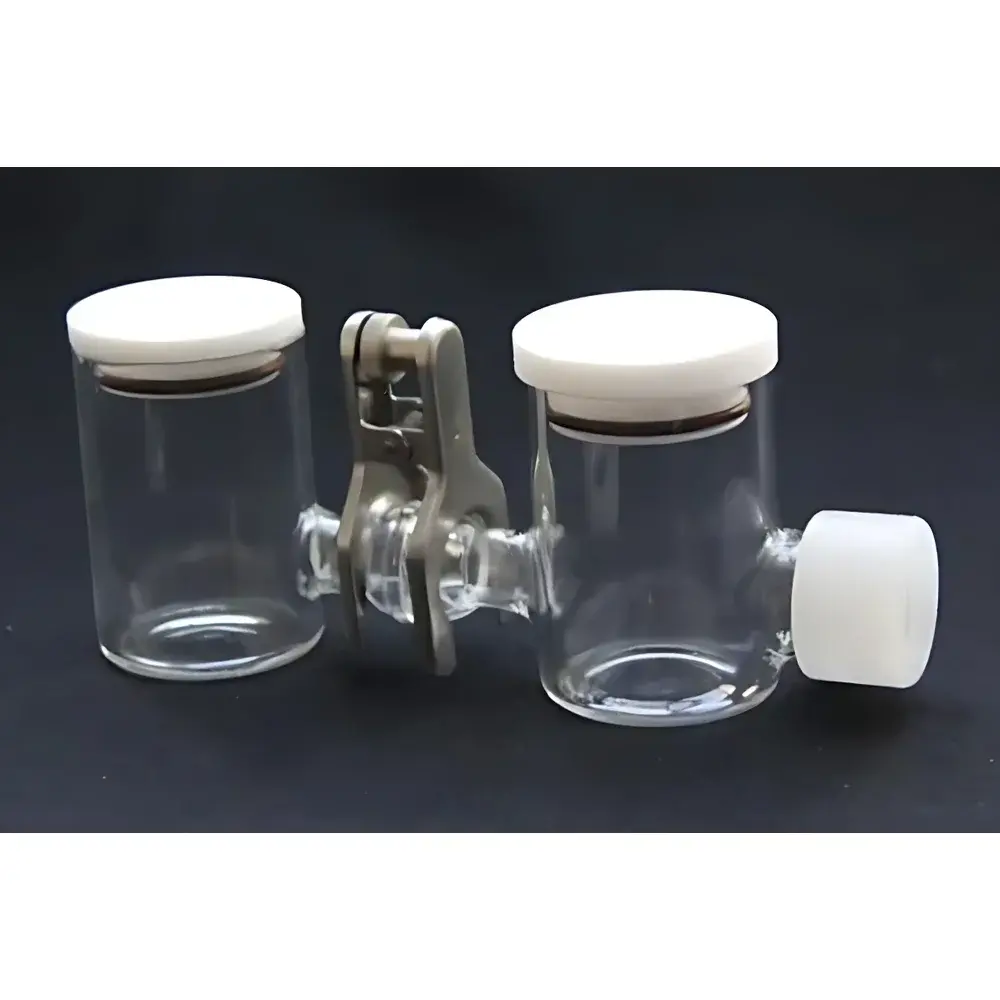
Zhongjiaojinyuan PECK12S Dual-Compartment Photoelectrochemical Cell (Sealed H-Type)
| Brand | Zhongjiaojinyuan |
|---|---|
| Origin | Beijing, China |
| Manufacturer Type | Direct Manufacturer |
| Product Category | Domestic |
| Model | PECK12S |
| Component Type | Optical Component |
| Body Material | Borosilicate Glass |
| Cap Material | PTFE |
| Optical Window | Fused Silica (24 mm Diameter) |
| Compartment Isolation | Replaceable Ion-Exchange Membrane or Fritted Glass Disc |
| Total Volume per Compartment | 50 mL |
| Electrode Configuration | Three-Electrode System (Working: Pt Clip |
| Counter | Pt Wire |
| Reference | Ag/AgCl) |
| Mounting | Threaded Electrode Holders + Flange Clamps |
| Customization Options | Single-compartment variants (100 mL / 200 mL), Custom Electrode Port Dimensions, Optional Quartz Window Kits |
Overview
The Zhongjiaojinyuan PECK12S Dual-Compartment Photoelectrochemical Cell is an engineered H-type optical-electrochemical reactor designed for controlled, spatially segregated photoelectrochemical investigations. It operates on the principle of compartmentalized electrochemical kinetics under illumination, where incident photons drive charge carrier generation at a photoactive working electrode surface while maintaining strict ionic and chemical separation between anolyte and catholyte compartments. This architecture is essential for studying half-reactions—such as water oxidation and proton reduction—independently, minimizing cross-contamination, back-reaction interference, and redox mediator crossover. The cell’s sealed, gas-tight design supports quantitative gas evolution analysis (e.g., O2, H2) in tandem with electrochemical measurements (CV, LSV, chronoamperometry), making it suitable for fundamental studies in solar fuel generation, photocorrosion resistance, and interfacial charge transfer dynamics.
Key Features
- Borosilicate glass body with high thermal stability, chemical inertness, and UV–visible transparency (200–2500 nm), ensuring minimal optical absorption during irradiation.
- Two interchangeable isolation options: standardized ion-exchange membrane ports (e.g., Nafion® compatible) or sintered glass frit (porosity grade G3/G4) for adjustable ionic conductivity and mass transport control.
- Fused silica optical windows (24 mm Ø, 5 mm thickness, AR-coated optional) mounted via compression sealing—enabling collimated or focused illumination from either side without leakage.
- PTFE caps with integrated threaded ports (M6 × 0.75) for secure, chemically resistant electrode insertion and gas sampling valve integration.
- Modular three-electrode configuration: platinum clip holder (adjustable clamping force), coiled Pt wire counter electrode, and double-junction Ag/AgCl reference electrode (3 M KCl, ceramic frit junction) with calibrated potential stability (±2 mV over 24 h).
- Flange-based assembly with silicone O-rings (FKM-compatible) ensures reproducible sealing pressure and leak rates <1 × 10⁻⁷ mbar·L/s under vacuum-rated operation (up to 0.5 bar differential pressure).
Sample Compatibility & Compliance
The PECK12S accommodates aqueous, non-aqueous, and mixed-solvent electrolytes—including acidic (0.5 M H2SO4), alkaline (1 M KOH), and organic media (acetonitrile/LiClO4). Its design conforms to standard laboratory safety practices for low-pressure electrochemical cells (IEC 61010-1). While not certified for explosion-proof use, the cell meets GLP-aligned documentation requirements for traceable experimental setup: each unit carries a serialized label, material certification (DIN ISO 3585 for borosilicate glass 3.3), and PTFE compliance with FDA 21 CFR 177.1550. For regulated environments, optional calibration reports (electrode potential verification per ASTM E2073) and audit-ready assembly logs are available upon request.
Software & Data Management
The PECK12S is hardware-agnostic and fully interoperable with industry-standard potentiostats (e.g., BioLogic SP-300, Metrohm Autolab PGSTAT302N) and spectrophotometers (e.g., Ocean Insight QE Pro). When paired with electrochemical workstations supporting multi-channel synchronization, users can correlate real-time current response with simultaneous optical monitoring (e.g., in situ UV-Vis absorbance changes at the electrode interface). Data acquisition adheres to IEEE 11073-10201 standards for device interoperability, and raw time-series files export in .mpt (BioLogic), .txt (Gamry), or .csv formats—compatible with Python (Pandas, SciPy), MATLAB, and OriginLab for kinetic modeling (Butler–Volmer, Marcus–Hush analysis).
Applications
- Quantitative photoelectrocatalytic water splitting efficiency evaluation (ABPE, IPCE, Faradaic efficiency via GC-TCD calibration).
- Stability testing of metal oxide photoanodes (e.g., BiVO4, Fe2O3) under prolonged AM 1.5G illumination with in situ pH monitoring.
- Redox-mediated photocurrent amplification studies using [Fe(CN)6]3−/4− or [Ru(NH3)6]3+/2+ shuttles across ion-selective membranes.
- Development and screening of molecular catalysts immobilized on conductive substrates (FTO, ITO, carbon cloth) under controlled mass transport conditions.
- Photoelectrochemical impedance spectroscopy (PEIS) in frequency range 100 kHz–10 mHz at open-circuit and biased potentials to resolve charge-transfer and recombination resistances.
FAQ
Can the PECK12S be used under inert atmosphere (N2/Ar)?
Yes—the flange-sealed design allows full purging via dual gas inlet/outlet ports; recommended purge flow rate: 20–30 mL/min for 15 min prior to measurement.
Is quartz window replacement possible without disassembling the entire cell?
Yes—quartz discs are retained by spring-loaded PTFE retaining rings; removal requires only a Torx T10 driver and takes <90 seconds.
What is the maximum operating temperature?
The standard configuration is rated for continuous operation up to 60 °C; for elevated temperatures (≤100 °C), optional high-temp silicone gaskets and borosilicate glass frits are available.
Does Zhongjiaojinyuan provide validation data for membrane resistance?
Upon request, a certificate of performance includes measured area-specific resistance (ASR) values for standard Nafion 117 and Fumasep FAP-450 membranes at 25 °C in 0.5 M H2SO4.
Can custom electrode port diameters be specified for non-standard electrodes?
Yes—port threading (M6, M8, or UNC 6-32) and inner diameter (3–8 mm) are configurable during order placement; lead time increases by 5 business days.




