
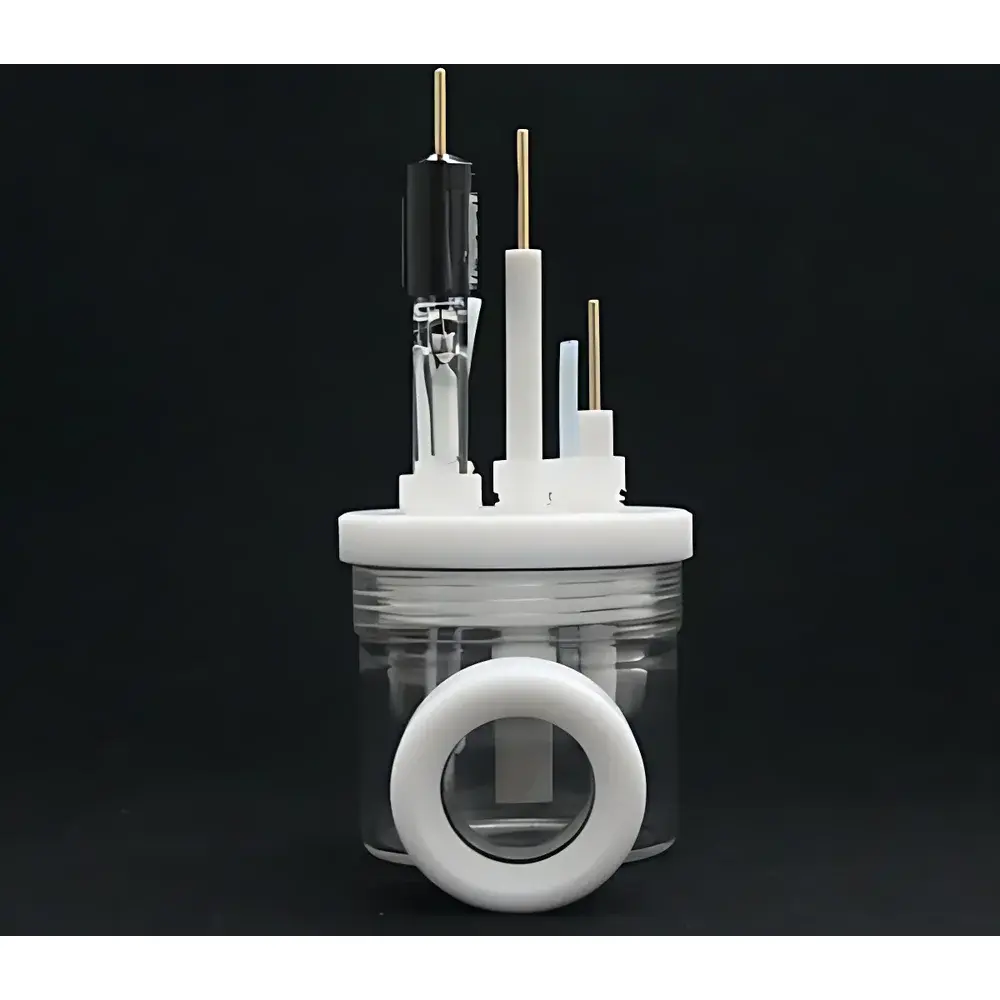
Zhongjiaojinyuan PECK40SG Standard Sealed Photoelectrochemical Cell (Glass Body)
| Brand | Zhongjiaojinyuan |
|---|---|
| Origin | Beijing, China |
| Manufacturer Type | Direct Manufacturer |
| Product Category | Domestic |
| Model | PECK40SG |
| Component Type | Optical Component |
| Cell Volume | 50 mL |
| Optical Window | Fused Silica, Ø24 mm |
| Body Material | Borosilicate Glass |
| Cap Material | PTFE |
| Electrode Configuration | Pt wire counter electrode, Ag/AgCl reference electrode, Pt electrode clamp for working electrode |
| Sealing Type | Threaded PTFE cap with O-ring seal |
| Max Operating Temperature | 80 °C |
| Chemical Resistance | Excellent against aqueous electrolytes, mild acids/bases, and common organic solvents |
Overview
The Zhongjiaojinyuan PECK40SG is a standard sealed photoelectrochemical (PEC) cell engineered for controlled, reproducible investigation of light-driven interfacial charge transfer processes at electrode–electrolyte interfaces. Designed around the fundamental principles of photoelectrochemistry—where incident photons generate electron–hole pairs in a photoactive material, inducing measurable photocurrents or photovoltages—the PECK40SG provides a robust, optically transparent platform compatible with both potentiostatic and galvanostatic electrochemical techniques. Its fused silica optical window (Ø24 mm) ensures high UV–vis transmission (190–2500 nm), enabling quantitative irradiation across spectroscopic and solar-simulated conditions. The borosilicate glass body offers thermal stability up to 80 °C and mechanical rigidity under vacuum or inert gas purging, while the threaded PTFE cap with integrated elastomeric sealing ensures leak-tight operation during long-term chronoamperometric or impedance measurements.
Key Features
- Borosilicate glass cell body with chemical inertness toward aqueous and moderately aggressive electrolytes (e.g., 0.5 M H2SO4, 1 M NaOH, 0.1 M KCl)
- Fused silica optical window (Ø24 mm, thickness 3 mm) mounted via precision-machined recess and silicone-free compression seal—enabling rapid exchange without adhesive residue or alignment drift
- Threaded PTFE cap with dual O-ring groove design for reliable hermetic sealing under ambient or N2/Ar-purged environments
- Modular three-electrode configuration: Pt wire counter electrode (10 cm length, 0.5 mm diameter), Ag/AgCl (3 M KCl) reference electrode with porous frit junction, and adjustable Pt electrode clamp accommodating rods up to 3 mm diameter
- Standardized 50 mL internal volume with calibrated fill line; optional custom volumes (e.g., 100 mL) available upon request with geometric recalibration documentation
- Electrode port geometry configurable per user specification—including single- or dual-working-electrode layouts, auxiliary irradiation ports, or gas-inlet/outlet fittings for in situ headspace analysis
Sample Compatibility & Compliance
The PECK40SG supports a broad range of photoactive materials including metal oxides (TiO2, WO3, BiVO4), chalcogenides (CdS, CuInGaSe2), perovskites (MAPbI3), and molecular catalysts immobilized on conductive substrates (FTO, ITO, Au sputtered electrodes). It complies with standard laboratory safety practices for low-pressure (<1 atm), ambient-temperature PEC experiments. While not certified to ISO/IEC 17025 or ASTM E2567, its dimensional repeatability and material traceability align with GLP-aligned experimental protocols for comparative photocurrent quantum yield (IPCE) and incident photon-to-current efficiency (ABPE) reporting. All PTFE and borosilicate components meet USP Class VI biocompatibility criteria for non-reactive labware.
Software & Data Management
The PECK40SG is hardware-agnostic and fully interoperable with industry-standard electrochemical workstations (e.g., BioLogic SP-300, CH Instruments 660E, PalmSens EmStat GO) and spectrophotometers equipped with fiber-optic coupling. No proprietary software is required. When used with compliant potentiostats supporting IEEE 488.2 or USB CDC protocols, raw current/voltage/time data are acquired in ASCII or CSV format—enabling direct import into MATLAB, Python (via pandas), or OriginLab for kinetic modeling (e.g., Butler–Volmer fitting, Mott–Schottky analysis). Audit trails, metadata tagging (irradiance, wavelength, scan rate), and timestamp synchronization are maintained through host workstation logging—not embedded firmware—ensuring full traceability under FDA 21 CFR Part 11–aligned workflows when paired with validated instrument control software.
Applications
- Quantitative photoelectrocatalytic water splitting performance evaluation (H2/O2 evolution under AM 1.5G illumination)
- Stability assessment of photoanodes/cathodes via chronoamperometry over >24 h under constant bias and illumination
- In situ electrochemical impedance spectroscopy (EIS) to resolve charge-transfer resistance and Helmholtz layer capacitance under illumination
- Wavelength-dependent IPCE mapping using monochromated light sources coupled to lock-in amplification
- Photoinduced corrosion studies of semiconductor electrodes in chloride-containing electrolytes
- Development and screening of molecular photosensitizers or co-catalysts in three-electrode configurations
FAQ
Can the PECK40SG be used under positive pressure or vacuum?
Yes—the PTFE cap and dual O-ring seal support operation within ±0.3 bar gauge pressure. For sustained vacuum applications (<10 mbar), optional Viton O-rings and reinforced cap torque specifications are recommended.
Is the quartz window replaceable in the field?
Yes—no adhesives are used. The window is held by mechanical compression; replacement requires only a Torx T10 driver and clean compressed air for debris removal.
What electrochemical techniques are validated with this cell?
Cyclic voltammetry, linear sweep voltammetry, chronoamperometry, open-circuit potential decay, and frequency-domain EIS (0.1 Hz–100 kHz) have been experimentally verified using standard redox couples (e.g., Fe(CN)63−/4−).
Does Zhongjiaojinyuan provide calibration certificates or dimensional drawings?
Dimensional drawings (PDF and STEP format) are supplied with each unit. NIST-traceable optical transmittance certification is available as an optional add-on service.
Can I integrate a temperature probe or pH sensor into the cell?
Yes—two auxiliary ports (M4 × 0.7 thread, depth 6 mm) are预留 (reserved) for insertion of micro-probes; custom port machining is offered for OEM integration requirements.





