
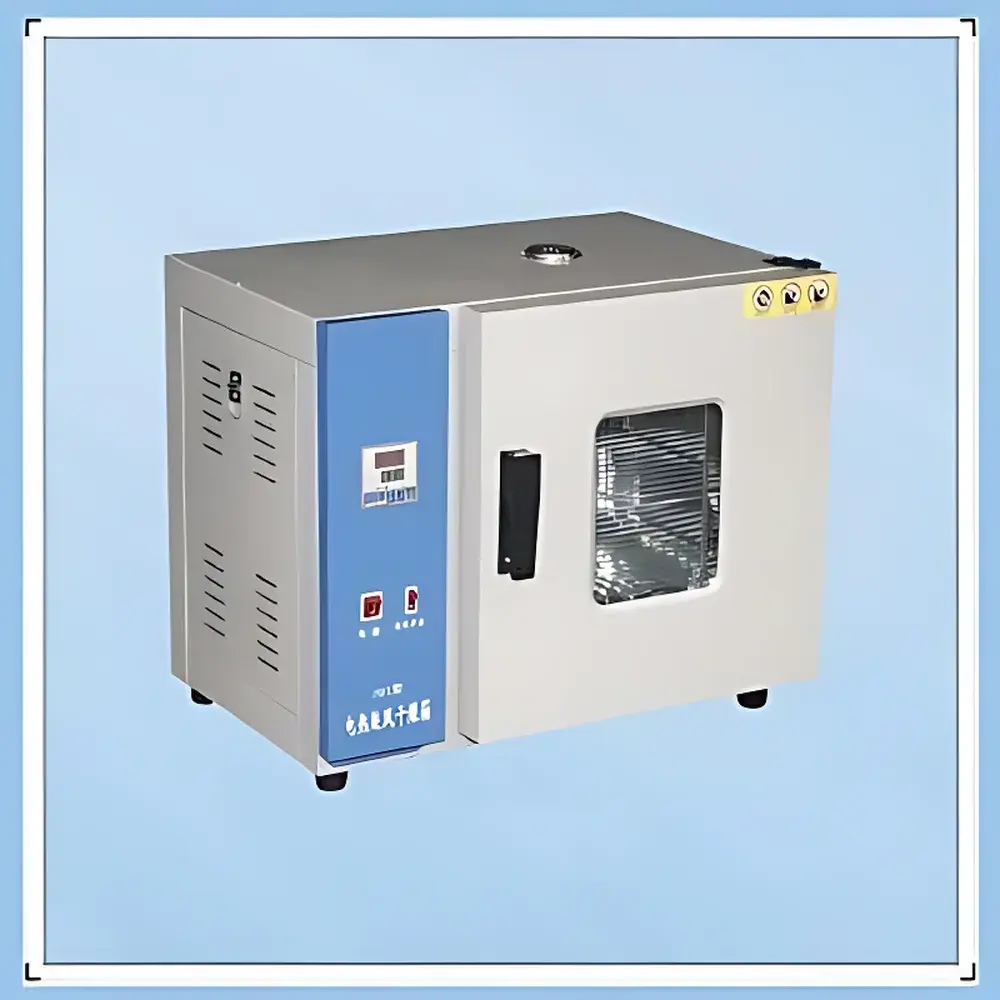
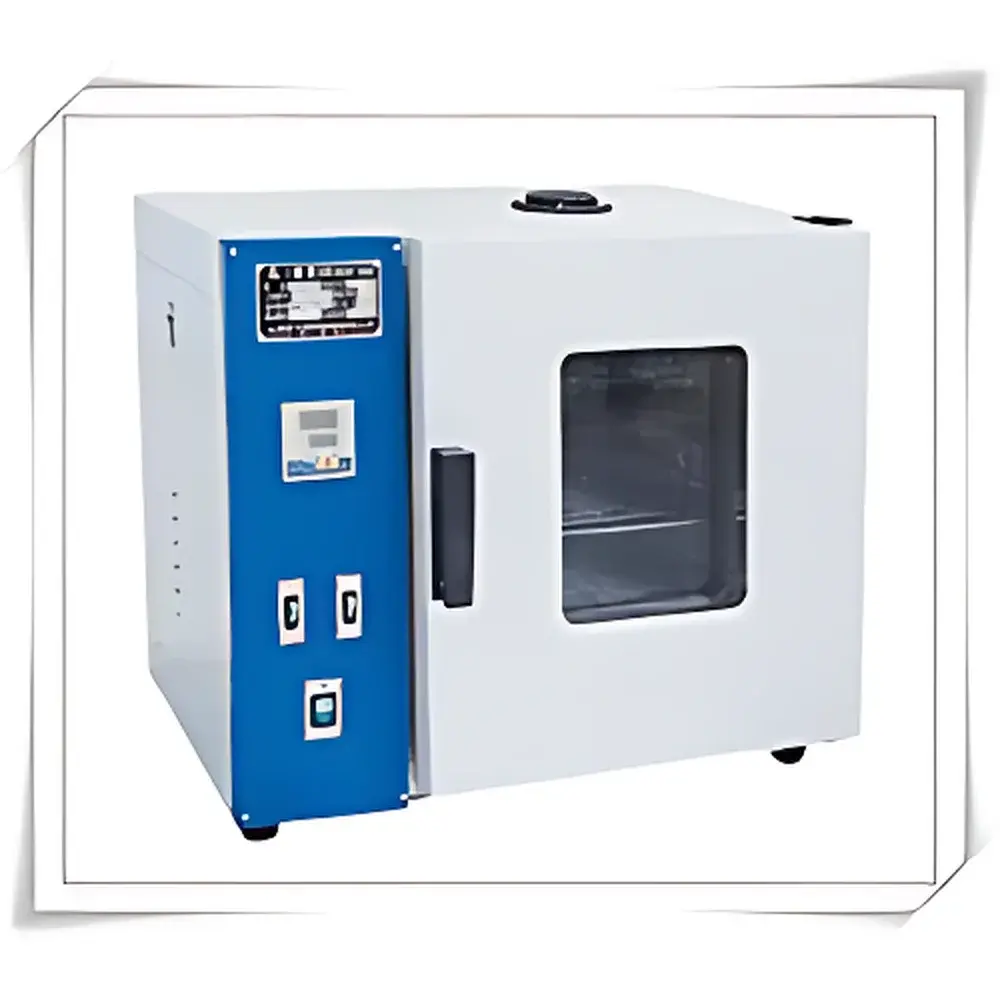
Zhongke Aobo 101-1 Precision Forced-Air Drying Oven
| Brand | Zhongke Aobo |
|---|---|
| Origin | Beijing, China |
| Manufacturer Type | Authorized Distributor |
| Country of Origin | China |
| Model | 101-1 |
| Instrument Type | Precision Drying Oven |
| Temperature Range | RT+10°C to 300°C |
| Temperature Uniformity | ±1°C |
| Temperature Fluctuation | ±1°C |
| Temperature Resolution | 0.1°C |
| Internal Chamber Dimensions (W×D×H) | 350×350×350 mm |
| External Dimensions (W×D×H) | 650×500×650 mm |
| Chamber Material | Stainless Steel (AISI 304) |
| Heating Method | Tubular Heaters with Forced Air Circulation |
| Operating Ambient Temperature | ≤30°C |
| Net Weight | 42 kg |
| Power Supply | AC 220 V / 50 Hz |
| Rated Power | 1.2 kW |
| Standard Shelving | 2 Adjustable Stainless Steel Wire Shelves |
Overview
The Zhongke Aobo 101-1 Precision Forced-Air Drying Oven is an engineered thermal processing instrument designed for routine and regulated laboratory drying, baking, sterilization, and moisture content determination tasks. It operates on the principle of convective heat transfer enhanced by a centrifugal blower-driven forced-air circulation system—ensuring rapid thermal equilibration and high spatial temperature uniformity across the working chamber. Unlike natural convection ovens, the 101-1 maintains consistent airflow velocity and direction, minimizing thermal stratification and reducing process variability in time- and temperature-sensitive applications such as pharmaceutical stability testing, polymer curing, and residual solvent removal. Its maximum operating temperature of 300°C supports extended thermal treatment protocols compliant with ASTM E145, ISO 188, and USP <1210> guidelines for thermal validation.
Key Features
- Forced-air convection system with adjustable-speed centrifugal fan, delivering uniform airflow distribution and enabling ≤±1°C temperature uniformity across the full chamber volume.
- Stainless steel (AISI 304) interior chamber—electropolished and fully welded—resists oxidation, corrosion, and particulate shedding under repeated thermal cycling.
- Microprocessor-based PID temperature controller with 0.1°C resolution, real-time deviation display, upper-limit alarm, and automatic cut-off function for over-temperature safety.
- Double-layer tempered glass observation window integrated into the insulated door, allowing continuous visual monitoring without compromising thermal integrity or operator safety.
- Two removable, height-adjustable stainless steel wire shelves with reinforced support brackets—optimized for load distribution and accessibility during sample loading/unloading.
- Robust outer casing fabricated from cold-rolled steel with electrostatic epoxy-polyester powder coating, providing mechanical durability and resistance to ambient laboratory abrasion and chemical exposure.
- Non-contact solid-state relay (SSR) control circuitry eliminates mechanical arcing, ensures silent operation, and extends system reliability over >10,000 operational cycles.
Sample Compatibility & Compliance
The 101-1 accommodates standard laboratory vessels including porcelain crucibles, glass Petri dishes, aluminum weighing pans, and stainless steel trays—up to 20 kg total static load. Its chamber geometry (350 × 350 × 350 mm) complies with ISO/IEC 17025 calibration traceability requirements for volumetric thermal mapping. The oven meets IEC 61010-1:2010 safety standards for electrical equipment used in laboratory environments and supports GLP/GMP workflows through configurable logging intervals (optional RS485 interface available for external data acquisition). While not inherently FDA 21 CFR Part 11–compliant, its analog control architecture allows integration with validated third-party data loggers for audit-ready electronic records in regulated QC labs.
Software & Data Management
The 101-1 operates via embedded firmware with no proprietary software dependency. All operational parameters—including setpoint, actual chamber temperature, elapsed time, and alarm status—are displayed in real time on a 4-digit LED interface. For laboratories requiring digital documentation, optional analog output (4–20 mA) and Modbus RTU over RS485 enable connection to SCADA systems, LIMS platforms, or standalone chart recorders. Firmware supports manual ramp-hold programming (up to 3 segments), making it suitable for standardized drying curves per ISO 527-2 or ASTM D6988. Calibration certificates traceable to NIM (National Institute of Metrology, China) are provided with each unit.
Applications
- Moisture loss-on-drying (LOD) analysis per USP <731> and Ph. Eur. 2.2.32.
- Pre- and post-weighing desiccation of filter papers, soil samples, and granular APIs.
- Curing of epoxy resins, silicone elastomers, and powder coatings under controlled thermal profiles.
- Baking of ceramic green bodies and sintering pre-treatment of metal oxide precursors.
- Accelerated aging studies for packaging materials and medical device components (ISO 11607-1).
- Residual solvent evaporation in HPLC vial preparation and GC sample concentration workflows.
FAQ
What is the difference between the 101-series and 202-series models?
The 101-series incorporates forced-air circulation via an internal blower, ensuring superior temperature uniformity and faster heating rates. The 202-series relies on natural convection and is intended for low-thermal-mass, non-critical drying where energy efficiency is prioritized over precision.
Can this oven be calibrated to ISO/IEC 17025 standards?
Yes—the unit ships with a factory calibration report referencing NIM-traceable reference thermometers. Full-volume thermal mapping and uncertainty budgeting can be performed using external Class A PT100 probes and accredited calibration services.
Is the stainless steel chamber electropolished?
Standard configuration uses brushed AISI 304 stainless steel. Electropolished finish is available as a custom option for high-purity applications requiring reduced surface roughness (Ra < 0.4 µm).
Does the oven support programmable ramp-and-soak cycles?
The base model supports single-setpoint operation with over-temperature protection. A programmable version (101-1P) with 3-segment ramp-hold capability is available upon request.
What maintenance is required for long-term reliability?
Biannual inspection of blower motor bearings, cleaning of air intake filters, and verification of door gasket compression force are recommended. Heater element resistance should be measured annually to detect incipient failure.



