
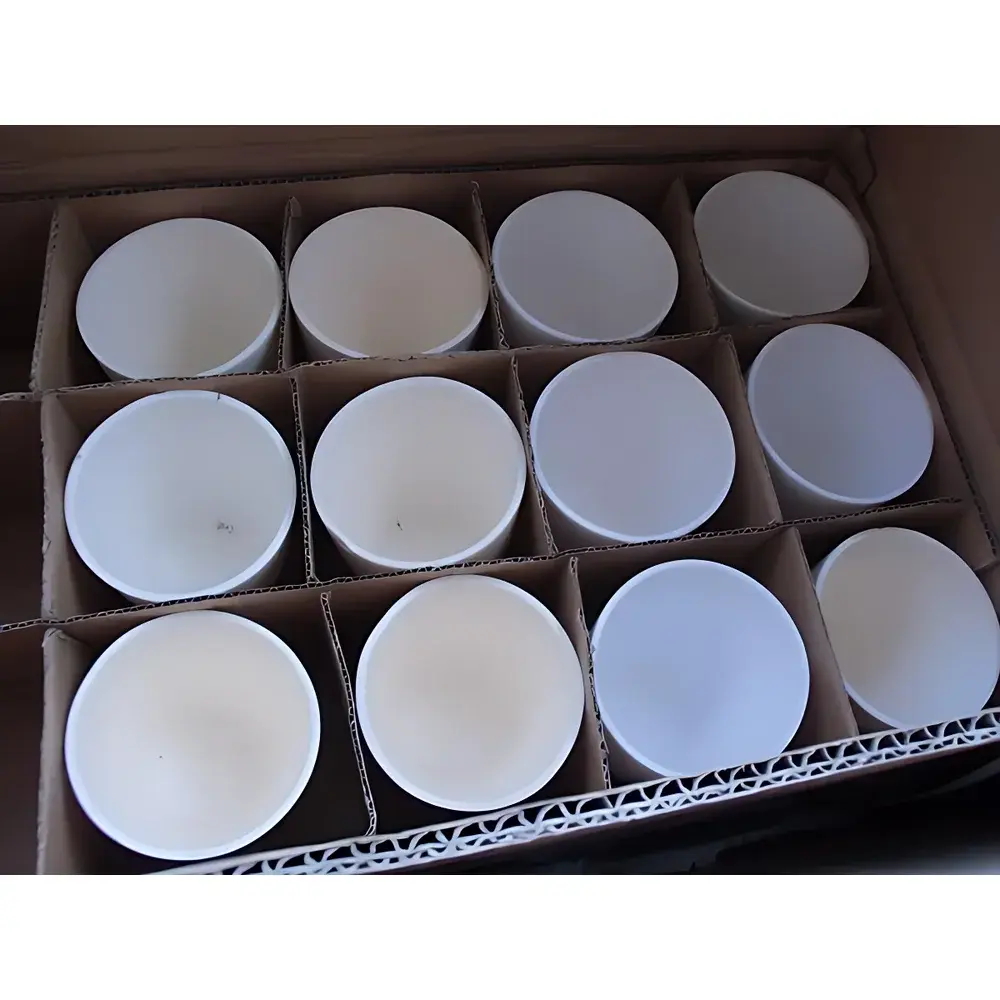
Zhongke Aobo 30 mL High-Purity Alumina Crucible (Corundum Ceramic)
| Key | Brand: Zhongke Aobo |
|---|---|
| Origin | Beijing, China |
| Material | ≥99% Al₂O₃ |
| Max Continuous Use Temp | 1600 °C |
| Max Short-Term Temp | 1800 °C |
| Bulk Density | ≥3.80 g/cm³ |
| Apparent Porosity | <1% |
| Flexural Strength | >350 MPa |
| Compressive Strength | >12,000 MPa |
| Dielectric Constant (1 MHz) | ~9.8 |
| Volume | 30 mL |
| Shape | Arc-shaped (hemispherical) |
| Outer Diameter | 38 mm |
| Inner Bottom Diameter | 25 mm |
| Height | 45 mm |
| Wall Thickness | 1.7 mm |
| Mass | ~0.03 kg |
Overview
The Zhongke Aobo 30 mL High-Purity Alumina Crucible is a precision-engineered laboratory ceramic component designed for high-temperature thermal processing, inert-atmosphere melting, and quantitative residue analysis. Fabricated from sintered alpha-alumina (α-Al₂O₃) with ≥99% purity, this arc-shaped crucible operates reliably under extreme thermal and chemical stress. Its performance is governed by the intrinsic properties of fully dense corundum ceramics—exhibiting exceptional resistance to molten metals (e.g., aluminum, copper, nickel alloys), slags, oxides, and aggressive fluxes including sodium hydroxide, lithium metaborate, and borax-based fusion media. Unlike fused silica or quartz crucibles, this alumina variant maintains structural integrity without volatilization or phase transformation up to 1800 °C in air or inert gas environments, making it suitable for thermogravimetric analysis (TGA), differential thermal analysis (DTA), ash content determination (ASTM E1755), and high-temperature X-ray fluorescence (XRF) sample preparation.
Key Features
- Ultra-high purity α-Al₂O₃ matrix (Al₂O₃ ≥99.0 wt%, R₂O ≤0.2 wt%, Fe₂O₃ ≤0.1 wt%, SiO₂ ≤0.2 wt%) ensures minimal trace element contamination during sample fusion or calcination.
- Density ≥3.80 g/cm³ and apparent porosity <1% provide low permeability to reactive vapors and molten phases, reducing cross-contamination risk between sequential analyses.
- Thermal shock resistance validated per ASTM C110–22: capable of repeated cycling between ambient temperature and 1600 °C without microcracking or spalling—critical for furnace ramp-and-hold protocols.
- Consistent dimensional tolerances achieved via controlled slip-casting and isostatic pressing; wall thickness uniformity (±0.1 mm) supports reproducible heat transfer profiles and mass-loss kinetics.
- Smooth, vitrified surface finish minimizes sample adhesion and facilitates complete residue recovery—essential for gravimetric assays and ICP-OES/MS calibration standards preparation.
Sample Compatibility & Compliance
This crucible is compatible with a broad spectrum of inorganic matrices, including silicates, carbonates, phosphates, sulfates, and refractory oxides. It is routinely employed in EPA Method 3050B (acid digestion), ISO 12944-5 (corrosion testing residues), and USP heavy metal limit tests requiring high-temperature ashing. The material complies with ISO 6474-1:2019 (ceramic biomaterials specifications) and meets the compositional requirements outlined in ASTM C704 for high-alumina refractories. While not certified to GLP or GMP as a standalone device, its documented lot-specific certificate of analysis (CoA) includes batch-tested values for Al₂O₃ content, density, and flexural strength—enabling full traceability in regulated QC/QA workflows.
Software & Data Management
As a passive consumable, this crucible does not incorporate embedded electronics or firmware. However, its standardized geometry and documented thermal mass (0.03 kg ±0.002 kg) enable precise integration into automated furnace control systems (e.g., Netzsch STA 449 F3, TA Instruments Q600). Users may assign unique identifiers (e.g., barcode-labeled lot numbers) within LIMS platforms such as LabWare LIMS or Thermo Fisher SampleManager to track usage history, thermal cycle counts, and associated analytical results—supporting audit readiness under FDA 21 CFR Part 11 where electronic records are maintained.
Applications
- Preparation of fused beads for wavelength-dispersive X-ray fluorescence (WD-XRF) analysis of geological, metallurgical, and cementitious samples.
- High-temperature ashing of organic-rich environmental samples (soils, sediments, biomass) prior to elemental quantification by ICP-MS.
- Melting and homogenization of calibration standards for atomic absorption spectroscopy (AAS) and inductively coupled plasma optical emission spectrometry (ICP-OES).
- Thermogravimetric studies of catalyst deactivation, polymer decomposition, and ceramic sintering kinetics under controlled atmospheres (N₂, Ar, O₂).
- Residue collection in combustion calorimetry (ASTM D240, ISO 1928) where inert containment and minimal mass drift are critical.
FAQ
Can this crucible be used for lithium metaborate fusion?
Yes—its ≥99% Al₂O₃ composition resists attack by molten LiBO₂ at 1050–1100 °C, provided fusion time remains ≤15 minutes and cooling follows controlled ramp rates (≤5 °C/min below 800 °C).
Is cleaning required between uses?
Yes—residues must be removed using dilute HNO₃ (10% v/v) followed by ultrasonic rinsing in deionized water and drying at 110 °C; avoid abrasive scrubbing to preserve surface integrity.
What is the recommended maximum heating rate?
For optimal longevity, limit ramp rates to ≤10 °C/min up to 1000 °C, then ≤5 °C/min above that threshold to mitigate thermal gradient-induced stress.
Does it meet ISO/IEC 17025 traceability requirements?
Each production lot is supplied with a CoA referencing NIST-traceable density and composition measurements; users must retain lot documentation to satisfy Clause 6.6.2 of ISO/IEC 17025:2017.
Can custom geometries be manufactured?
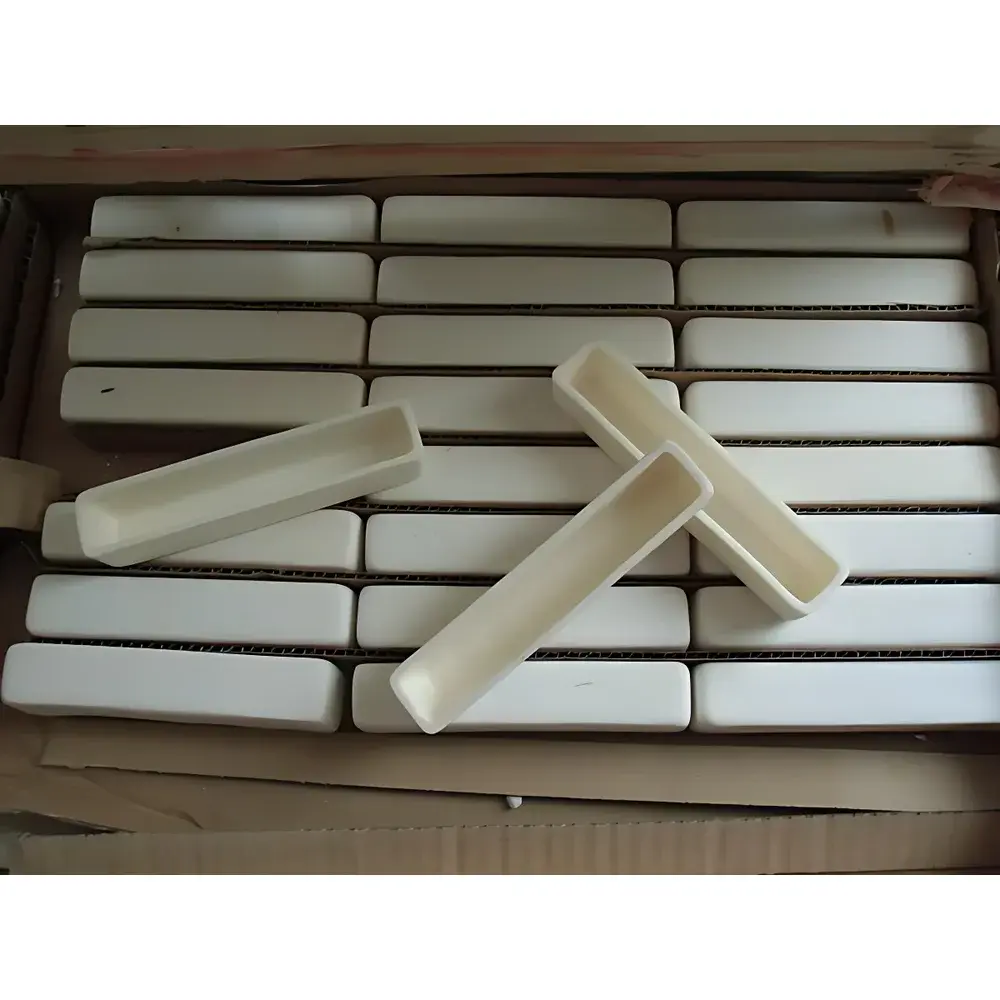
Yes—Zhongke Aobo accepts non-standard drawings for arc, cylindrical, rectangular, and stepped crucibles; minimum order quantity applies, and lead time is typically 4–6 weeks after design approval.



