
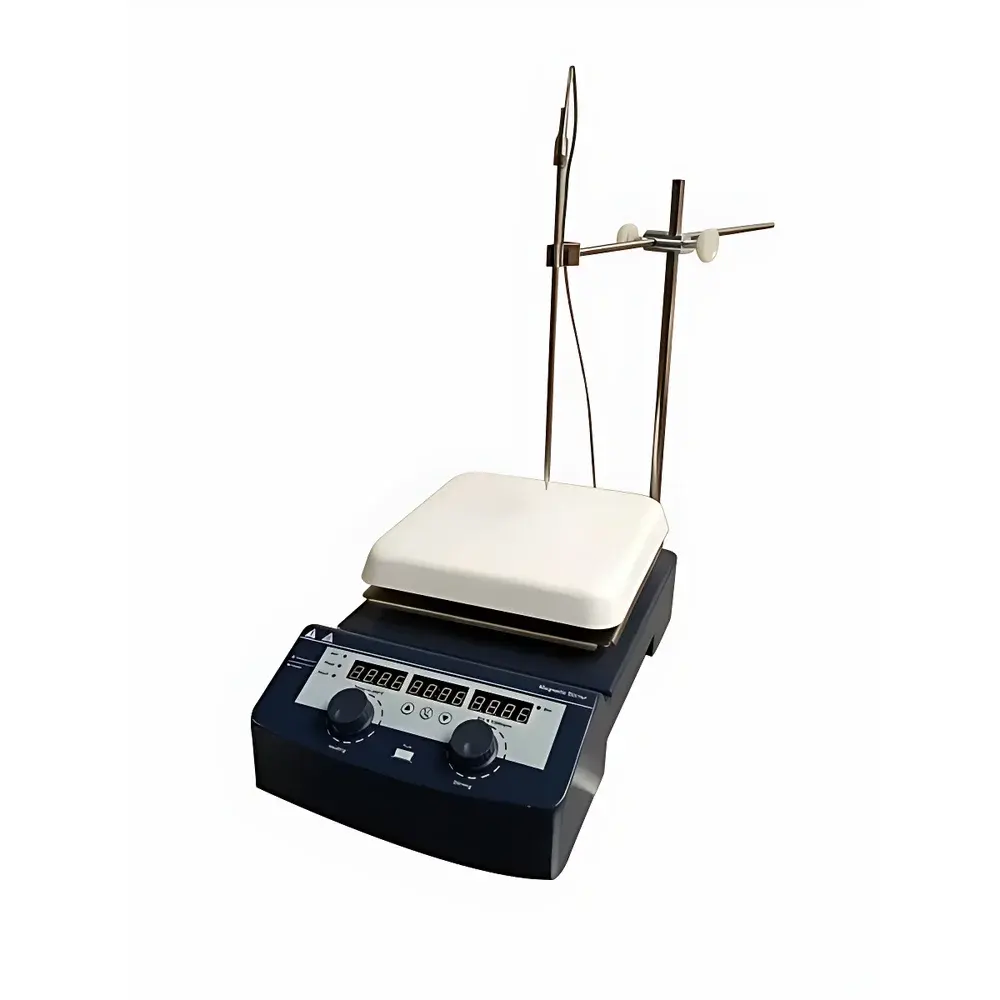
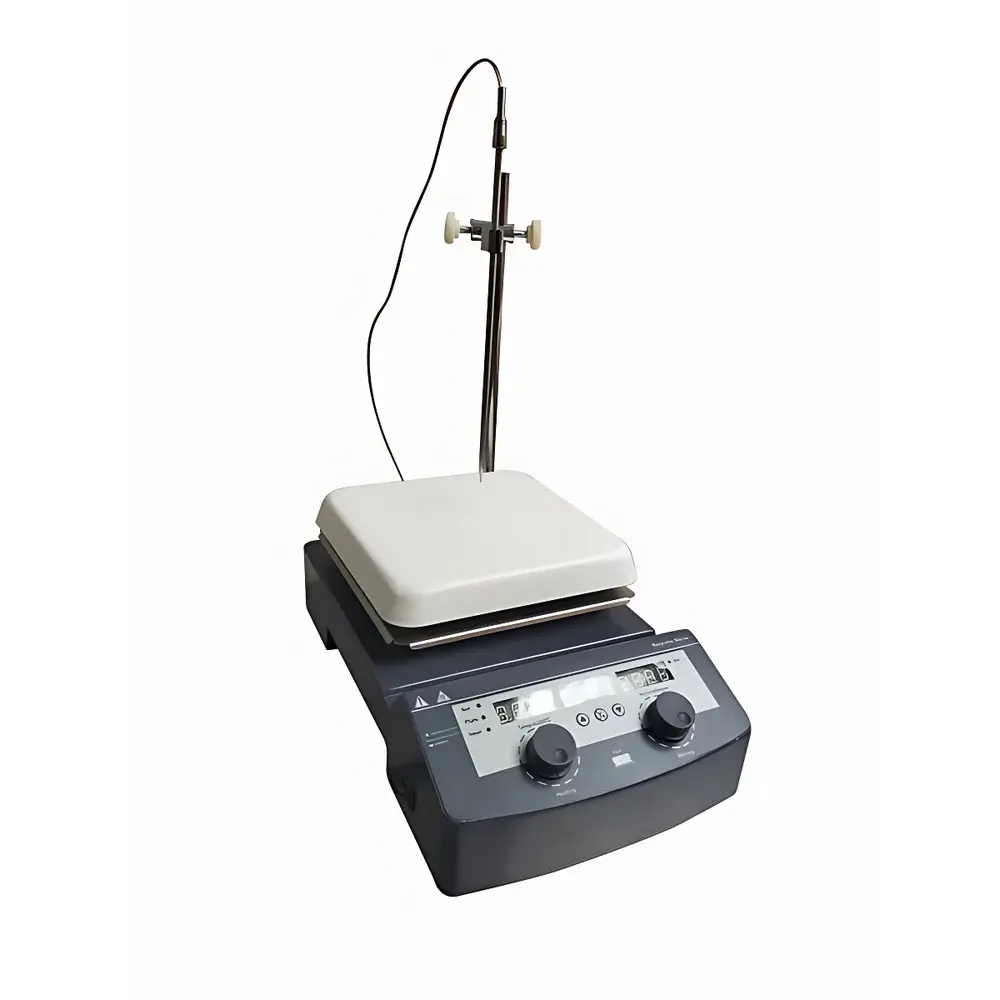
Zhongke Aobo CJ-20D Digital Magnetic Stirrer with Hotplate
| Brand | Zhongke Aobo |
|---|---|
| Model | CJ-20D |
| Type | Magnetic Stirrer |
| Max. Stirring Volume | 5000 mL |
| Speed Range | 100–1500 rpm |
| Heating Temperature Range | Ambient to 350 °C |
| Power | 600 W |
| Heating Plate Size | 200 × 200 mm |
| Temp. Control Accuracy | ±1 °C |
| Timer Function | None |
| Dimensions (W×D×H) | 310 × 200 × 130 mm |
| Construction | Cold-Rolled Steel Housing, Enamel-Coated Aluminum Heating Plate |
| Motor | Imported Brushless DC Motor |
| Safety | Over-Temperature Cut-Off Alarm |
Overview
The Zhongke Aobo CJ-20D Digital Magnetic Stirrer with Hotplate is an integrated laboratory instrument engineered for precise, reproducible heating and stirring of liquid samples in open or sealed vessels. It operates on the principle of magnetic coupling: a rotating permanent magnet beneath the heated ceramic-coated aluminum plate induces synchronous rotation of a PTFE- or glass-coated magnetic stir bar immersed in the sample. This contactless drive mechanism eliminates mechanical shaft seals, reducing contamination risk and maintenance requirements. The unit combines proportional-integral-derivative (PID) temperature control with digital speed regulation, enabling stable thermal and hydrodynamic conditions essential for reaction kinetics studies, dissolution testing, buffer preparation, and sample homogenization across academic, environmental, pharmaceutical, and industrial QA/QC laboratories.
Key Features
- Brushless DC motor delivering consistent torque across the full 100–1500 rpm range, with low acoustic emission (<45 dB(A)) and high resistance to mechanical vibration.
- Enamel-coated aluminum heating plate (200 × 200 mm) ensuring uniform thermal distribution and corrosion resistance against common solvents, acids, and bases.
- Dual independent temperature sensing capability—users may select between internal plate sensor or external probe input for accurate sample-centric temperature feedback.
- LED digital display simultaneously showing real-time speed (rpm) and temperature (°C), with intuitive push-button interface for parameter setting.
- PID-based temperature controller minimizing overshoot (<2 °C) and maintaining stability within ±1 °C under steady-state conditions.
- Over-temperature safety cutoff with audible alarm, automatically disabling heating when plate temperature exceeds user-defined or system-limited thresholds.
- Robust enclosure fabricated from cold-rolled steel with electrostatic powder coating, rated IP20 for indoor laboratory use.
Sample Compatibility & Compliance
The CJ-20D accommodates standard laboratory glassware—including beakers (20–5000 mL), Erlenmeyer flasks, and round-bottom flasks—when used with appropriately sized magnetic stir bars (e.g., 20–40 mm length, PTFE- or glass-sheathed). Its non-inductive heating surface is compatible with borosilicate glass, quartz, and stainless-steel containers. While not certified for hazardous area use (e.g., ATEX or IECEx), the device complies with general-purpose electrical safety standards applicable to Class I, Division 1 laboratory equipment per IEC 61010-1. Its design supports GLP-aligned workflows through traceable parameter logging (when interfaced via optional RS232/USB module) and auditable operational states including thermal ramp profiles and dwell times.
Software & Data Management
The base CJ-20D operates as a standalone instrument with local digital control only. For enhanced data integrity and regulatory compliance, an optional communication interface (RS232 or USB-to-serial adapter) enables connection to PC-based acquisition software. This configuration supports time-stamped export of speed, temperature, and runtime data in CSV format—facilitating integration into LIMS environments and supporting 21 CFR Part 11 requirements when paired with validated electronic signature and audit trail modules. Firmware updates are performed manually via vendor-provided utilities; no cloud connectivity or remote firmware deployment is implemented.
Applications
- Preparation of homogeneous aqueous and organic solutions for spectroscopic calibration standards (UV-Vis, FTIR).
- Controlled-temperature dissolution testing of pharmaceutical tablets per USP and Ph. Eur. 2.9.3 protocols.
- Heating and mixing during titration reagent conditioning and buffer equilibration in clinical chemistry labs.
- Supporting enzymatic assays requiring precise thermal maintenance at 37 °C or elevated temperatures up to 350 °C for solvent evaporation steps.
- Environmental sample digestion (e.g., EPA Method 3050B) using hotplate-stirring synergy for acid-mediated metal extraction.
- Cell culture media warming and component dispersion prior to sterile filtration.
FAQ
What is the maximum recommended vessel diameter for optimal stirring efficiency?
For consistent vortex formation and bottom-layer mixing, vessels with diameters ≤180 mm are recommended when using the standard 30 mm stir bar; larger vessels may require extended stabilization time or higher rpm settings.
Can the CJ-20D be used with corrosive reagents such as concentrated HNO₃ or HF?
The enamel-coated aluminum plate provides moderate resistance to diluted acids and bases; however, prolonged exposure to concentrated mineral acids—including HF, aqua regia, or fuming H₂SO₄—is not advised due to potential coating degradation and substrate pitting.
Is external temperature probe calibration traceable to NIST standards?
The instrument accepts standard PT100 or thermistor probes; calibration traceability depends on the end-user’s metrology program and probe certification—no factory NIST-traceable certificate is supplied with the base unit.
Does the unit support continuous operation beyond 8 hours?
Yes—the CJ-20D is rated for unattended continuous duty at ≤80% of maximum temperature and speed ratings, provided ambient temperature remains below 30 °C and ventilation clearance ≥50 mm is maintained on all sides.
How frequently should the magnetic stir bar be replaced?
Stir bars show no scheduled replacement interval; visual inspection for PTFE chipping, magnet demagnetization (reduced rotational response), or surface etching should guide replacement—typically every 6–12 months in high-throughput labs.
Related Products



