
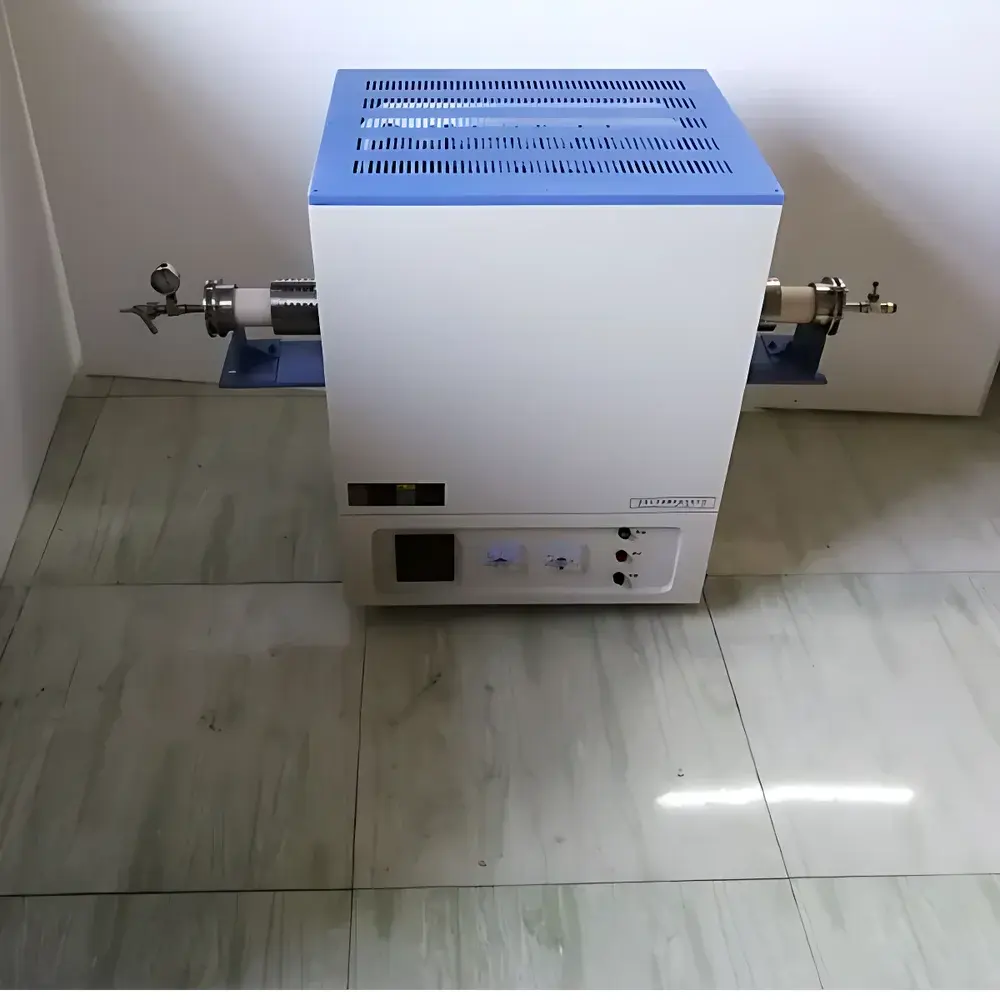
Zhongke Aobo GL1012 Vacuum & Controlled-Atmosphere Horizontal Tube Furnace
| [Brand | Zhongke Aobo |
|---|---|
| Origin | Beijing, China |
| Model | GL1012 |
| Max Temperature | 1200 °C |
| Control Accuracy | ±1 °C |
| Max Power | 3000 W |
| Heating Rate (to max temp) | 30 °C/min |
| Heating Method | Resistance Wire (HRE Alloy) |
| Chamber Dimensions | 120 mm ID × 420 mm L |
| Control System | PID-based 30-Stage Programmable Controller |
| Tube Dimensions | Φ100/Φ92 mm × 1000 mm (quartz or high-purity alumina ceramic options available) |
| Insulation | Polycrystalline mullite fiber vacuum-formed lining |
| Sealing | Dual-O-ring KF stainless steel flanges (304 SS) |
| Gas Compatibility | Inert (N₂, Ar), oxidizing (O₂, CO₂), reducing (H₂, forming gas) — non-toxic/non-explosive only |
| Safety Features | Surface temperature auto-cooling (fan activation at ≥45 °C), over-temperature alarm, step-joint furnace door design for structural integrity and thermal containment] |
Overview
The Zhongke Aobo GL1012 is a horizontally oriented, vacuum-capable and atmosphere-controlled tube furnace engineered for precision thermal processing in research and development laboratories. It operates on the principle of resistive heating via high-stability HRE alloy heating elements embedded within a polycrystalline mullite fiber insulation matrix—enabling rapid thermal response, exceptional energy efficiency, and uniform axial temperature distribution across its 420 mm heated zone. Designed to meet stringent requirements for reproducible high-temperature experiments under controlled gaseous environments or deep vacuum (≤10⁻³ mbar with optional pump integration), the GL1012 supports applications ranging from solid-state synthesis and sintering to annealing, carburizing, and reduction reactions. Its modular construction accommodates interchangeable quartz or high-purity alumina ceramic tubes (Φ100/Φ92 mm × 1000 mm), ensuring compatibility with both low-temperature inert processes and high-temperature oxidative/reducing atmospheres up to 1200 °C.
Key Features
- High-Efficiency Thermal Architecture: Vacuum-formed polycrystalline mullite fiber insulation reduces thermal mass and improves ramp efficiency—achieving ≤30 °C/min heating rates while maintaining ±1 °C control accuracy over the full operating range.
- Dual-Layer Safety Enclosure: Air-gap insulated double-shell design with intelligent surface-temperature monitoring; integrated cooling fans activate automatically when external casing exceeds 45 °C, ensuring operator safety and long-term mechanical stability.
- Precision Atmosphere Management: Equipped with dual KF-40 stainless steel flanges (304 grade), dual silicone/fluoroelastomer O-rings, and fine-adjustment needle valves for inlet/outlet gas flow—enabling stable pressure regulation (0–1 atm gauge) and real-time monitoring via analog pressure gauges.
- Robust Mechanical Integration: Load-bearing gas-line support brackets eliminate mechanical stress transfer to the quartz or ceramic tube, preventing fracture during thermal cycling or pressure transitions.
- Advanced Programmable Control: 30-segment PID controller with auto-tuning, fuzzy logic compensation, and power-loss recovery functionality—retaining active program state and setpoints after interruption.
- Structural Integrity Engineering: Step-joint furnace door assembly and monolithic chamber design prevent dome collapse, minimize heat leakage, and extend service life under repeated thermal cycling.
Sample Compatibility & Compliance
The GL1012 accommodates cylindrical samples up to 92 mm in diameter and 1000 mm in length, compatible with crucibles, boats, and substrate holders made from alumina, quartz, graphite, or molybdenum—subject to chemical and thermal compatibility with process gases. The furnace meets general laboratory safety standards per IEC 61010-1 for electrical equipment used in measurement, control, and laboratory use. While not certified to UL or CE as a standalone system (as supplied without integrated vacuum pump or gas panel), it is fully compatible with ISO/IEC 17025-accredited lab infrastructure when paired with validated ancillary components. Gas-handling configurations comply with CGA G-1.1 guidelines for inert and reactive gas delivery in research settings. For GLP/GMP-aligned workflows, optional data logging modules support 21 CFR Part 11-compliant audit trails when integrated with validated third-party software platforms.
Software & Data Management
The standard GL1012 operates via an embedded 30-stage programmable PID controller with local LCD interface and manual parameter entry. Optional RS485/Modbus RTU communication enables integration into centralized lab automation systems (e.g., LabVIEW, Delta Tau PMAC, or custom SCADA). When deployed with compliant data acquisition hardware, temperature profiles, ramp/soak sequences, and alarm events can be timestamped, exported in CSV format, and archived for traceability. Firmware supports user-defined calibration offsets per thermocouple channel (Type K standard), ensuring metrological consistency across instrument lifecycles. No proprietary cloud platform or vendor-locked software is required—data sovereignty remains fully under institutional control.
Applications
- Thermal treatment of battery cathode/anode materials (LiCoO₂, NMC, Si-C composites) under Ar/H₂/N₂ atmospheres
- Vacuum annealing of semiconductor wafers and thin-film substrates (ITO, ZnO, perovskites)
- Synthesis and graphitization of carbon nanotubes and graphene precursors
- Controlled oxidation of metal foils and nanoparticles (Cu, Ni, Fe)
- Thermogravimetric pre-treatment prior to XRD, SEM-EDS, or XPS analysis
- High-temperature catalytic testing (e.g., CO oxidation, methane reforming) using fixed-bed reactor configurations
- Diffusion bonding and transient liquid phase sintering of advanced ceramics and refractory metals
FAQ
What tube materials are supported, and what are their maximum service temperatures?
Quartz tubes are rated to 1100 °C in inert/vacuum conditions; high-purity 99% alumina ceramic tubes support continuous operation up to 1200 °C and short-term excursions to 1300 °C.
Can the furnace be upgraded for higher temperature operation (e.g., 1400 °C or 1700 °C)?
No—the GL1012 is structurally and electrically optimized for 1200 °C. Higher-temperature variants (GL1014, GL1017) require different heating elements (SiC rods or MoSi₂), thermocouple types (Type S or B), and insulation formulations.
Is vacuum pumping capability included?
The base unit does not include a vacuum pump or gauge; however, it features standard KF-40 ports compatible with rotary vane, diaphragm, or turbomolecular pumps (sold separately).
What gases are safe to introduce, and which require additional safety interlocks?
N₂, Ar, He, CO₂, and dry air are permitted without modification. H₂ and forming gas (5% H₂/95% N₂) require leak-tested gas lines, flashback arrestors, and optional O₂ depletion monitoring—per local EHS protocols.
How is temperature uniformity verified across the hot zone?
Uniformity is characterized per ASTM E220-19 using three calibrated Type K thermocouples placed at center, +100 mm, and –100 mm along the tube axis; typical deviation is ≤±3 °C over the 200 mm specified uniform zone.



