
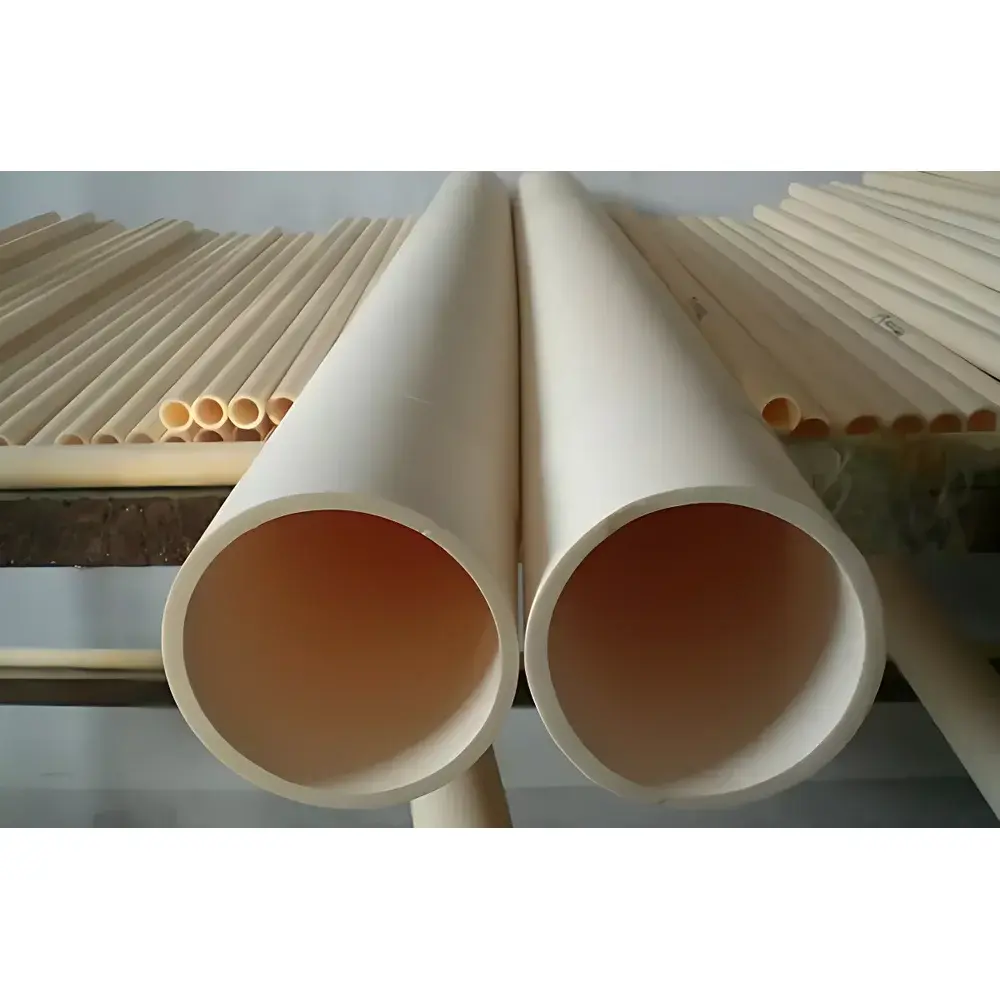
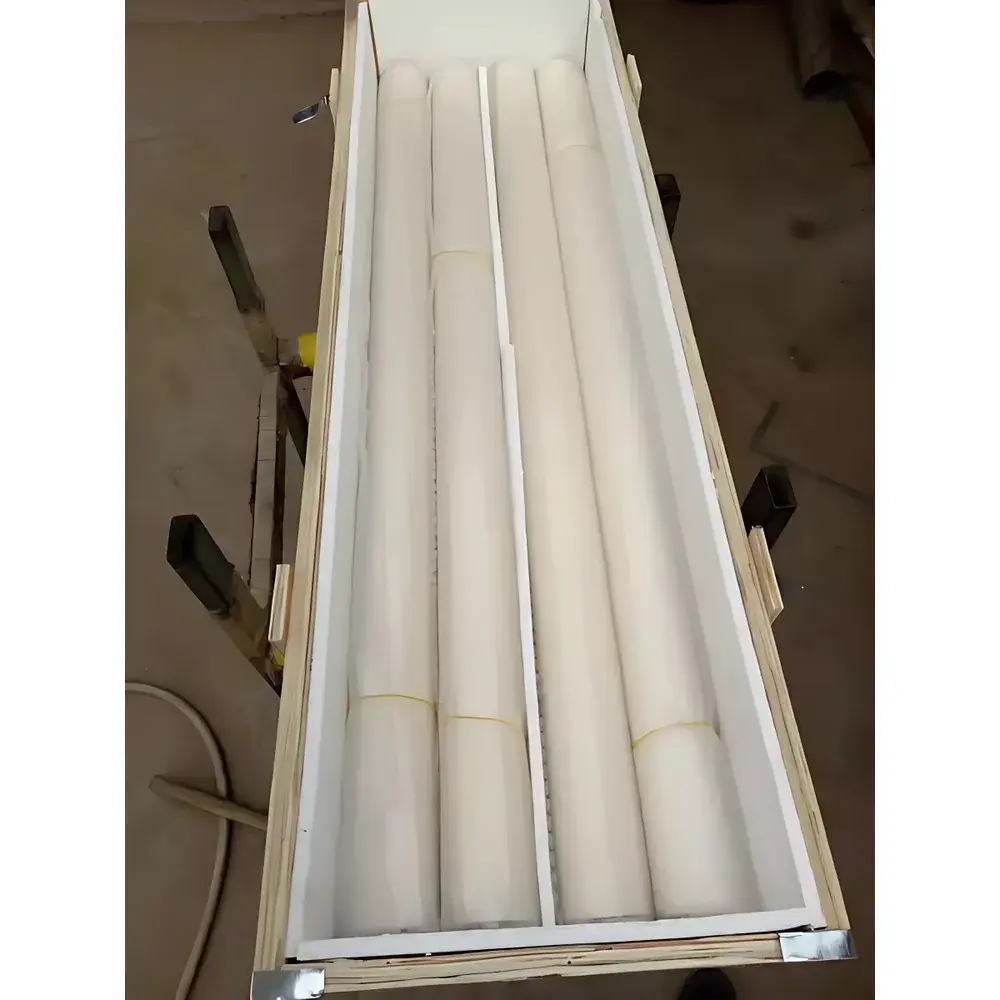
Zhongke Aobo High-Purity Alumina Tube (80 mm ID × 1000 mm L) for Tube Furnaces
| Brand | Zhongke Aobo |
|---|---|
| Origin | Beijing, China |
| Manufacturer Type | Authorized Distributor |
| Product Origin | Domestic (China) |
| Model | 80×1000 mm |
| Price | USD 280 (FOB Beijing) |
| Al₂O₃ Content | 99.0–99.3 wt% |
| Density | 3.88 g/cm³ |
| Water Absorption | ≤0.01% |
| Cold Crushing Strength | ≥350 MPa |
| Vacuum Leak Rate | <1×10⁻¹¹ Torr·L/s |
| Thermal Expansion Coefficient (20–1000 °C) | 8.2×10⁻⁶ /°C |
| Thermal Conductivity (25 °C) | 25 W/(m·K) |
| Electrical Insulation Strength (20 °C) | ≥20 kV/mm |
| DC Volume Resistivity (20 °C) | ≥1×10¹⁴ Ω·cm |
| High-Temperature Insulation Resistance | ≥0.08 MΩ at 1000 °C, ≥0.02 MΩ at 1300 °C |
| Max Continuous Use Temperature | 1600 °C |
| Max Short-Term Service Temperature | 1800 °C |
| Flexural Strength at 1600 °C | ≥160 MPa |
| Non-Wetting Behavior at 1600 °C | No Adhesion Observed |
Overview
The Zhongke Aobo High-Purity Alumina Tube is a precision-engineered structural component designed for integration into high-temperature tube furnaces used in materials synthesis, thermal processing, and controlled-atmosphere annealing applications. Constructed from sintered α-alumina (Al₂O₃ ≥99.0 wt%), the tube exhibits exceptional dimensional stability, chemical inertness, and mechanical integrity under sustained thermal loads up to 1600 °C—making it suitable for demanding laboratory and pilot-scale processes including CVD precursor delivery, catalyst calcination, powder sintering, and inert/reducing gas treatments. Its microstructure—achieved via slip-casting and high-temperature densification—ensures low open porosity (<0.01% water absorption), minimal outgassing, and ultra-low vacuum leak rates (<1×10⁻¹¹ Torr·L/s), critical for maintaining process purity in vacuum or low-pressure environments. Unlike fused quartz or silicon carbide alternatives, this alumina grade delivers superior resistance to molten metal contact, halogen-containing atmospheres, and alkaline vapors, while retaining high electrical resistivity and dielectric strength across wide temperature ranges.
Key Features
- Ultra-high-purity α-alumina matrix (99.0–99.3% Al₂O₃) with trace SiO₂ content strictly controlled to minimize glass-phase formation and intergranular weakening.
- Engineered for thermal shock resilience: capable of repeated cycling between ambient and 1600 °C without cracking—validated through ASTM C1171 thermal shock testing protocols.
- Dense, homogeneous microstructure (density = 3.88 g/cm³) achieved via optimized sintering profiles, ensuring consistent wall thickness, concentricity, and surface finish.
- Non-wetting behavior at 1600 °C prevents adhesion of molten oxides, metals, or slag—critical for furnace tube longevity during reactive sintering or metallurgical processing.
- High mechanical retention: flexural strength ≥160 MPa at 1600 °C supports self-supporting configurations and minimizes sag deformation under prolonged heating.
- Electrical insulation performance compliant with IEC 60674-2 requirements: volume resistivity ≥10¹⁴ Ω·cm at room temperature; ≥0.02 MΩ at 1300 °C—enabling safe operation in electrically heated furnace assemblies.
Sample Compatibility & Compliance
This alumina tube is chemically compatible with oxidizing, inert (N₂, Ar), reducing (H₂, CO), and mildly carburizing atmospheres. It resists corrosion from molten alkali carbonates, borosilicate glasses, and transition metal oxides—common in battery cathode synthesis and ceramic co-firing. The material meets ISO 13384-1 for dimensional tolerances of technical ceramics and conforms to ASTM C20 for bulk density and water absorption verification. All tubes undergo batch-certified non-destructive inspection (NDI) per ASTM E1444 (magnetic particle) and visual assessment under 10× magnification to exclude surface defects exceeding 50 µm in length. Documentation includes full material test reports (MTRs) listing lot-specific Al₂O₃ content, density, and thermal expansion data—supporting GLP/GMP audit readiness and traceability requirements in regulated R&D environments.
Software & Data Management
As a passive structural component, the alumina tube does not incorporate embedded electronics or firmware. However, its certified thermal and mechanical specifications are fully integrated into furnace system calibration workflows. Users may import material property datasets—including temperature-dependent thermal conductivity, expansion coefficients, and emissivity values—into commercial thermal modeling platforms (e.g., COMSOL Multiphysics®, ANSYS Fluent®) to simulate radial temperature gradients, stress distribution, and thermal mass effects during ramp-hold-cool cycles. Batch-specific MTRs are supplied in PDF/A-1b format, digitally signed and timestamped, enabling long-term archival and compliance with FDA 21 CFR Part 11 electronic record retention standards when paired with validated LIMS or ELN systems.
Applications
- High-temperature annealing of semiconductor wafers and thin-film substrates under ultra-clean N₂/H₂ atmospheres.
- Catalyst activation and regeneration in fixed-bed reactors operating at 800–1200 °C.
- Synthesis of advanced ceramics (e.g., spinels, titanates) via solid-state reaction under controlled O₂ partial pressure.
- Thermal gravimetric analysis (TGA) sample containment where quartz degradation limits accuracy above 1100 °C.
- Calibration reference tubes for optical pyrometer validation in metrology labs (NIST-traceable emissivity: ε = 0.85 ± 0.02 at 1000 °C).
- Custom-engineered furnace inserts for in-situ XRD/XAS cells requiring simultaneous vacuum integrity and thermal stability.
FAQ
What is the maximum recommended heating rate to avoid thermal shock?
For optimal service life, limit ramp rates to ≤10 °C/min below 800 °C and ≤5 °C/min above 800 °C—especially during first-time conditioning cycles.
Can this tube be used in chlorine-containing atmospheres?
Yes—unlike silica-based tubes, high-purity alumina demonstrates negligible corrosion in Cl₂ or HCl up to 800 °C; extended exposure >1000 °C requires prior validation for specific gas concentrations.
Is custom geometry available with full certification?
Yes—Zhongke Aobo provides OEM/ODM services for non-standard dimensions, flange integrations, or port drilling, all accompanied by ISO/IEC 17025-accredited test reports.
How does alumina compare to mullite or cordierite for furnace tube applications?
Alumina offers higher max temperature capability and chemical resistance but lower thermal shock tolerance than cordierite; mullite sits between them in cost and performance—selection depends on required Tmax, atmosphere, and cycle frequency.
What surface finish options are offered for minimizing particle shedding?
Standard tubes feature ground inner/outer surfaces (Ra ≤0.8 µm); electropolished or lapped finishes (Ra ≤0.2 µm) are available upon request for ultra-high-purity applications such as photovoltaic precursor processing.



