
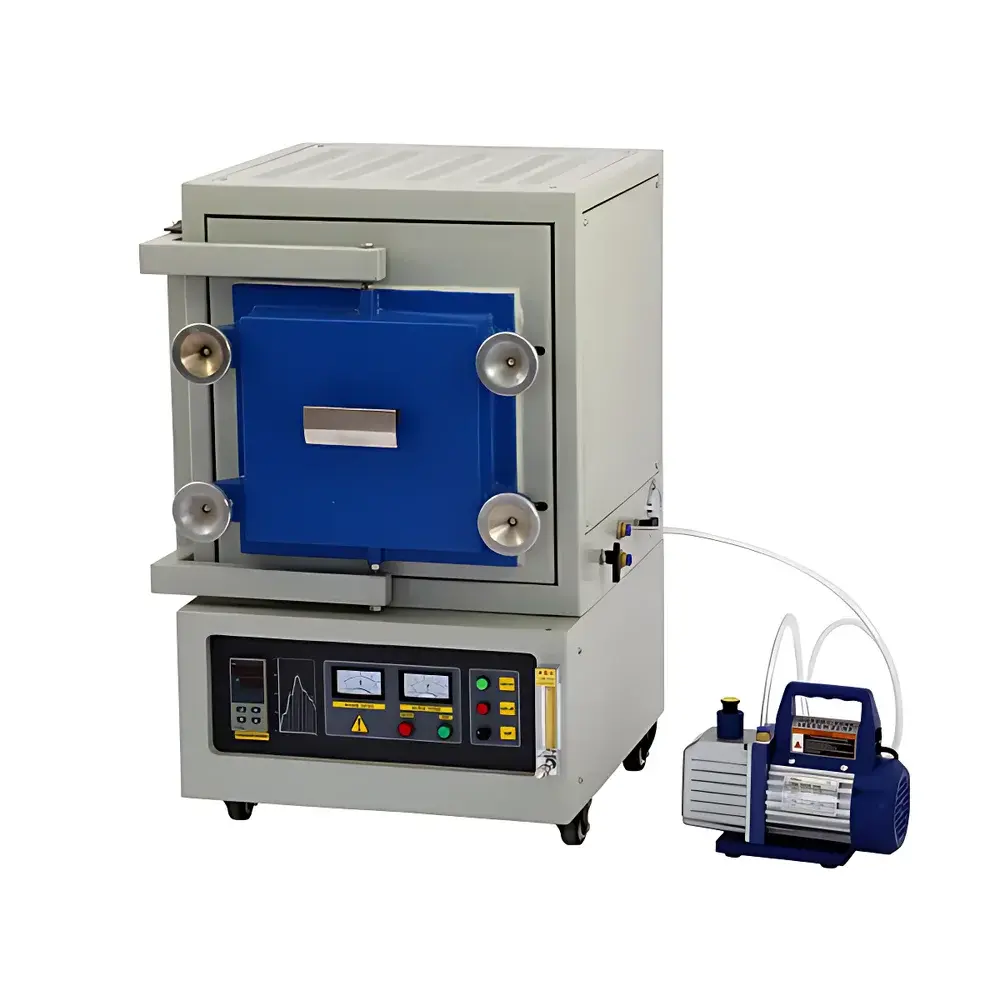
Zhongke Aobo QE0417 Vacuum Atmosphere Box Furnace
| Brand | Zhongke Aobo |
|---|---|
| Model | QE0417 |
| Type | Box-type Muffle Furnace |
| Max Temperature | 1700 °C |
| Temperature Uniformity | ±1 °C |
| Chamber Dimensions (W×D×H) | 200×150×150 mm |
| Internal Volume | 4.5 L |
| Max Power | 4 kW |
| Heating Rate (to Max Temp) | ≤90 min |
| Heating Elements | Silicon Molybdenum Rods / Silicon Carbide Rods / Resistance Wire |
| Atmosphere Options | Vacuum, Inert (N₂, Ar), Reducing (H₂/N₂), or Controlled Oxidizing (Air, O₂) |
| Control System | 30-Stage Programmable PID with Auto-Tuning |
| Communication Interface | Optional RS-485 for PC Integration |
| Insulation | Lightweight Alumina Ceramic Fiber |
| Safety Protection | Dual-Circuit Over-Temp, Thermocouple Break, Over-Current, Over-Voltage, and Deviation Alarm |
Overview
The Zhongke Aobo QE0417 Vacuum Atmosphere Box Furnace is a precision-engineered high-temperature thermal processing system designed for controlled-atmosphere sintering, annealing, calcination, and heat treatment under vacuum or reactive/non-reactive gas environments. Operating up to 1700 °C, it employs dual-mode heating architecture—compatible with silicon molybdenum (MoSi₂), silicon carbide (SiC), or resistance wire elements—to ensure stable thermal output across diverse material processing requirements. Its core design integrates vacuum-tight stainless-steel construction with double-layer forced-air cooling, maintaining external casing temperature near ambient even during extended 1700 °C operation—a critical safety feature for shared laboratory environments. The furnace chamber is lined with high-purity alumina ceramic fiber insulation, offering low thermal mass, rapid thermal response, exceptional thermal retention (>85% energy efficiency vs. traditional brick-lined furnaces), and resistance to thermal shock and chemical degradation from process gases.
Key Features
- Robust vacuum-rated chamber with ISO-KF or CF flange options (standard configuration supports ≤10⁻³ mbar base pressure with optional turbomolecular pumping)
- 30-segment programmable PID controller with auto-tuning, ramp-soak profiling, and real-time deviation monitoring
- Dual-loop safety architecture: independent over-temperature cutoff (±5 °C alarm threshold), thermocouple break detection, current/voltage surge protection, and process deviation alerting
- Modular heating element compatibility—field-swappable MoSi₂ rods (for >1600 °C oxidizing atmospheres), SiC rods (for 1400–1600 °C inert/reducing conditions), or Ni-Cr resistance wire (for ≤1200 °C applications)
- Optimized chamber geometry with interlocking ceramic fiber modules engineered per mechanical stress distribution models to minimize thermal gradient-induced cracking and extend liner service life beyond 1,200 cycles
- Surface finish: electrostatically applied, high-temp cured polyester powder coating rated for continuous exposure up to 200 °C; UV-stabilized pigments prevent chromatic degradation under long-term lab lighting
Sample Compatibility & Compliance
The QE0417 accommodates ceramic green bodies, metal powders (e.g., Ti, Ni, Fe-based alloys), battery cathode precursors (LiCoO₂, NMC), semiconductor substrates, catalyst supports, and refractory composites. Its gas inlet/outlet manifold supports mass flow-controlled delivery of N₂, Ar, H₂/N₂ mixtures (≤5% H₂), CO/CO₂ blends, and synthetic air—fully compatible with ASTM C1171 (ceramic sintering), ISO 17873 (metal powder heat treatment), and USP (thermal sterilization validation protocols). Vacuum operation complies with ISO 27427-2 for residual gas analysis readiness. All electrical subsystems meet IEC 61000-6-3 (EMC) and IEC 61010-1 (safety) standards. Optional data logging meets FDA 21 CFR Part 11 requirements when paired with validated PC software.
Software & Data Management
An optional RS-485 interface enables bidirectional communication with Windows-based control software (supplied), supporting full remote operation: start/stop/pause cycles, upload/download of multi-curve programs, real-time temperature trajectory visualization, and timestamped audit logs with user authentication. Data export formats include CSV and XML, facilitating integration into LIMS platforms (e.g., LabVantage, Thermo Fisher SampleManager) and statistical process control (SPC) workflows. Firmware supports GLP/GMP-compliant electronic signatures, change tracking, and calibration certificate linkage—essential for regulated R&D and pilot-scale manufacturing documentation.
Applications
- Sintering of advanced ceramics (Al₂O₃, ZrO₂, Si₃N₄) under vacuum or nitrogen to suppress grain boundary oxidation
- Graphitization of carbon composites and preforms at 1500–1700 °C in argon atmosphere
- Thermal reduction of metal oxides (e.g., CuO → Cu, NiO → Ni) using H₂/N₂ mixtures
- Crystallization annealing of thin-film photovoltaic absorbers (CIGS, CZTS)
- Pre-oxidation of Ni-based superalloy powders prior to HIP consolidation
- Controlled-atmosphere ashing of polymer-derived ceramics and biochar precursors
FAQ
What vacuum level can the QE0417 achieve without auxiliary pumping?
With standard mechanical pump integration, the furnace reaches ≤10⁻² mbar; with optional turbomolecular pump package, base pressure improves to ≤10⁻⁵ mbar.
Is the furnace suitable for hydrogen atmospheres?
Yes—when configured with SiC heating elements and H₂-rated gas fittings, it supports up to 5% H₂ in N₂ at temperatures ≤1500 °C per EN 13445-3 Annex C guidelines.
Can multiple QE0417 units be synchronized via network?
Yes—using Modbus RTU over RS-485 daisy-chaining, up to 32 units can share a single host PC for centralized batch scheduling and cross-furnace thermal uniformity reporting.
Does the ceramic fiber lining require periodic replacement?
Under normal use (≤1600 °C, <5 cycles/week), the liner maintains structural integrity for ≥1,200 operational hours; visual inspection every 200 h is recommended per maintenance protocol ZKA-QA-07.
Is third-party calibration certification available?
Yes—NIST-traceable temperature calibration (at 1000 °C, 1300 °C, and 1700 °C) with uncertainty ≤±0.8 °C is provided upon request (certified per ISO/IEC 17025).



