
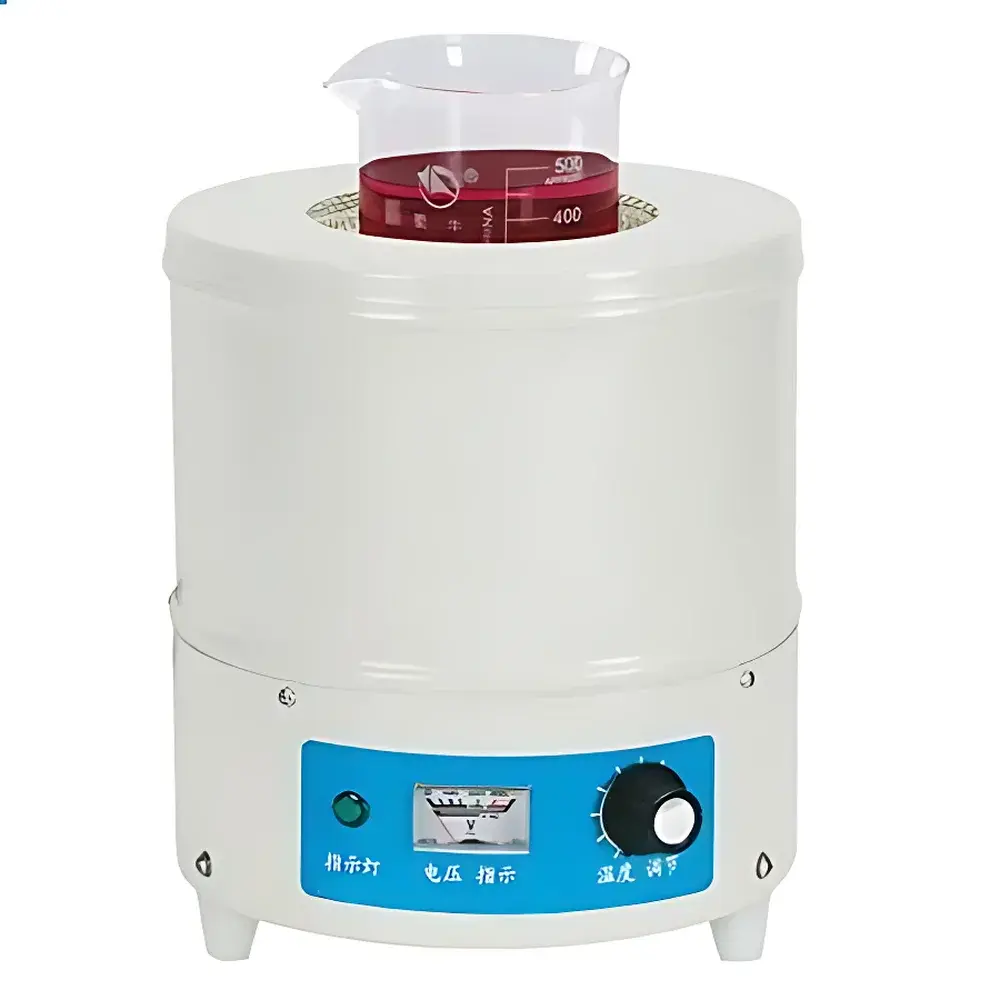
Zhongke Aobo SJ-100ml Intelligent Electric Heating Mantle
| Brand | Zhongke Aobo |
|---|---|
| Origin | Beijing, China |
| Model | SJ-100ml |
| Capacity | 100 mL |
| Inner Core Dimensions | Φ53 × 45 mm |
| Power | 100 W |
| Voltage/Frequency | AC 220 V, 50 Hz |
| Max Surface Temperature | 380 °C |
| Heating Method | Microprocessor-controlled PID temperature regulation with dual-sensor input (heater core + sample) |
| Construction | Ni-Cr resistance wire embedded in alkali-free high-temp glass fiber insulation |
Overview
The Zhongke Aobo SJ-100ml Intelligent Electric Heating Mantle is a precision-engineered laboratory heating device designed for controlled, uniform, and flameless thermal treatment of liquid samples in glass vessels—primarily round-bottom flasks and beakers. Unlike open-heating elements or hot plates, this mantle employs a hemispherical, conformal geometry that envelops the vessel base, enabling efficient convective and conductive heat transfer while minimizing thermal gradients. Its core heating principle relies on Joule heating via a sealed Ni-Cr resistance coil embedded within alkali-free, high-temperature glass fiber insulation—a configuration engineered to withstand repeated thermal cycling up to 380 °C at the heater surface without degradation. The unit operates under microprocessor-based PID control, supporting stable setpoint maintenance within ±1 °C typical deviation under steady-state conditions, making it suitable for applications requiring reproducible thermal profiles in analytical, synthetic, and quality control workflows.
Key Features
- Conformal hemispherical design ensures optimal thermal coupling with standard 100 mL round-bottom flasks and low-form beakers, delivering rapid heating rates and exceptional temperature uniformity across the vessel base.
- Dual independent temperature sensors—one embedded in the heater core and one contact-probe configurable for direct sample measurement—enable real-time differential monitoring and adaptive thermal compensation.
- Alkali-free high-temperature glass fiber insulation provides electrical isolation, thermal stability, and chemical inertness, eliminating risk of fiber shedding or alkaline leaching during prolonged operation.
- Cold-rolled steel housing with electrostatic powder coating offers mechanical robustness, corrosion resistance, and long-term dimensional stability under routine lab handling and cleaning protocols.
- No open flame, no exposed coils, and automatic over-temperature cutoff (hardware-limited at 400 °C) comply with standard laboratory safety requirements for Class I, Division 1 environments per IEC 61010-1.
- Front-panel digital display with intuitive push-button interface supports precise setpoint entry (range: ambient to 380 °C), ramp/soak programming, and real-time dual-channel readout in °C or °F.
Sample Compatibility & Compliance
The SJ-100ml mantle is compatible with borosilicate glass (e.g., Pyrex®, Duran®) vessels rated for thermal shock and sustained temperatures up to 300 °C. It is not intended for use with plastic, quartz, or metal containers unless explicitly validated by the end user. The device conforms to IEC 61010-1:2010 for electrical safety in laboratory equipment and meets RoHS Directive 2011/65/EU for hazardous substance restrictions. While not certified to UL or CSA standards out-of-the-box, its construction and sensor architecture support integration into GLP/GMP-compliant workflows when paired with documented calibration procedures and audit-trail-enabled software (see Software & Data Management).
Software & Data Management
The SJ-100ml operates as a standalone instrument with local PID control but includes an RS-485 serial interface (Modbus RTU protocol) for integration into centralized lab automation systems. Optional PC-based software enables remote setpoint adjustment, continuous logging of both core and sample temperatures at user-defined intervals (1–60 s), and export to CSV or Excel-compatible formats. All logged data include timestamps, operator ID fields, and event markers (e.g., “setpoint changed”, “overtemp alarm triggered”), satisfying basic FDA 21 CFR Part 11 requirements for electronic records when deployed with appropriate system validation and access controls.
Applications
- Controlled solvent evaporation and concentration in environmental analysis (e.g., EPA Method 503.1, 525.3).
- Preparative distillation and reflux setups in organic synthesis laboratories.
- Temperature-dependent solubility studies and crystallization kinetics experiments.
- Viscosity measurement pre-conditioning per ASTM D445 and ISO 3104, where bath stability < ±0.5 °C is required.
- Moisture content determination in pharmaceutical excipients per USP <731>, when used in conjunction with validated gravimetric protocols.
- Heating of aqueous and organic reaction mixtures in QC/QA labs adhering to ISO/IEC 17025 accreditation criteria.
FAQ
What vessel sizes are compatible with the SJ-100ml model?
The SJ-100ml is optimized for vessels with outer diameters between 50–60 mm and heights up to 80 mm—including standard 100 mL round-bottom flasks (e.g., 24/40 joint), low-form 100 mL beakers, and similarly dimensioned reaction tubes.
Does the unit support calibration traceability?
Yes—dual-sensor architecture allows independent verification using NIST-traceable reference thermometers. Users may perform in-house calibration per ISO/IEC 17025 Annex A.3 guidelines, with documentation templates available upon request.
Can multiple mantles be daisy-chained for synchronized control?
Yes—via Modbus RTU over RS-485, up to 32 units can be addressed on a single bus with unique node IDs, enabling coordinated ramp-soak sequences across multi-vessel reaction blocks.
Is the heater surface temperature monitored independently from the setpoint?
Yes—the internal core sensor continuously reports heater surface temperature, triggering hardware-based thermal cutoff if exceeding 400 °C, irrespective of user-set values.
What maintenance is required for long-term accuracy?
Annual verification of sensor drift using a calibrated dry-block calibrator is recommended. No consumables or field-replaceable parts are required under normal operating conditions.



