
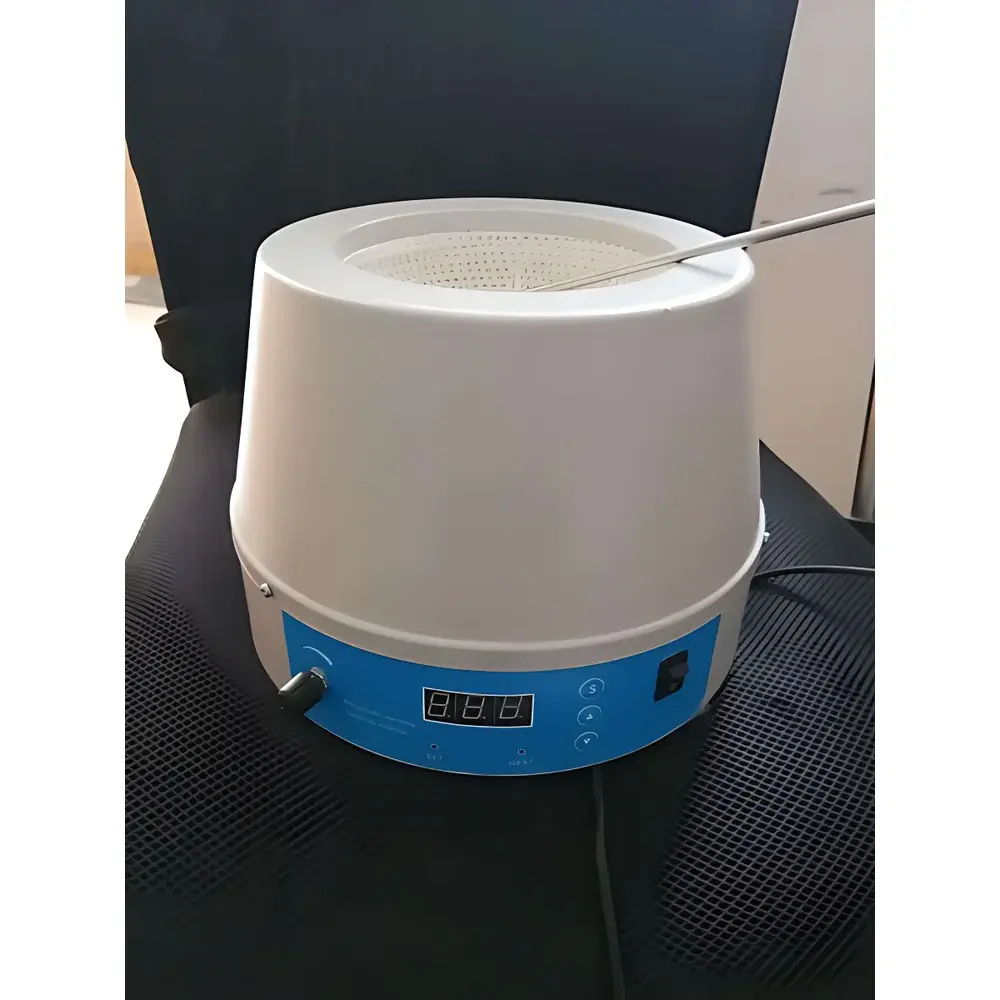
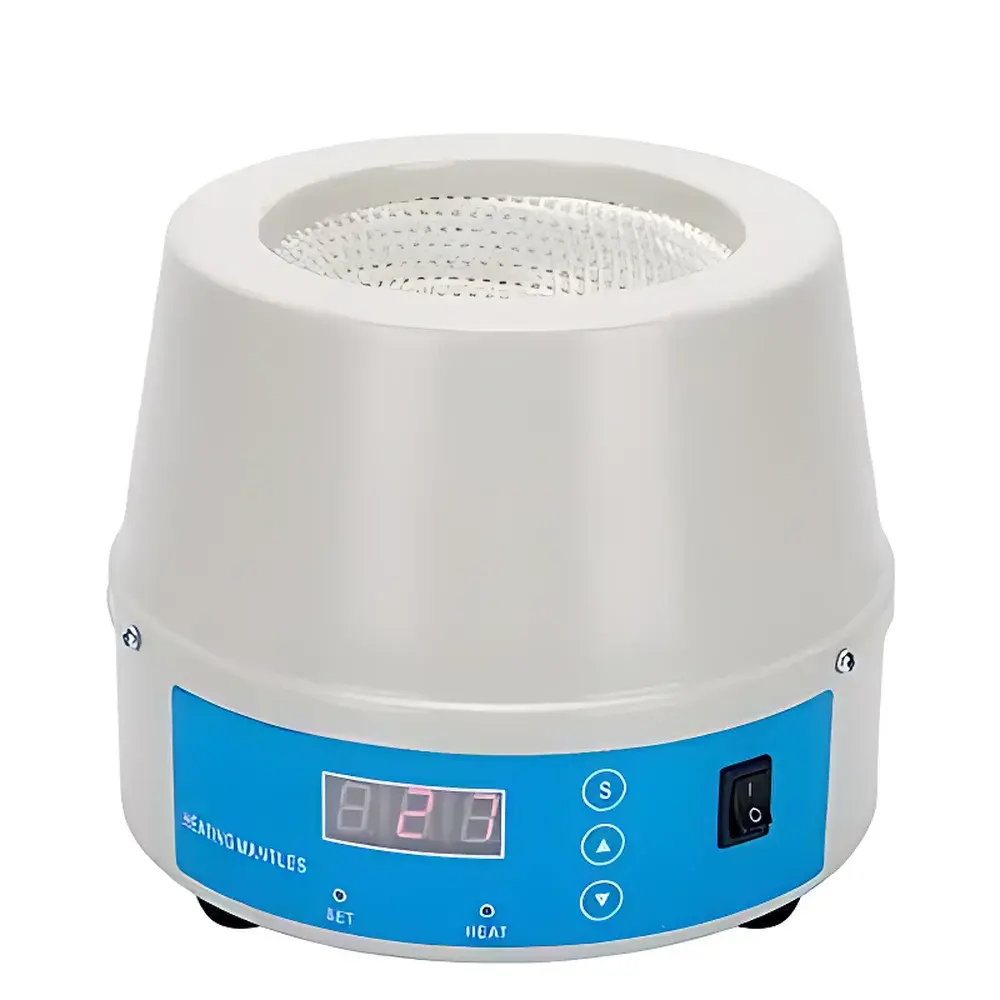
Zhongke Aobo SXKW-500 Intelligent Magnetic Stirring Heating Mantle
| Brand | Zhongke Aobo |
|---|---|
| Origin | Beijing, China |
| Manufacturer Type | Authorized Distributor |
| Product Origin | Domestic (China) |
| Model | SXKW-500 |
| Price | USD 85 (FOB) |
| Max Operating Temperature | 380 °C |
| Heating Power | 500 W |
| Speed Range | 0–1200 rpm |
| Input Voltage | AC 220 V ±10% |
| Max Stirring Volume | 500 mL |
| Insulation Material | High-Temperature Alkali-Free Fiberglass |
| Heating Element | Sealed Ni-Cr Resistance Wire |
| Control Type | Solid-State Electronic Temperature & Speed Regulation |
Overview
The Zhongke Aobo SXKW-500 Intelligent Magnetic Stirring Heating Mantle is an integrated laboratory heating and agitation system engineered for precise thermal control and reproducible mixing of small-to-medium volume liquid samples. Unlike conventional hotplates or separate stirrer/heater setups, this mantle employs a hemispherical, internally wound resistive heating element embedded within high-purity alkali-free fiberglass insulation—ensuring uniform radial heat distribution, rapid thermal response, and long-term dielectric stability up to 380 °C. The unit operates on the principle of conductive heating combined with magnetic coupling: a rotating permanent magnet beneath the mantle base induces synchronous rotation of a PTFE-coated magnetic stir bar immersed in the vessel, enabling contactless agitation without mechanical shaft penetration. This architecture eliminates contamination risk, supports sealed-vessel operation (e.g., reflux, inert-atmosphere reactions), and maintains consistent temperature gradients across glassware ranging from 50 mL to 500 mL capacity.
Key Features
- Full solid-state electronic control circuitry for both temperature and stirring speed—no mechanical potentiometers or relay-based switching, ensuring zero electrical arcing, extended service life, and immunity to dust-induced drift.
- Hemispherical mantle geometry optimized for thermal coupling with round-bottom flasks (RBFs) and standard laboratory glassware; minimizes heat loss and improves energy efficiency by >25% compared to flat-surface heaters.
- High-density fiberglass insulation layer provides Class H (180 °C) thermal endurance with low thermal conductivity (<0.045 W/m·K), maintaining external surface temperature below 60 °C at full output—a critical safety requirement under ISO 13857 and IEC 61000-6-3.
- Dual independent digital displays (LED) for real-time monitoring of setpoint temperature and actual RPM, with ±1 °C and ±10 rpm resolution respectively—enabling GLP-compliant experimental logging when paired with external data acquisition.
- Integrated over-temperature cut-off (OTC) and motor stall protection circuits compliant with IEC 61000-4-5 surge immunity standards, automatically de-energizing the system if sensor failure or thermal runaway is detected.
Sample Compatibility & Compliance
The SXKW-500 is compatible with borosilicate glass vessels (e.g., Pyrex®, Kimax®), stainless steel reactors, and PTFE-lined containers rated for continuous operation up to 350 °C. It supports ASTM E2913-22 protocols for viscosity measurement of thermally sensitive polymer solutions and USP compounding workflows requiring sterile, non-contact agitation. All electrical components meet CE marking requirements per EN 61010-1:2010 (Safety Requirements for Electrical Equipment for Measurement, Control, and Laboratory Use) and EMC compliance per EN 61326-1:2021. The unit does not incorporate wireless connectivity or cloud interfaces; thus, it inherently satisfies FDA 21 CFR Part 11 requirements for audit-trail-free environments where manual SOP execution is mandated.
Software & Data Management
This is a standalone analog-digital hybrid instrument with no embedded firmware, operating system, or network interface. Temperature and speed setpoints are adjusted via front-panel rotary encoders with tactile feedback; all operational parameters are retained in non-volatile memory during power cycling. For traceable data capture, users may connect optional external USB data loggers (e.g., Omega OM-DAQPRO-5300) via the rear-panel analog output terminals (0–5 V DC proportional to temperature and RPM). Raw signal outputs comply with NIST-traceable calibration practices and support integration into LIMS or ELN platforms via Modbus RTU (RS-485 adapter required, sold separately).
Applications
- Controlled-rate heating and homogenization of reagent solutions prior to HPLC sample preparation (ASTM D86, ISO 3405).
- Low-shear mixing of nanoparticle suspensions (e.g., TiO₂, Fe₃O₄) where mechanical stirrers induce aggregation—validated per ISO/TS 80004-2:2015 nanomaterial dispersion protocols.
- Synthesis of metal-organic frameworks (MOFs) under solvothermal conditions requiring stable 80–150 °C setpoints and gentle agitation to prevent premature nucleation.
- Calibration of thermocouples and RTDs using fixed-point reference baths (e.g., zinc freezing point at 419.527 °C), leveraging the mantle’s thermal stability of ±0.5 °C over 4-hour dwell periods.
- QC testing of pharmaceutical excipients (e.g., methylcellulose gels) per USP , where viscosity-temperature profiles must be acquired at 0.5 °C/min ramp rates.
FAQ
Does the SXKW-500 support programmable temperature ramps or multi-step profiles?
No. It features only manual setpoint control with analog feedback regulation. For programmable thermal profiles, integration with an external PID controller (e.g., Watlow F4T) via its 0–5 V analog input is recommended.
Can it be used with Teflon-coated stir bars larger than 40 mm?
Yes—provided the stir bar length does not exceed 60 mm and aspect ratio remains ≤6:1. Longer bars may exhibit wobble-induced vibration above 800 rpm due to magnetic field asymmetry inherent in hemispherical mantles.
Is the unit suitable for use in fume hoods with continuous exhaust airflow?
Yes, but ambient air velocity at the mantle surface must remain below 0.5 m/s to prevent convective cooling that compromises temperature stability. A hood face velocity of ≤0.3 m/s is optimal per ANSI/AIHA Z9.5 guidelines.
What is the expected service life of the heating element under continuous 300 °C operation?
Based on accelerated life testing per IEC 60068-2-2, the Ni-Cr wire assembly maintains ≥95% resistance stability after 5,000 hours at 300 °C—equivalent to ~2 years of 24/7 usage in regulated QC labs.



