
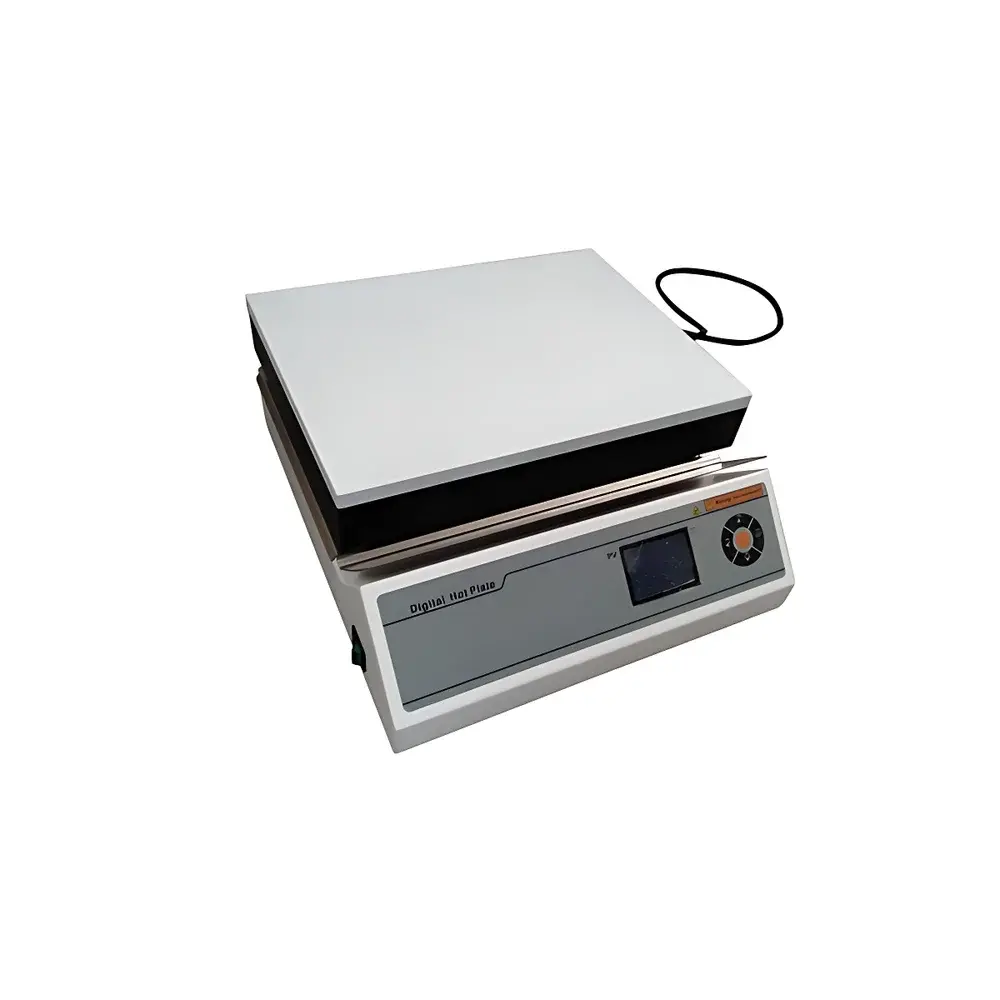
Zhongke Aobo TC09-4 Infrared Ceramic Electric Heating Plate
| Brand | Zhongke Aobo |
|---|---|
| Origin | Beijing, China |
| Manufacturer Type | Authorized Distributor |
| Country of Origin | China |
| Model | TC09-4 |
| Max Temperature | 400°C |
| Plate Dimensions | 300 × 300 mm |
| Temperature Uniformity | ±3–5°C |
| Temperature Fluctuation | ±1°C |
| Control Accuracy | ±1°C |
| Heating Time to Max Temp | ≤30 min |
| Surface Material | High-Temperature Ceramic |
| Control Method | Intelligent PID |
| Temperature Sensor | K-Type Thermocouple |
| Power Rating | 1600 W |
| Voltage/Frequency | 220 V / 50 Hz |
| External Dimensions (W×L×H) | 300 × 430 × 190 mm |
| Net Weight | 18 kg |
| Timer Range | 0–9999 min |
| Duty Cycle | Continuous Operation |
Overview
The Zhongke Aobo TC09-4 Infrared Ceramic Electric Heating Plate is a precision-engineered laboratory heating device designed for stable, uniform, and controllable thermal delivery across a wide range of analytical, preparative, and quality control workflows. Unlike conventional resistive coil or aluminum-sheathed heaters, this unit employs an infrared-emitting high-alumina ceramic heating element integrated into a fully enclosed, non-porous plate surface. The ceramic matrix emits broad-spectrum mid-infrared radiation (peaking near 3–5 µm), enabling efficient, contactless energy transfer to samples placed directly on the plate—minimizing convective losses and improving thermal coupling with glassware, metal crucibles, and polymer containers. Engineered for continuous-duty operation in ISO 17025-accredited laboratories and GLP-compliant environments, the TC09-4 delivers repeatable thermal profiles essential for gravimetric analysis, solvent evaporation, ashing protocols, catalyst activation, and standardized drying procedures per ASTM D2240, ISO 293, and USP .
Key Features
- High-density alumina ceramic heating surface rated for continuous operation up to 400°C, offering exceptional resistance to chemical corrosion (including exposure to HCl, HNO₃, NaOH, and organic solvents) and mechanical abrasion from repeated glassware placement.
- Hermetically sealed heating element architecture eliminates exposed coils or wiring, eliminating fire hazard and reducing oxidation-related drift—ensuring long-term calibration stability and compliance with IEC 61010-1 safety requirements for laboratory equipment.
- Intelligent PID temperature controller with auto-tuning capability, delivering ±1°C setpoint accuracy and <±1°C short-term fluctuation under load; integral digital display with real-time temperature feedback and adjustable ramp/soak programming.
- Robust cold-rolled steel chassis with electrostatic epoxy powder coating (film thickness ≥60 µm), providing mechanical rigidity, ESD-safe grounding, and resistance to ambient humidity and incidental chemical splashes.
- Integrated 0–9999-minute programmable timer with audible end-of-cycle alert and automatic power cutoff—supporting unattended operation during overnight drying or extended thermal conditioning protocols.
Sample Compatibility & Compliance
The TC09-4 accommodates standard laboratory vessels including borosilicate glass beakers (50–1000 mL), porcelain crucibles, stainless-steel digestion cups, and PTFE-coated trays. Its 300 × 300 mm heated area ensures uniform thermal distribution across flat-bottomed containers with base diameters ≤280 mm. Temperature uniformity of ±3–5°C (measured at 5-point grid per ASTM E220) meets requirements for method validation under FDA 21 CFR Part 11 when paired with audit-trail-enabled data logging software. Device construction complies with RoHS Directive 2011/65/EU and CE marking standards for electromagnetic compatibility (EN 61326-1) and low-voltage safety (EN 61010-1).
Software & Data Management
While the TC09-4 operates as a standalone instrument, its analog voltage output (0–5 V DC proportional to measured temperature) and RS-485 Modbus RTU interface enable integration with centralized laboratory information management systems (LIMS) or SCADA platforms. When connected to compliant third-party data loggers (e.g., Omega OM-DAQPRO-5300), the unit supports full electronic record retention—including timestamped temperature logs, setpoint history, and alarm events—satisfying ALCOA+ principles for data integrity in GMP-regulated settings.
Applications
- Residue determination and moisture content analysis per AOAC 955.04 and ISO 665.
- Pre-concentration of environmental water samples prior to ICP-MS or GC-MS analysis.
- Controlled thermal decomposition of pharmaceutical excipients during stability studies.
- Drying of filter papers in suspended solids (TSS) quantification (EPA Method 160.2).
- Pre-heating of reaction blocks in enzymatic assay preparation where oil baths pose contamination risk.
FAQ
Is the TC09-4 suitable for use under a fume hood?
Yes—the fully enclosed ceramic surface produces no volatile emissions or combustion byproducts, making it compatible with ventilated enclosures. Ensure minimum clearance of 100 mm around all sides for airflow and heat dissipation.
Can the unit maintain temperature stability during prolonged operation (>8 hours)?
Yes—its thermal mass and PID algorithm ensure sustained stability within ±1°C over extended cycles; verified via 24-hour drift testing per ISO/IEC 17025 Clause 5.4.2.
Does the device support external calibration verification?
Yes—K-type thermocouple input allows traceable calibration using NIST-traceable reference probes (e.g., Fluke 724 or Hart 1529), with documented procedure available upon request.
What maintenance is required for long-term reliability?
No routine maintenance is needed beyond periodic cleaning of the ceramic surface with ethanol and lint-free cloth; avoid abrasive cleaners or steel wool to preserve emissivity.
Is the TC09-4 compatible with automated sample handling systems?
Yes—via optional relay module (sold separately), it supports TTL-level start/stop signals and status feedback for integration into robotic workcells compliant with SEMI E10 standards.
Related Products



