
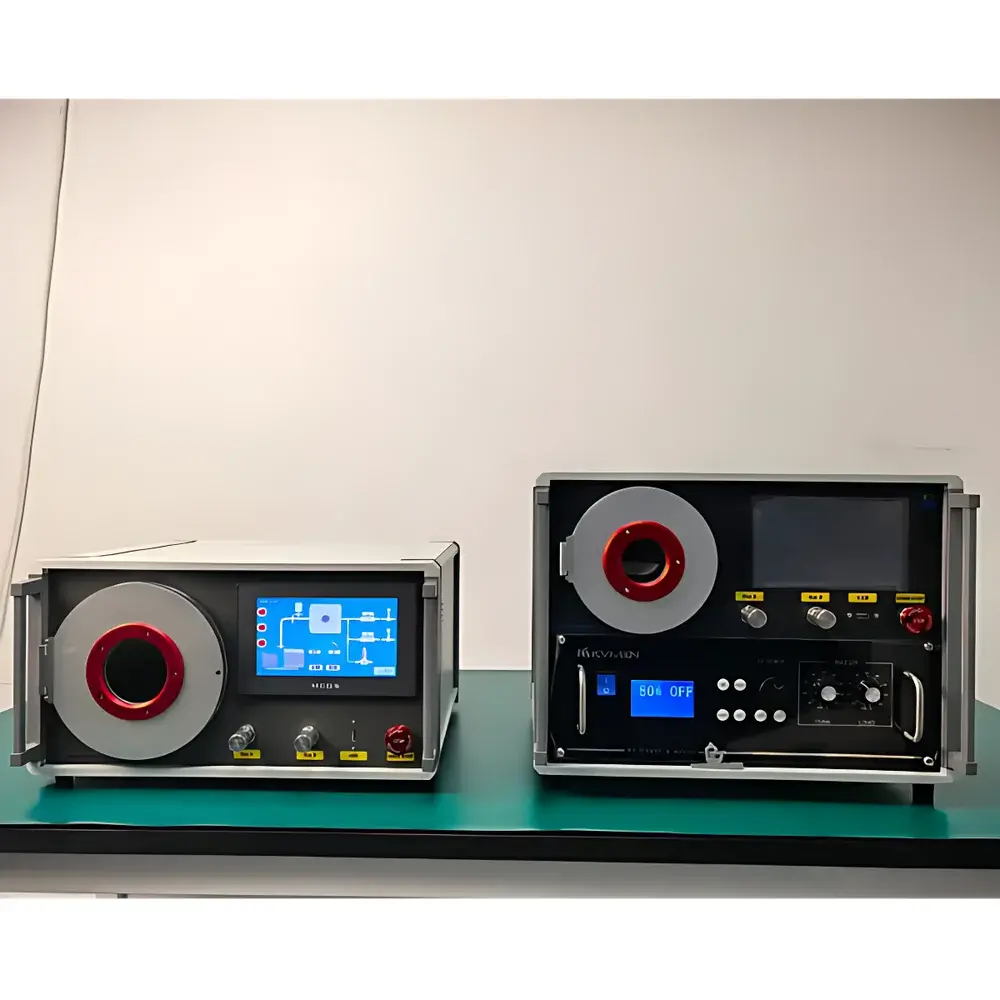
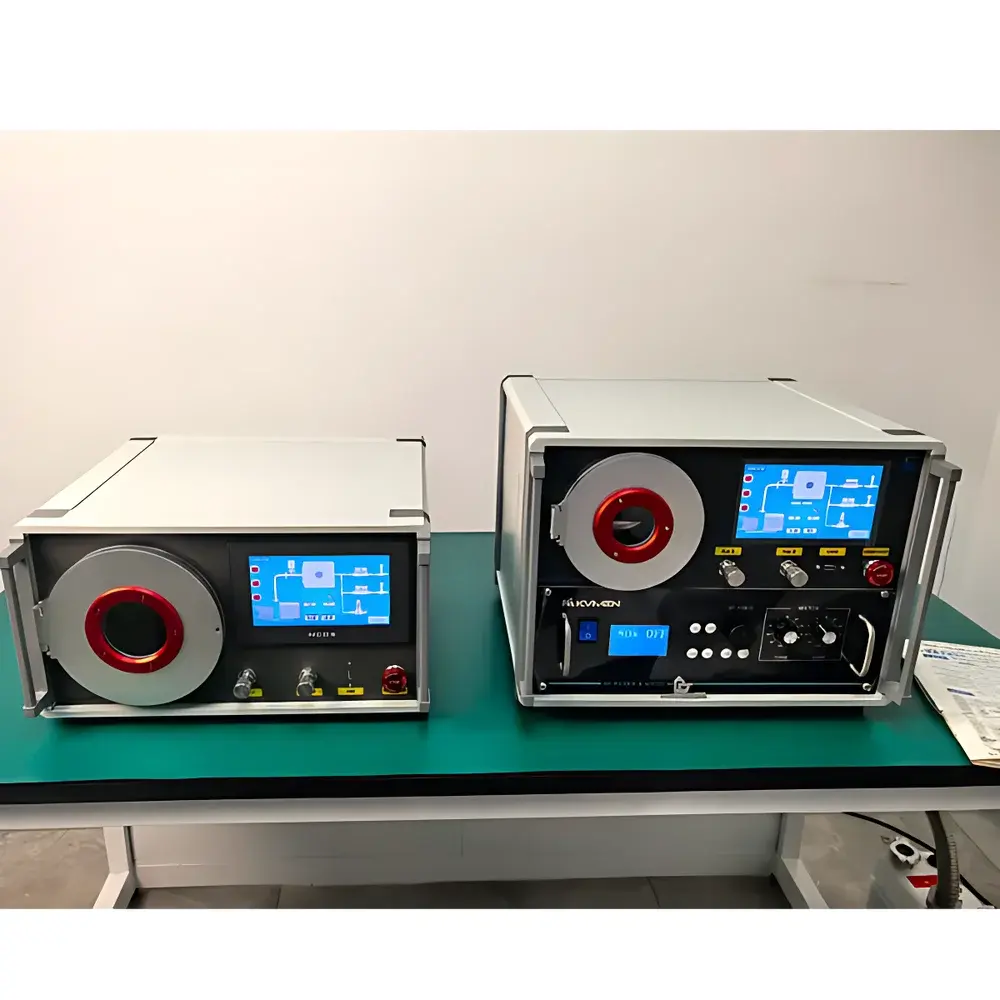
Zhongke Aobo Z5KQX Plasma Cleaner
| Brand | Zhongke Aobo |
|---|---|
| Origin | Beijing, China |
| Model | Z5KQX |
| Chamber Volume | 2–5 L |
| Heating Power | 150–500 W |
| Cleaning Temperature | 100 °C |
| External Dimensions (L×W×D) | 450 × 450 × 250 mm |
| RF Power | 150 W / 500 W |
| Operating Frequency | 40 kHz / 13.56 MHz |
| Vacuum Range | ≤30 Pa / ≤50 Pa |
| Chamber Material | High-Purity Quartz |
| Gas Flow Control | 0–50 mL/min (dual thermal mass flow sensors) |
| Vacuum Gauge Range | 1×10⁵ Pa to 1×10⁻¹ Pa (Pirani gauge) |
| Cooling Method | Forced Air Cooling |
| Control Interface | 7-inch Touchscreen HMI |
| Power Supply | AC 220 V (110 V optional) |
| Max. Operating Current | ≤3.5 A (excl. vacuum pump) |
Overview
The Zhongke Aobo Z5KQX Plasma Cleaner is a compact, benchtop-capable low-pressure plasma processing system engineered for precision surface modification and contamination removal at the microscale. It operates on the principle of capacitively coupled radiofrequency (RF) plasma generation in controlled gaseous environments—typically oxygen, argon, nitrogen, or forming gas mixtures. Under applied RF power (13.56 MHz or 40 kHz), neutral process gases are ionized to produce a non-thermal plasma containing reactive species: electrons, positive/negative ions, metastable atoms, free radicals (e.g., atomic O, OH), and UV photons. These active species interact physically and chemically with substrate surfaces—removing organic residues via oxidation, breaking C–C/C–H bonds, and simultaneously introducing polar functional groups (e.g., –OH, –COOH) to enhance wettability and adhesion. Unlike wet chemical cleaning, this dry process leaves no solvent residue, avoids thermal damage to heat-sensitive substrates, and achieves uniform treatment even on complex topographies and blind vias.
Key Features
- High-purity fused quartz reaction chamber (Φ110 mm × 220 mm or Φ152 mm × 280 mm variants) ensuring optical transparency, chemical inertness, and minimal metallic contamination—critical for semiconductor and MEMS applications.
- Dual-frequency RF source (13.56 MHz for high-density, low-damage plasma; 40 kHz for enhanced ion bombardment)—selectable via touchscreen interface to optimize cleaning vs. activation trade-offs.
- Integrated solid-state RF generator with automatic impedance matching, eliminating manual tuning and improving process reproducibility across variable load conditions and gas compositions.
- Real-time dual-channel mass flow control (0–50 mL/min, thermal-based) enabling precise, repeatable gas dosing for multi-step processes (e.g., Ar sputter + O₂ ash).
- Wide-range Pirani vacuum gauge (1×10⁵ Pa to 1×10⁻¹ Pa) with digital feedback loop supporting stable operation down to ≤30 Pa—validated for consistent plasma ignition and uniformity.
- 7-inch capacitive touchscreen HMI with pre-programmed protocols, timer-based cycle control, and manual parameter override—designed for intuitive operation in teaching labs and R&D settings.
- Forced-air cooling system maintains chamber wall temperature below 65 °C during extended operation, preserving thermally labile polymers and biological samples.
Sample Compatibility & Compliance
The Z5KQX accommodates substrates up to 100 mm in diameter—including silicon wafers, glass slides, ceramic PCBs, metal foils, polymer films (PET, PDMS, PTFE), and biomedical scaffolds. Its gentle, non-abrasive mechanism meets requirements for pre-bonding surface preparation in microfluidics, COG (Chip-on-Glass) assembly, and hermetic sealing of MEMS packages. The system complies with general laboratory safety standards (IEC 61010-1) and supports GLP-aligned documentation through timestamped operation logs. While not certified to ISO 13485 or FDA 21 CFR Part 11 out-of-the-box, its deterministic process parameters (pressure, power, time, gas ratio) enable full traceability when integrated into validated workflows.
Software & Data Management
No external PC or proprietary software is required—the embedded controller handles all operational logic locally. Process parameters (RF power, frequency, gas flow rates, vacuum setpoint, dwell time) are stored as named protocols with version-stamped execution records. All logs—including start/stop timestamps, error codes, and real-time vacuum/temperature readings—are exportable via USB to CSV for audit trail generation. Optional RS-232 or Ethernet interfaces (available upon request) support integration with centralized lab management systems for remote monitoring and automated reporting.
Applications
- Semiconductor & Microelectronics: Photoresist stripping, wafer deburring, oxide layer reduction prior to ALD/PVD, and removal of photoresist residuals from etched trenches.
- PCB & Packaging: Removal of solder mask residues, flux contaminants, and epoxy bleed-out from HDI boards; surface activation of FR-4 and polyimide flex circuits before conformal coating.
- Life Sciences: Sterilization of microtiter plates and PDMS chips; hydrophilization of cell culture surfaces; enhancement of protein adsorption on biosensor transducers.
- Materials Research: Pre-treatment of carbon fiber composites for improved resin wetting; functionalization of graphene oxide membranes; cleaning of TEM grids prior to electron microscopy.
- Academic & Teaching Labs: Demonstrating plasma physics fundamentals (sheath formation, electron energy distribution), surface science techniques (contact angle measurement pre/post treatment), and cleanroom-adjacent fabrication protocols.
FAQ
What vacuum level is required for stable plasma ignition?
Stable plasma discharge is achieved at ≤30 Pa for O₂ and ≤50 Pa for Ar/N₂ mixtures, verified by the integrated Pirani gauge with ±5% full-scale accuracy.
Can the system operate continuously for extended periods?
Yes—continuous operation up to 120 minutes per cycle is supported under forced-air cooling; duty cycles exceeding 3 hours/day require periodic inspection of RF coupling stability and quartz chamber integrity.
Is ozone generation a concern during oxygen plasma operation?
Ozone is produced as a secondary byproduct; the system includes passive venting through the vacuum exhaust line—use in a fume hood or with an inline ozone destruct unit is recommended for prolonged O₂ use.
What consumables require periodic replacement?
The quartz chamber shows negligible wear under normal use; primary maintenance items include the KF16 O-rings (recommended replacement every 6 months), thermal mass flow sensor calibration (annually), and vacuum pump oil (per pump manufacturer schedule).
Does the Z5KQX support custom gas mixtures beyond O₂ and Ar?
Yes—any non-corrosive, non-toxic gas compatible with stainless-steel and quartz (e.g., N₂, H₂, CF₄, NH₃) may be introduced via the dual MFC ports, subject to user-defined safety interlocks and local regulatory approval.



