
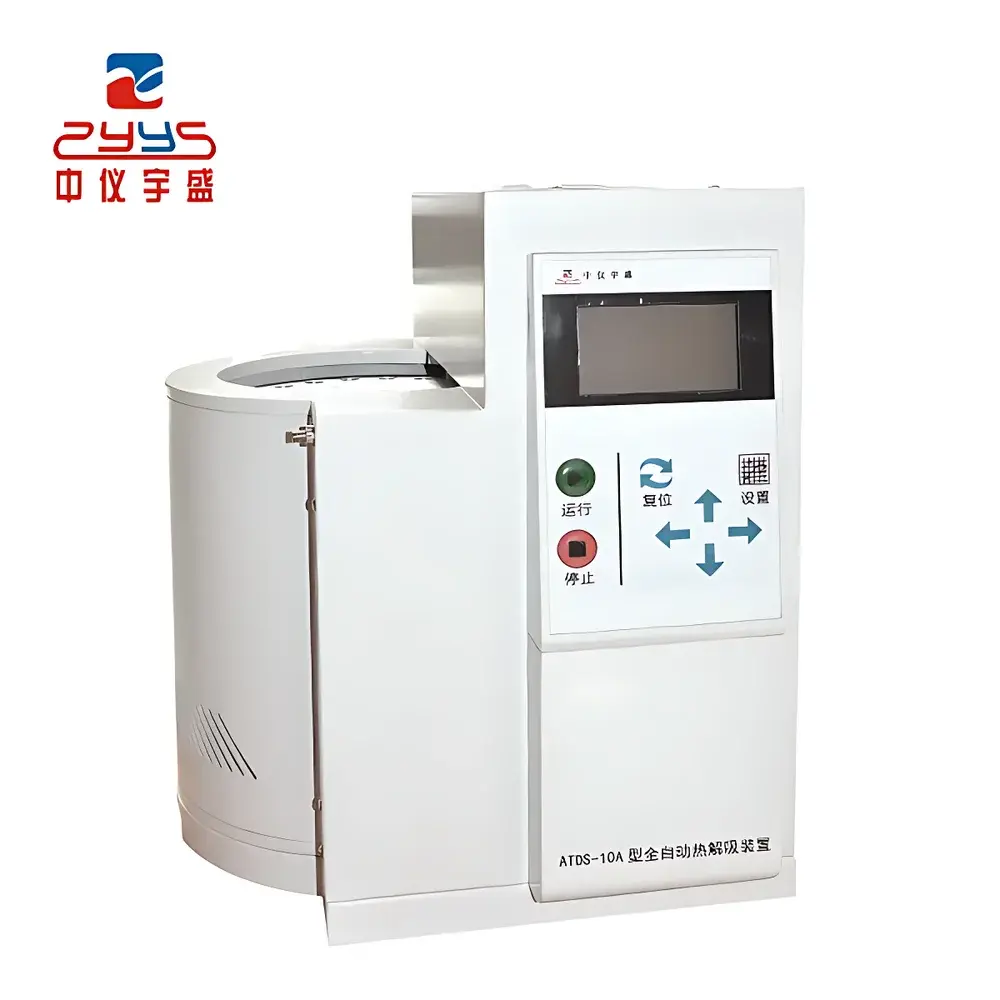
Zhongyi Yusheng ATDS-10A Fully Automated Two-Stage Thermal Desorber
| Brand | Zhongyi Yusheng |
|---|---|
| Origin | Beijing, China |
| Manufacturer Type | Direct Manufacturer |
| Instrument Type | Two-Stage Thermal Desorber |
| Automation Level | Fully Automated |
| Sample Capacity | 10 Positions |
| Compliance | HJ 644–2013, HJ/T 400–2007, GB/T 18883–2002, HJ 583–2010, GB 50325–2020, HJ 734–2014 |
| Heating Zones | Four Independent Zones (Desorption Zone, Injection Valve, Transfer Line, Second-Stage Desorption Zone) |
| Cooling Method | Electronic Peltier Cooling |
| Sample Tube Handling | Automated Tube Activation & Conditioning |
| GC Interface | Universal GC Inlet Compatibility (Split/Splitless, PTV) |
| Data Integration | Trigger Output for GC Start & Chromatography Software Synchronization |
| Software | Embedded Microprocessor Control with Touchscreen UI, Method Programming, Real-Time Status Animation, Audit-Trail Capable Logging |
Overview
The Zhongyi Yusheng ATDS-10A Fully Automated Two-Stage Thermal Desorber is an engineered solution for quantitative trace-level volatile organic compound (VOC) and semi-volatile organic compound (SVOC) analysis in environmental, occupational health, and indoor air quality laboratories. It operates on the principle of two-stage thermal desorption: first-stage desorption releases analytes from sorbent tubes under controlled inert gas flow and temperature ramping; second-stage cryo-focusing followed by rapid thermal desorption delivers narrow, reproducible analyte bands into the gas chromatograph (GC) inlet. This architecture minimizes band broadening, enhances sensitivity (sub-ppt detection limits achievable with compatible GC–MS systems), and ensures high analytical precision across extended unattended sequences. Designed for compliance-driven workflows, the ATDS-10A supports full method traceability and integrates seamlessly into regulated environments requiring adherence to ISO/IEC 17025, GLP, and FDA 21 CFR Part 11–aligned data integrity practices.
Key Features
- Fully automated batch processing of up to 10 sorbent tubes without manual intervention—ideal for high-throughput monitoring programs;
- Four independently controlled heating zones: primary desorption oven, injection valve, heated transfer line (up to 300 °C), and secondary cold trap (with Peltier-based electronic cooling to –30 °C);
- Integrated tube activation module enabling automated thermal conditioning of Tenax®, Carbopack™, or multi-bed sorbent tubes prior to sampling or reuse;
- Programmable multi-step sequence control: primary desorption → inert gas purge → cryo-focusing → rapid second-stage desorption → GC injection → post-run transfer line and valve back-flush;
- Real-time touchscreen interface with animated status visualization, method parameter storage, and timestamped operational logging;
- Hardware-level GC synchronization: TTL trigger output initiates GC acquisition simultaneously with desorption start; optional external start signal input supported;
- Cross-contamination mitigation via active back-flush of the transfer line and injection valve using carrier gas between runs;
- Modular inlet compatibility: standard 1/4″ compression fittings accept stainless steel or fused silica transfer lines; optional quartz-lined transfer tubing available for reactive analytes (e.g., aldehydes, organic acids);
- Self-diagnostics at power-on: automatic mechanical position calibration, heater verification, and fault-flagging with descriptive error codes.
Sample Compatibility & Compliance
The ATDS-10A accommodates industry-standard 6 mm OD × 90 mm sorbent tubes (including Markes UNITY™, PerkinElmer UltraCold™, and custom-packed beds). It is validated for use with EPA TO-17 compliant sampling protocols and fully supports Chinese national and environmental standards including HJ 644–2013 (VOCs in ambient air), HJ 734–2014 (stack emissions), and GB 50325–2020 (indoor formaldehyde and TVOC testing). All thermal profiles, dwell times, and gas flows are programmable and stored as auditable methods. System logs—including user actions, method loads, run completions, and error events—are retained with date/time stamps and operator ID fields, facilitating internal QA reviews and regulatory inspections under CNAS or CMA accreditation frameworks.
Software & Data Management
Control firmware resides on an embedded ARM-based microprocessor with 800×480 capacitive touchscreen. No PC dependency is required for routine operation. Method files (.atd format) store complete thermal and pneumatic parameters, including ramp rates (°C/min), hold times (s), flow rates (mL/min), and cooling setpoints. Each run generates a local CSV log containing start time, sample ID, cycle duration, peak temperature achieved per zone, and any system alerts. Optional USB export enables integration with LIMS or third-party chromatography data systems (CDS) such as OpenLab CDS, Chromeleon, or Empower. Audit-trail functionality records all method edits, user logins, and critical parameter changes—meeting minimum ALCOA+ principles for raw data integrity in GxP environments.
Applications
- Ambient and indoor air monitoring for benzene, toluene, ethylbenzene, xylenes (BTEX), C2–C12 aliphatics, and oxygenated VOCs;
- Workplace exposure assessment per OSHA/NIOSH methodologies using NIOSH 1501, 1600, or ISO 16017–1;
- Building material emission testing (e.g., carpets, adhesives, particleboard) per ASTM D5116 and GB/T 27630;
- Automotive cabin air quality evaluation per HJ/T 400–2007 and ISO 12219–1;
- Soil headspace analysis following EPA Method TO-15 derivations;
- Method development and calibration curve generation via built-in standard spiking capability using certified gas-phase or liquid-phase reference materials.
FAQ
Is the ATDS-10A compatible with non-Chinese GC systems?
Yes—it provides universal hardware interfaces (TTL trigger I/O, 24 V DC control lines) and accepts standard 1/4″ Swagelok® fittings for direct connection to Agilent, Thermo Fisher, Shimadzu, and PerkinElmer GC inlets.
Does it support single-stage desorption mode?
No—the ATDS-10A is purpose-built for two-stage thermal desorption only; its architecture excludes bypass or single-stage operation to maintain peak shape fidelity and sensitivity.
Can the system be integrated into a 21 CFR Part 11–compliant workflow?
While the base firmware does not include electronic signatures or role-based access control, its audit-log structure, immutable run records, and method versioning align with Part 11 Annex A expectations; full compliance requires supplemental procedural controls and validated CDS integration.
What maintenance is required for long-term reliability?
Routine tasks include quarterly verification of temperature accuracy (NIST-traceable probe), annual replacement of O-rings in the sample tray and valve manifold, and biannual cleaning of the cold trap surface using low-residue solvents per manufacturer guidelines.
Related Products




