
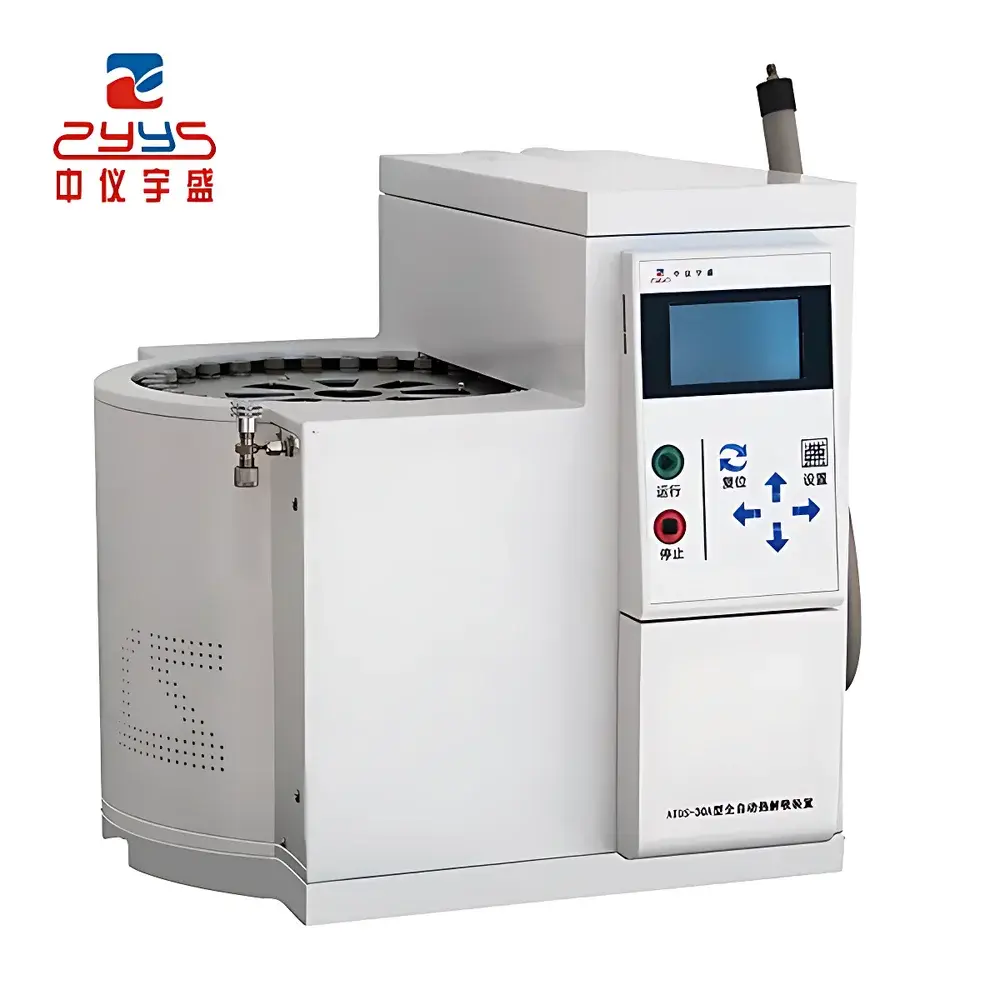
Zhongyi Yusheng ATDS-30A Fully Automated Two-Stage Thermal Desorber
| Brand | Zhongyi Yusheng |
|---|---|
| Origin | Beijing, China |
| Manufacturer Type | Direct Manufacturer |
| Country of Origin | China |
| Model | ATDS-30A (Two-Stage) |
| Instrument Type | Two-stage Thermal Desorber |
| Automation Level | Fully Automated |
| Sample Capacity | 30 positions |
| Compliance | HJ 644–2013, HJ/T 400–2007, GB/T 18883–2002, HJ 583–2010, GB 50325–2020, HJ 734–2014 |
Overview
The Zhongyi Yusheng ATDS-30A Fully Automated Two-Stage Thermal Desorber is an engineered solution for quantitative trace-level volatile organic compound (VOC) and semi-volatile organic compound (SVOC) analysis in environmental, occupational health, and indoor air quality monitoring applications. It operates on the principle of two-stage thermal desorption: first, analytes pre-concentrated on sorbent tubes are thermally released in a controlled, inert gas stream; second, the evolved vapors are cryogenically focused (via electronic cooling) onto a narrow cold trap before rapid injection into the GC inlet. This dual-stage architecture enhances sensitivity, improves chromatographic peak shape, and minimizes breakthrough and carryover—critical for regulatory-compliant analysis of complex, low-concentration VOC mixtures.
Key Features
- Fully automated batch processing of up to 30 sorbent tubes without manual intervention—ideal for high-throughput laboratory environments requiring unattended overnight operation.
- Integrated self-diagnostic system with real-time fault detection, audible/visual alerts, and automatic sample tray calibration and positioning.
- Independent four-zone temperature control: primary desorption oven, sampling valve, transfer line, and secondary focusing trap—each programmable with ±0.1 °C stability for precise thermal management.
- Time-based sequence programming supporting full method automation: primary desorption, inert gas purge, secondary cold trapping, flash desorption, GC injection, and post-run valve/line backflush.
- Onboard electronic Peltier cooling enables sub-ambient trapping (down to –30 °C), ensuring sharp, symmetrical peaks and improved resolution for early-eluting compounds such as formaldehyde, benzene, and acetaldehyde.
- Dedicated backflush functionality for both the transfer line and sampling valve—prevents cross-contamination between samples and extends system longevity.
- Modular interface design compatible with major GC platforms (Agilent, Thermo Fisher, Shimadzu, PerkinElmer, and domestic GC systems), including standardized electrical and pneumatic connections per ISO 8573-1 and ASTM D5464 requirements.
- Optional fused quartz transfer line available for enhanced inertness when analyzing reactive or polar analytes (e.g., aldehydes, organic acids, amines).
- Quick-release syringe needle assembly facilitates tool-free replacement and ensures compatibility with split/splitless, PTV, and cold-on-column GC inlets.
Sample Compatibility & Compliance
The ATDS-30A supports standard 6 mm OD stainless steel or glass sorbent tubes (e.g., Tenax TA, Carbopack B/C, Carboxen 1000, or multi-bed configurations) used in accordance with EPA TO-17, ISO 16017-1, and Chinese national standards. Its operational parameters and validation protocols align with the methodological requirements of:
- HJ 644–2013: Ambient air VOCs analysis using sorbent tube sampling followed by thermal desorption–GC/MS
- HJ/T 400–2007: In-vehicle VOC and carbonyl compound sampling and quantification
- GB/T 18883–2002 and GB 50325–2020: Indoor air quality assessment for residential and civil construction projects
- HJ 583–2010 and HJ 734–2014: Stationary source emissions monitoring of aromatic hydrocarbons and general VOCs
The instrument’s firmware supports audit-trail-enabled method storage and execution, meeting GLP documentation expectations for routine environmental testing laboratories.
Software & Data Management
Controlled via a 7-inch capacitive touchscreen HMI with embedded Linux-based firmware, the ATDS-30A provides intuitive method setup, real-time status visualization (including temperature profiles, valve actuation, and timeline progress), and event logging. All methods—including desorption ramp rates, hold times, trap temperatures, and backflush durations—are stored with user-defined naming and versioning. The system supports external triggering via TTL or RS232 signals, enabling synchronized start with GC acquisition software (e.g., OpenLAB CDS, Chromeleon, GCsolution). Raw event logs (timestamped diagnostics, error codes, temperature deviations) are exportable in CSV format for internal QA review and regulatory submissions.
Applications
- Ambient and indoor air monitoring for benzene, toluene, ethylbenzene, xylenes (BTEX), C2–C12 aliphatics, and oxygenated VOCs
- Workplace exposure assessment per OSHA and GBZ 159–2004 methodologies
- Building material emission testing (e.g., carpets, adhesives, particleboard) under controlled chamber conditions
- Automotive cabin air quality evaluation, including formaldehyde and acetaldehyde profiling
- Soil gas and landfill leachate headspace analysis following EPA Method TO-15 derivations
- Method development and calibration curve generation via integrated standard vapor introduction and tube spiking routines
FAQ
Is the ATDS-30A compliant with US EPA Method TO-17?
Yes—the hardware architecture, temperature control precision, and desorption timing resolution meet the technical specifications outlined in TO-17 for two-stage thermal desorption systems.
Can the system perform tube conditioning (baking) automatically?
Yes—it includes a built-in tube activation protocol with programmable temperature ramps, inert gas flow control, and duration settings for pre-analysis regeneration of sorbent tubes.
What is the maximum operating temperature of the primary desorption oven?
The primary oven is rated to 400 °C with ±0.5 °C accuracy across its full range, suitable for high-boiling SVOCs including polycyclic aromatic hydrocarbons (PAHs) and phthalates.
Does the instrument support 21 CFR Part 11 compliance?
While the base firmware does not include electronic signatures or role-based access control, it exports fully traceable audit logs and supports integration with validated LIMS or CDS platforms that implement Part 11 controls.
How is carryover mitigated between sequential analyses?
Through a combination of high-efficiency inert gas purging, active backflushing of all fluidic pathways, and optional quartz-lined transfer tubing—validated to <0.1% carryover for BTEX at 10 ng levels.
Related Products






