
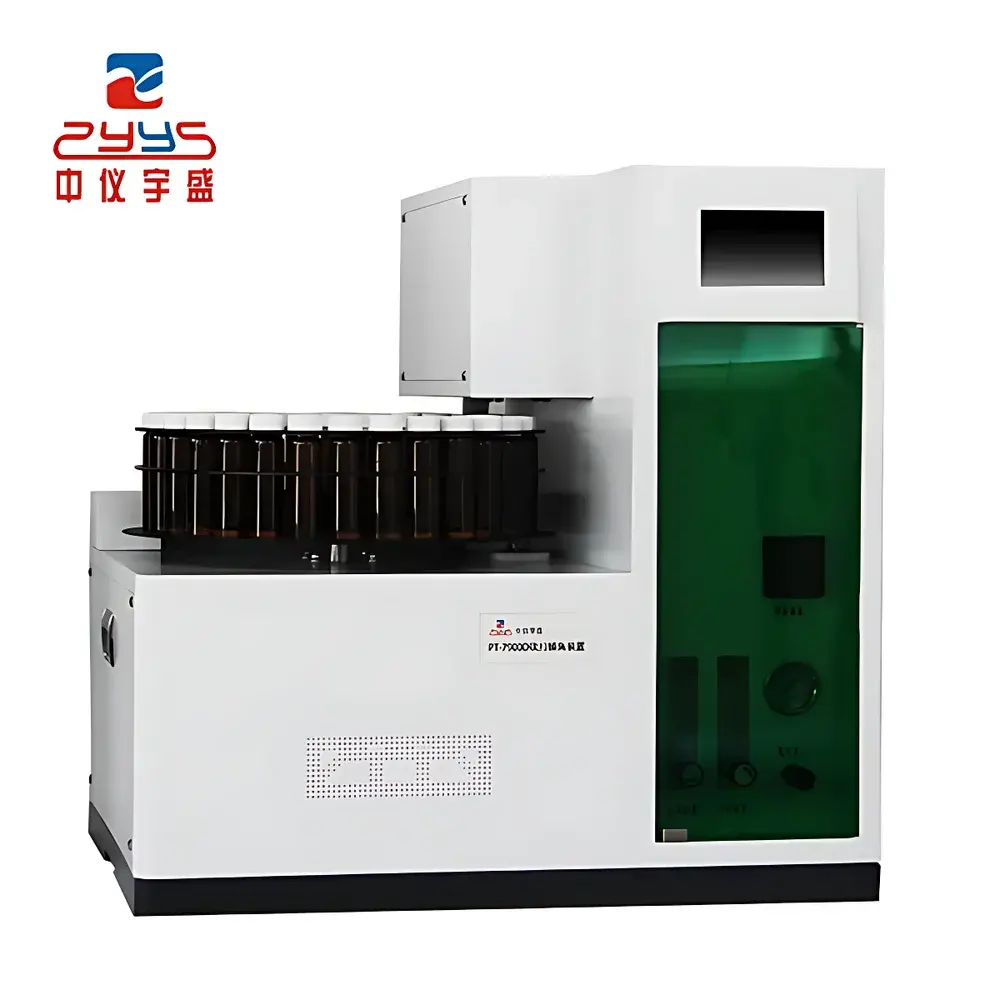
Zhongyi Yusheng PT-7900D Fully Automated Purge and Trap System
| Brand | Zhongyi Yusheng |
|---|---|
| Origin | Beijing, China |
| Manufacturer Type | OEM Manufacturer |
| Product Category | Domestic |
| Model | PT-7900D |
| Instrument Type | Water-and-Soil Integrated Purge and Trap System |
| Sample Tray Capacity | 30-position |
Overview
The Zhongyi Yusheng PT-7900D Fully Automated Purge and Trap System is an engineered solution for trace-level volatile organic compound (VOC) preconcentration prior to gas chromatographic analysis. Based on the established purge-and-trap principle—where inert gas purges VOCs from aqueous or solid-phase samples into a sorbent trap, followed by thermal desorption and transfer to a GC or GC-MS—the PT-7900D delivers reproducible, low-background quantification for regulatory-compliant environmental testing. Designed for unattended operation in high-throughput laboratories, it supports both liquid (e.g., drinking water, wastewater) and solid matrices (e.g., soil, sediment, solid waste) without manual intervention between samples. Its architecture integrates precise temperature control across critical fluidic zones, active moisture management, and synchronized GC/GC-MS triggering—ensuring analytical integrity across diverse sample types and regulatory workflows.
Key Features
- Fully automated 30-sample batch processing with zero operator attendance required after method initiation
- Self-diagnostic startup sequence with real-time fault detection and error logging for system health monitoring
- Embedded microprocessor control enabling customizable method programming—including purge time, trap desorption temperature, bake-out duration, and GC synchronization timing
- Independent four-zone heating: purge valve, transfer line, water removal trap, and trap desorption zone—each with PID-controlled temperature stability (±1 °C)
- Integrated Peltier-based electronic cooling for trap conditioning down to –20 °C, supporting efficient capture of highly volatile analytes (e.g., vinyl chloride, chloromethane)
- Dedicated water management module featuring a cryogenically assisted water trap to minimize H2O breakthrough and prevent column degradation or detector saturation in downstream GC systems
- Automatic back-flush function for both transfer line and injection valve to eliminate carryover between heterogeneous samples
- Programmable sample agitation during purge phase to enhance mass transfer efficiency for heterogeneous or viscous matrices
- Standardized 40 mL EPA-compliant vial compatibility with optional crimp-cap or screw-cap configurations
- Universal GC/GC-MS trigger interface supporting TTL, RS-232, and contact closure protocols for seamless integration with Agilent, Thermo Fisher, Shimadzu, and PerkinElmer platforms
Sample Compatibility & Compliance
The PT-7900D is validated for use with environmental matrices defined under major U.S. EPA, Chinese national, and ISO-aligned standards. It meets performance criteria specified in HJ 605–2011 (soil/sediment VOCs), HJ 639–2012 and HJ 686–2014 (water VOCs), HJ 713–2014 and HJ 735–2015 (solid waste and sediment VOCs by GC-MS), as well as GB/T 5750.8–2023 (drinking water testing). Its design accommodates both aqueous samples (including high-salinity or turbid waters) and solid-phase samples up to 25 g via direct spiking or methanol-assisted extraction. All thermal desorption parameters are auditable and timestamped, supporting GLP-compliant documentation requirements. While not FDA 21 CFR Part 11 certified out-of-the-box, the system’s method storage, user access logs, and audit trail capabilities can be extended via third-party LIMS integration.
Software & Data Management
The PT-7900D operates via a dedicated Windows-based control software with intuitive graphical workflow builder. Users define multi-step sequences—including purge, dry purge, trap desorption, GC trigger delay, and post-run trap bakeout—with granular time resolution (1-second increments). Method files include embedded metadata (operator ID, date/time stamp, version number) and support password-protected parameter locking. Raw status logs (temperature profiles, valve actuation events, error codes) are stored in CSV format for traceability. Software export options include PDF method reports and Excel-compatible run summaries. No cloud connectivity or remote access is enabled by default—ensuring data sovereignty in regulated environments.
Applications
This system is routinely deployed in environmental testing laboratories conducting compliance monitoring per national discharge permits, drinking water safety assessments, contaminated site investigations (e.g., brownfield characterization), and hazardous waste profiling. Typical analyte classes include BTEX (benzene, toluene, ethylbenzene, xylenes), trihalomethanes (chloroform, bromodichloromethane), haloacetonitriles, acrylonitrile, aldehydes (acrolein, propionaldehyde), petroleum hydrocarbons (C6–C9), and nitriles (acetonitrile). Its solid-phase capability extends utility to landfill leachate screening, pesticide formulation residue analysis, and polymer off-gassing studies where headspace equilibration alone lacks sensitivity.
FAQ
Does the PT-7900D support both water and soil samples without hardware modification?
Yes—its dual-mode configuration allows direct analysis of aqueous samples and solid matrices using the same trap and thermal desorption path; no mechanical reconfiguration is required.
What is the maximum recommended sample volume for soil analysis?
The system is optimized for 1–25 g of homogenized soil or sediment, spiked with internal standards and diluted with deionized water or methanol as needed.
Is the water trap replaceable in the field?
Yes—the moisture removal cartridge is user-serviceable and designed for quick replacement without tools or system calibration recalibration.
Can method parameters be locked to prevent unauthorized changes during routine runs?
Yes—software supports role-based access control with administrator-defined method lockdown and electronic signature enforcement.
What maintenance intervals are recommended for optimal performance?
Trap conditioning every 100 runs, transfer line cleaning every 500 runs, and annual verification of temperature accuracy and purge gas flow rate are advised per the manufacturer’s maintenance schedule.





