
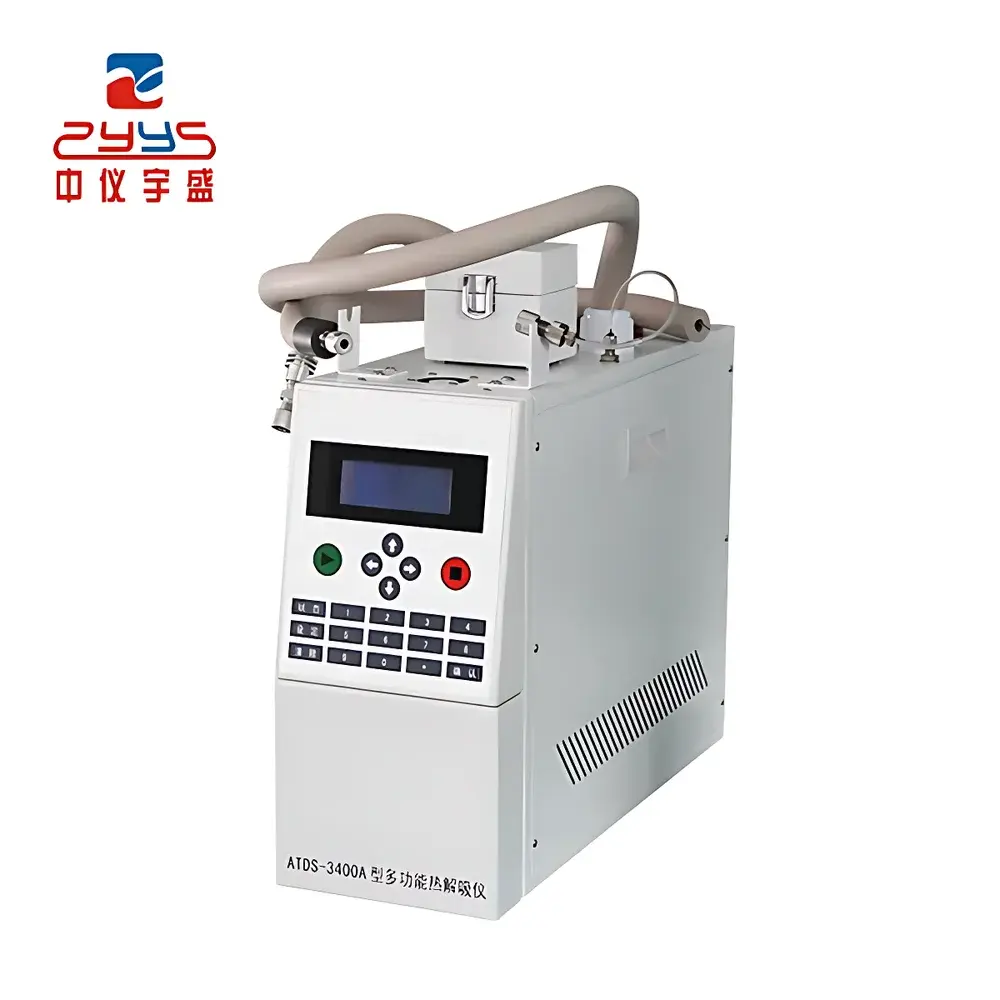
Zhongyi Yusheng ATDS-3400A Integrated Thermal Desorber
| Brand | Zhongyi Yusheng |
|---|---|
| Origin | Beijing, China |
| Manufacturer Type | Direct Manufacturer |
| Instrument Type | Single-Stage Thermal Desorber |
| Automation Level | Semi-Automatic |
| Desorption Zone Temperature Range | Ambient to 400 °C (1 °C increments) |
| Valve & Injection Port Temperature Range | Ambient to 180 °C (1 °C increments, ~60 W heating power) |
| Transfer Line Temperature Range | Ambient to 200 °C (1 °C increments, ~40 W heating power) |
| Cold Trap Temperature Range | Down to −35 °C |
| Temperature Control Accuracy | ±0.1 °C |
| Analyte Recovery Rate | ≥95% |
| Sample Capacity | 6 sample tubes + 1 activation tube |
Overview
The Zhongyi Yusheng ATDS-3400A Integrated Thermal Desorber is a laboratory-engineered, semi-automated sample introduction system designed for the quantitative transfer of volatile and semi-volatile organic compounds (VOCs and SVOCs) from sorbent-packed thermal desorption tubes into gas chromatography (GC) systems. Operating on the principle of controlled thermal desorption—where analytes are thermally released from solid-phase sorbents under inert carrier gas flow—the ATDS-3400A enables high-fidelity, low-background transfer without solvent use. Its integrated architecture combines three critical pre-analytical functions: thermal desorption for GC injection, simulated standard sampling for calibration curve generation, and in-situ adsorbent tube conditioning (baking/activation). This eliminates inter-instrument handling, reduces contamination risk, and improves method reproducibility—particularly essential for regulatory-compliant environmental, occupational health, and forensic analyses.
Key Features
- Triple-function integration: simultaneous or independent operation of thermal desorption, standard vapor generation (simulated sampling), and adsorbent tube reconditioning—reducing workflow complexity and cross-contamination.
- Precision temperature control across four independently regulated zones: desorption oven (ambient–400 °C), valve/injection interface (ambient–180 °C), heated transfer line (ambient–200 °C), and cryogenic cold trap (down to −35 °C), all with ±0.1 °C stability and 1 °C programmable resolution.
- Dual-path gas management: built-in adjustable carrier gas regulation allows seamless interfacing with any GC system—without hardware modification to the host instrument—and supports both external and native GC carrier gas supply.
- Modular inlet compatibility: standardized needle interface accommodates universal GC injectors (split/splitless, PTV, cold-on-column), including legacy and modern configurations from Agilent, Thermo Fisher, Shimadzu, and PerkinElmer.
- Optimized thermal efficiency: zone-specific heating power (60 W for desorption zone; 40 W for transfer line) ensures rapid ramp rates and stable plateau temperatures, minimizing analyte degradation and breakthrough.
- High recovery performance: validated ≥95% recovery across C2–C16 VOCs and common SVOCs (e.g., naphthalene, biphenyl) under ISO 16017-1 and ASTM D6196 conditions.
Sample Compatibility & Compliance
The ATDS-3400A accepts industry-standard 1/4″ OD stainless steel or quartz thermal desorption tubes packed with multi-bed sorbents (e.g., Tenax TA, Carbopack B/C, Carboxen 1000). It supports direct coupling to EPA TO-17 compliant methods and aligns with analytical requirements specified in GB 50325–2020 (indoor air benzene/toluene/xylene and TVOC determination), as well as ISO 16017-1 (indoor/outdoor air VOC analysis), ISO 21028-1 (workplace air), and ASTM D6196 (selection of sorbents for air monitoring). While not inherently 21 CFR Part 11 compliant (as it lacks electronic audit trail functionality), its operational parameters are fully documentable via external LIMS or GC data systems—supporting GLP/GMP-aligned workflows when integrated into validated laboratory procedures.
Software & Data Management
The ATDS-3400A operates via front-panel keypad and LCD interface with non-volatile parameter storage for up to 20 user-defined methods. All temperature setpoints, dwell times, gas flow profiles, and sequence steps (e.g., bake-cool-desorb-transfer) are programmable and recallable. Method files can be exported manually via USB for traceability and SOP documentation. Although the unit does not include proprietary PC software or network connectivity, its timing and temperature logic is fully synchronized with GC start signals (TTL trigger input), enabling precise event coordination during sequence runs. For laboratories requiring electronic records, integration with third-party chromatography data systems (CDS) such as OpenLab CDS, Chromeleon, or Empower permits full method archiving, run logging, and electronic signature support.
Applications
- Indoor air quality assessment per GB 50325–2020 and ISO 16017–1 for benzene, toluene, ethylbenzene, xylenes (BTEX), and TVOC profiling.
- Occupational exposure monitoring in manufacturing, pharmaceutical, and petrochemical facilities (per OSHA ID-255, NIOSH 1501).
- Rapid identification of unknown airborne contaminants during emergency response or hazmat incidents.
- Residual solvent analysis in pharmaceutical products and packaging materials (ICH Q3C, USP <467>).
- Forensic toxicology: detection of volatile metabolites (e.g., ethanol, acetone, chloroform) in breath or headspace samples.
- Flavor and fragrance profiling in food, cosmetic, and tobacco industries using dynamic headspace enrichment.
- Environmental screening of landfill gas, ambient urban air, and industrial stack emissions.
FAQ
Is the ATDS-3400A compatible with my existing GC system?
Yes—it features universal mechanical and pneumatic interfaces, supporting direct connection to all major GC models without hardware modification.
Can I perform tube activation and sample desorption simultaneously?
Yes—its dual-zone thermal architecture allows concurrent operation of the activation oven and desorption chamber with no cross-interference.
What is the lowest achievable cold trap temperature?
The integrated cryogenic trap reaches −35 °C, enabling efficient focusing of light volatiles (e.g., C2–C5) prior to GC injection.
Does the instrument support method validation per ISO/IEC 17025 requirements?
All thermal and timing parameters are programmable, repeatable, and manually recordable—providing the foundational data integrity required for method validation when used within a documented QA framework.
How many desorption tubes can be processed in one batch?
The carousel accommodates six sample tubes plus one dedicated activation tube, allowing unattended sequential processing with manual tube loading.





