
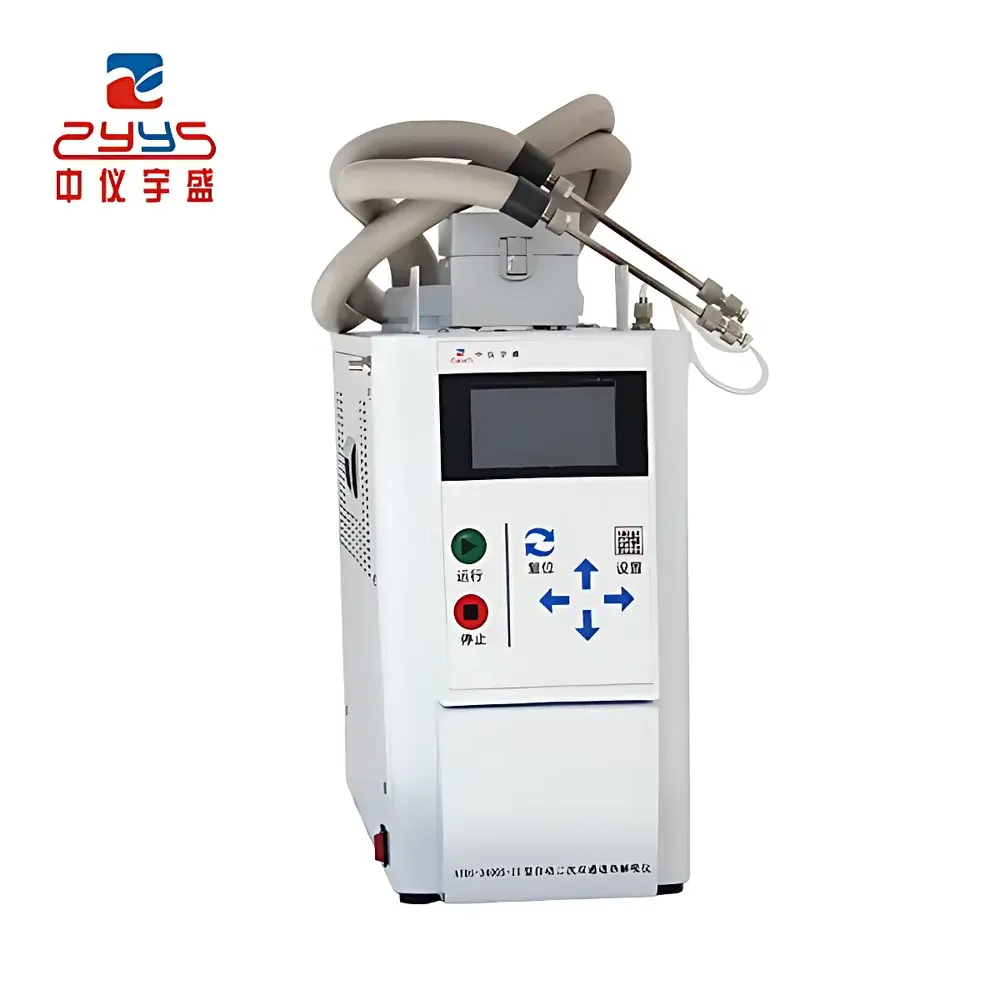
Zhongyi Yusheng ATDS-3400B-II Dual-Channel Automated Two-Stage Thermal Desorber
| Brand | Zhongyi Yusheng |
|---|---|
| Origin | Beijing, China |
| Manufacturer Type | Direct Manufacturer |
| Instrument Type | Two-Stage Thermal Desorber |
| Automation Level | Semi-Automatic |
| Sample Positions | 2 |
| Compliance Standards | HJ 644-2013, HJ 400-2007, GB/T 18883-2002, HJ 583-2010, GB 50325-2020, HJ 734-2014 |
Overview
The Zhongyi Yusheng ATDS-3400B-II is a semi-automated dual-channel two-stage thermal desorber engineered for precise, reproducible thermal desorption of volatile organic compounds (VOCs) from sorbent tubes prior to gas chromatographic analysis. It operates on the principle of sequential thermal desorption—first-stage desorption transfers analytes from the sorbent tube into a focusing trap (typically cryogenically or thermally cooled), followed by second-stage rapid desorption into the GC inlet under controlled temperature ramping and carrier gas flow. This two-stage architecture minimizes band broadening, enhances sensitivity, and delivers sharp, symmetrical chromatographic peaks—critical for trace-level VOC quantification in environmental, indoor air, and industrial emission matrices.
Key Features
- Semi-automated dual-channel architecture supports parallel processing of two samples with independent thermal control per channel, improving laboratory throughput without compromising method consistency.
- Four independently programmable heating zones: primary desorption oven, sampling valve, transfer line, and secondary desorption/focusing zone—each maintained within ±1 °C accuracy for optimal analyte integrity and recovery.
- Integrated electronic cooling system enables low-temperature trapping (down to –30 °C typical) for enhanced focusing of light VOCs (e.g., C2–C5 hydrocarbons), while optional ambient- or cryo-assisted secondary desorption modules accommodate diverse analyte volatility profiles.
- Full method programming via 7-inch color touchscreen interface: time-resolved control of desorption, purge, trap focusing, re-desorption, GC trigger, and post-run bake-out/cool-down cycles.
- Automated back-flush functionality for both transfer line and sampling valve prevents carryover between analyses—validated with <50 pg carryover for benzene across consecutive injections (per internal QC protocol).
- Built-in calibration mode supports standard vapor generation directly from liquid standards, enabling direct generation of multi-point calibration curves without external dynamic dilution systems.
- Universal GC interface compatibility: pre-configured electrical and pneumatic connections for Agilent, Thermo Fisher, Shimadzu, and PerkinElmer GC models; modular adapter kits available for legacy or custom inlet configurations.
- Optional fused silica transfer lines minimize adsorption of polar or reactive analytes (e.g., aldehydes, organic acids), ensuring quantitative recovery in compliance with HJ 734-2014 and HJ 400-2007 requirements.
Sample Compatibility & Compliance
The ATDS-3400B-II is validated for use with standard 6 mm OD stainless steel or glass sorbent tubes packed with Tenax TA, Carbopack B/C, Carboxen, or multi-bed configurations (e.g., Tenax GR + Carbograph 1TD). It meets instrumental performance criteria specified in multiple Chinese national and environmental monitoring standards, including but not limited to: HJ 644-2013 (ambient air VOCs by TD-GC/MS), HJ 583-2010 (benzene series in ambient air), GB/T 18883-2002 (indoor air quality), GB 50325-2020 (civil building IAQ control), HJ 400-2007 (in-vehicle VOCs), and HJ 734-2014 (stationary source emissions). While not certified to ISO/IEC 17025 or FDA 21 CFR Part 11 out-of-the-box, its programmable audit trail logging, method locking, and electronic signature-ready operation support GLP-compliant workflow integration when deployed with validated LIMS or chromatography data systems.
Software & Data Management
Control firmware supports method export/import via USB and provides timestamped event logs (including temperature setpoints, valve actuation, error codes, and GC trigger signals). Raw operational data—including real-time zone temperatures, pressure status, and cycle timing—is stored locally and exportable as CSV for QA/QC review. The system interfaces natively with major third-party chromatography data systems (CDS) via TTL or Ethernet-triggered start commands; optional OPC UA gateway module enables bidirectional communication with enterprise-level laboratory informatics platforms. All method parameters are password-protected and version-controlled, supporting traceability per ISO/IEC 17025 clause 7.2.2.
Applications
- Regulatory monitoring of ambient and indoor air VOCs (e.g., benzene, toluene, ethylbenzene, xylenes, styrene, C2–C5 alkanes/alkenes) per HJ 644-2013 and GB/T 18883-2002.
- Occupational exposure assessment in manufacturing, printing, and coating facilities using HJ 734-2014 protocols.
- Automotive cabin air quality testing for formaldehyde, acetaldehyde, and aromatic compounds per HJ 400-2007.
- Material emission testing (e.g., carpets, adhesives, furniture composites) aligned with GB 50325-2020 compliance workflows.
- Method development and validation studies requiring high-fidelity thermal desorption performance across wide volatility ranges (C2–C16).
FAQ
What distinguishes two-stage thermal desorption from single-stage systems?
Two-stage desorption isolates analyte transfer and focusing functions: first-stage desorption elutes compounds into a cold trap, where they are refocused; second-stage flash-heating injects a narrow, concentrated band into the GC column. This improves resolution, detection limits, and reproducibility—especially for early-eluting, low-boiling VOCs.
Can the ATDS-3400B-II be integrated into a fully automated unattended workflow?
Yes—when paired with a robotic autosampler (e.g., CTC PAL or GERSTEL MPS), it supports overnight batch runs. Its TTL/Ethernet GC trigger and status feedback enable synchronization within broader analytical sequences.
Is cryogenic cooling required for compliant operation under HJ 644-2013?
HJ 644-2013 permits either cryogenic or ambient-temperature secondary trapping, provided the system demonstrates ≤10% peak area RSD and ≤5% breakthrough for target compounds during validation. The ATDS-3400B-II’s electronic cooling option satisfies the former; its ambient secondary module meets the latter when validated per Section 8.2 of the standard.
How is carryover managed between high-concentration and low-concentration samples?
The instrument executes automatic back-flush of the transfer line and six-port valve with inert gas post-injection; bake-out at 350 °C for ≥5 min further eliminates residual organics. Routine verification uses blank tube analysis after 10 µg benzene injection.
Does the system support USP or EPA TO-17 methodologies?
While designed primarily for Chinese regulatory standards, its thermal precision, trap efficiency, and programmability allow method adaptation to TO-17 (EPA) and USP with appropriate validation per ICH Q2(R2); users must verify recovery, linearity, and LOD/LOQ under their specific SOPs.
Related Products





