
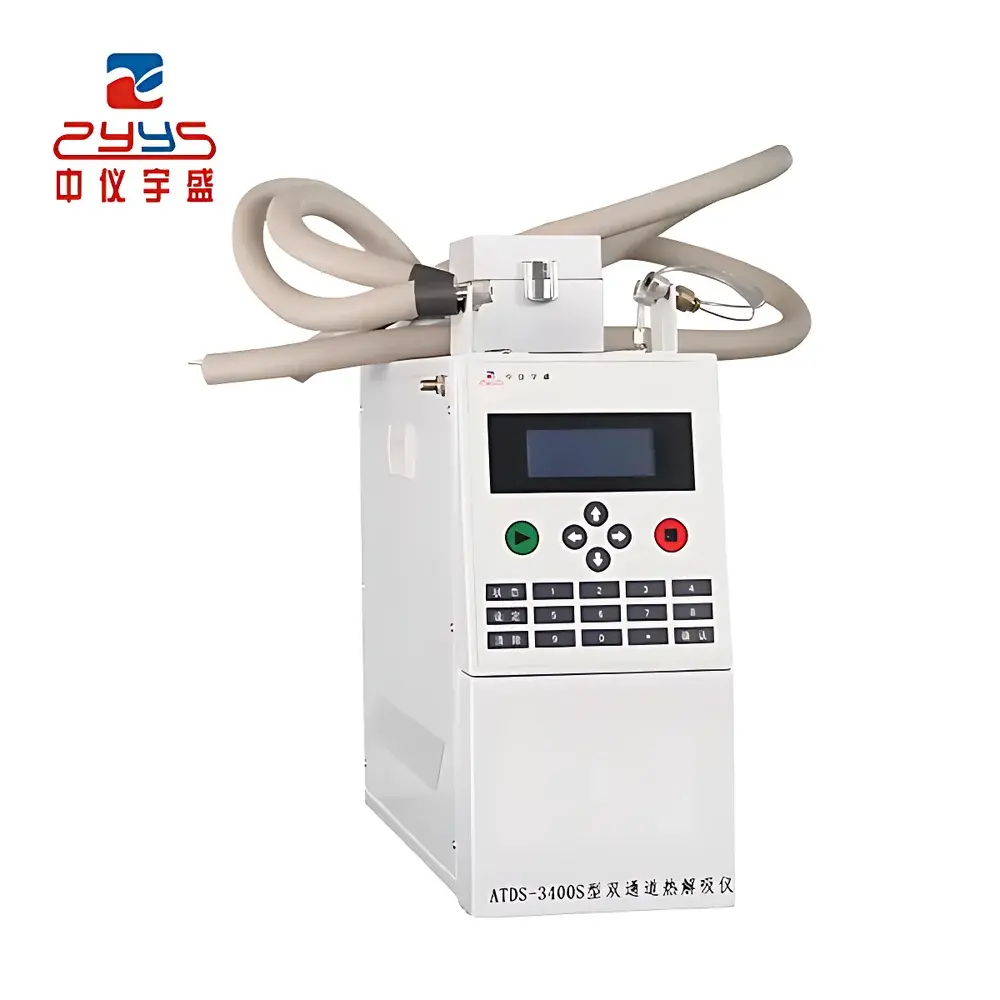
Zhongyi Yusheng ATDS-3400S Dual-Channel Thermal Desorber
| Brand | Zhongyi Yusheng |
|---|---|
| Origin | Beijing, China |
| Manufacturer Type | Direct Manufacturer |
| Instrument Type | Single-Stage Thermal Desorber |
| Automation Level | Semi-Automatic |
| Sample Positions | 2 |
| Compatible GC Interfaces | Universal (Split/Splitless Inlets) |
| Regulatory Compliance | Designed for GB 50325-2020, ASTM D6196, ISO 16017-1, USP <467> Class 2 Residual Solvents |
Overview
The Zhongyi Yusheng ATDS-3400S Dual-Channel Thermal Desorber is a semi-automated, single-stage thermal desorption system engineered for high-efficiency sample preparation prior to gas chromatographic analysis. It operates on the principle of controlled resistive heating of sorbent-packed tubes—typically Tenax TA, Carbopack B/C, or multi-bed configurations—to thermally release volatile and semi-volatile organic compounds (VOCs and SVOCs) quantitatively into the carrier gas stream. Unlike cryogenic or cold-trap-based systems, the ATDS-3400S employs direct tube heating with precise temperature ramping and hold profiles, enabling reproducible desorption across analyte volatility ranges from C2–C16 hydrocarbons to polar aldehydes and aromatic solvents. Its dual-channel architecture allows concurrent processing of two independent samples or synchronized operation with two GC inlets—either on a single instrument equipped with dual inlets or across two separate GC systems—thereby improving laboratory throughput without requiring additional hardware investment.
Key Features
- Dual independent thermal desorption channels with individual temperature control (desorption range: 50–400 °C; trap cooling optional via ambient air)
- Semi-automated workflow: programmable time-based sequence for desorption, transfer, GC injection, and post-run tube purging
- Integrated simulated sampling module for generating calibration standards directly on sorbent tubes—eliminating manual spiking and enhancing trace-level accuracy
- Universal carrier gas interface: supports He, N₂, or H₂ at standard GC inlet pressures (0–100 psi); no GC modification required
- Modular transfer line design: optional fused silica or deactivated quartz capillary tubing (0.53 mm ID) for enhanced recovery of reactive analytes (e.g., formaldehyde, acrolein)
- Quick-change injection needle assembly compatible with Agilent, Thermo Fisher, Shimadzu, and PerkinElmer GC inlets (split/splitless)
- Onboard timer-based event programming with up to 10 user-defined method steps per channel
Sample Compatibility & Compliance
The ATDS-3400S accommodates standard 6 mm OD × 89 mm length stainless steel or glass sorbent tubes, including commercial formats from Markes International, Supelco, and Restek. It supports both single-bed and multi-bed configurations for broad analyte coverage—from light VOCs (e.g., benzene, toluene) to heavier SVOCs (e.g., naphthalene, phenanthrene). The system is validated for compliance with Chinese national standard GB 50325-2020 (Indoor Air Quality Control for Civil Construction Projects), specifically Sections 6.7.1 (determination of benzene, toluene, xylene) and 6.7.2 (TVOC measurement using thermal desorption–GC–FID). Methodologically aligned with ASTM D6196-22 (Standard Practice for Selection of Sorbents, Sampling, and Thermal Desorption Analysis of Volatile Organic Compounds in Air), ISO 16017-1:2000 (Indoor, Ambient and Workplace Air — Sampling and Determination of Volatile Organic Compounds), and USP residual solvent testing protocols, the ATDS-3400S delivers data suitable for regulatory reporting and GLP-compliant laboratories.
Software & Data Management
The ATDS-3400S operates via front-panel membrane keypad with LCD display—no proprietary PC software required. All method parameters (desorption temp/time, transfer line temp, purge flow, GC trigger delay) are stored in non-volatile memory and recalled per channel. Event logs—including date/time stamps, setpoint deviations (<±1 °C), and operational status—are retained for audit trail purposes. While not FDA 21 CFR Part 11 compliant out-of-the-box due to lack of electronic signature capability, the system supports integration with LIMS or third-party chromatography data systems (CDS) via dry-contact TTL triggers and analog signal outputs (0–5 V), enabling full traceability when deployed within validated workflows under ISO/IEC 17025 or GMP environments.
Applications
- Indoor air quality monitoring per GB 50325-2020 and EPA TO-17 equivalents
- Occupational exposure assessment (NIOSH 1501, OSHA 51
- Rapid field screening of unknown airborne contaminants using portable GC–MS coupling
- Flavor & fragrance profiling in food, cosmetic, and tobacco products
- Forensic toxicology: detection of volatile metabolites (e.g., ethanol, acetone, chloroform) in breath or headspace samples
- Pharmaceutical packaging leachables testing (ICH Q3C, Q5C)
- VOC emissions profiling from automotive interior materials (SAE J1756, VDA 278)
- Chemical agent surveillance in perimeter monitoring systems for defense infrastructure
- Emergency response triage: real-time determination of safe re-entry thresholds following hazardous material incidents
FAQ
Can the ATDS-3400S be used with cryogenically cooled traps?
No—the ATDS-3400S is a single-stage thermal desorber and does not include cryofocusing capability. For analytes below C6 or highly polar compounds requiring cold trapping, a dedicated two-stage desorber is recommended.
Is method validation documentation available?
Yes—application notes and performance verification data (including breakthrough volume, desorption efficiency, and carryover tests per ASTM D6196 Annex A3) are provided upon request for IQ/OQ qualification support.
What maintenance is required for long-term reliability?
Routine maintenance includes quarterly inspection of O-rings, annual calibration of thermocouples against NIST-traceable references, and periodic replacement of quartz transfer lines after ~2000 cycles when analyzing reactive species.
Does it support automated tube conditioning?
Tube conditioning must be performed offline using a dedicated tube oven or GC injector; the ATDS-3400S does not incorporate integrated tube bake-out functionality.
Can both channels run different methods simultaneously?
Yes—each channel maintains independent temperature and timing profiles, allowing heterogeneous sample sets (e.g., environmental air + polymer headspace) to be processed in parallel without cross-contamination risk.
Related Products







