
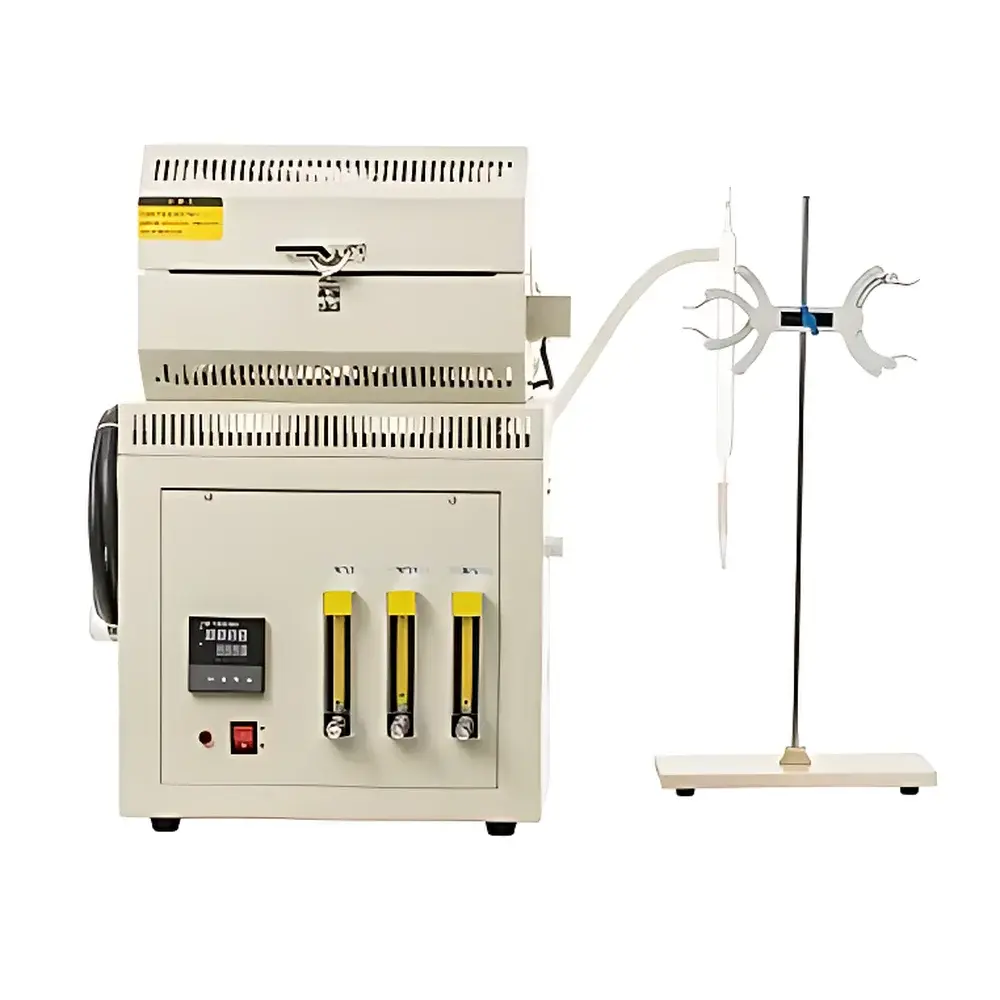
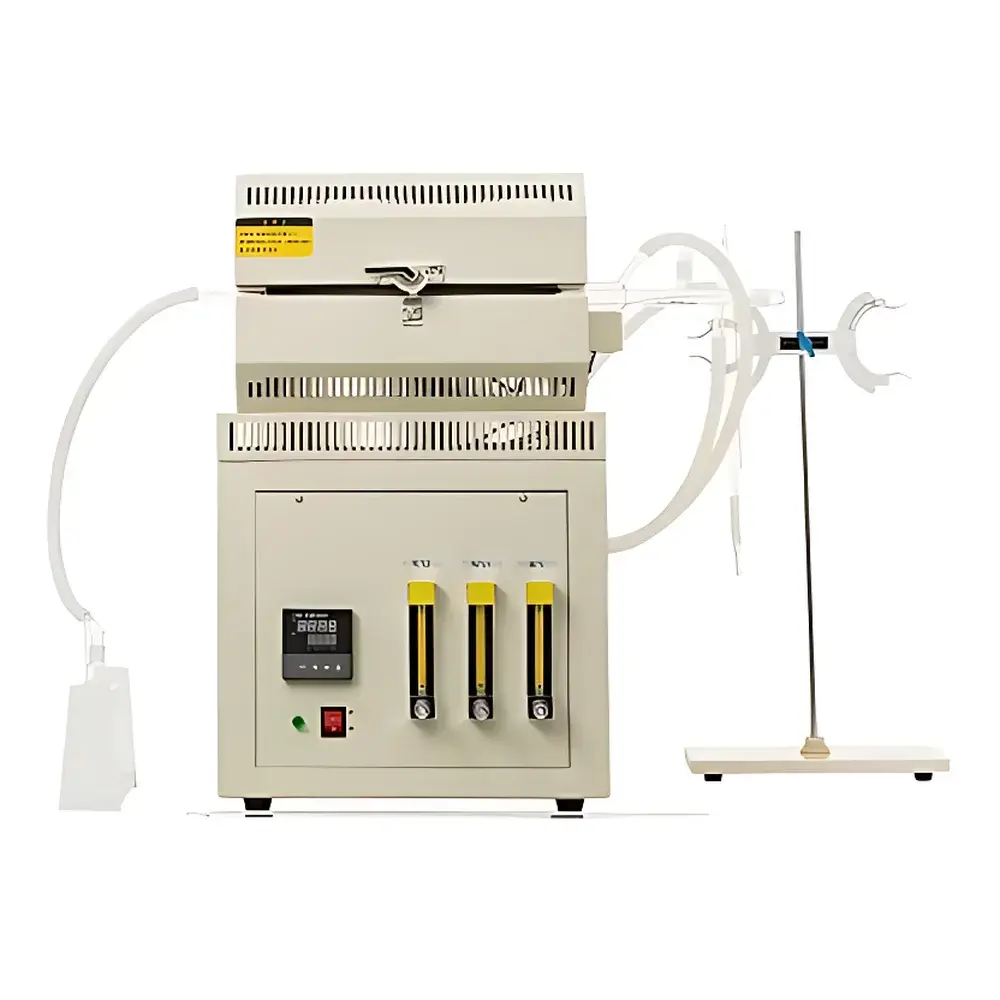
Zhuchi AOX-3 Adsorbable Organic Halogens (AOX) Combustion Analyzer
| [Brand | Zhuchi |
|---|---|
| Origin | Zhejiang, China |
| Model | AOX-3 |
| Detection Principle | High-Temperature Combustion Coupled with Coulometric Titration or Ion Chromatography |
| Detection Range | 0.8 µg/L – 1000 µg/L |
| Accuracy | ±1% |
| Repeatability | ≤1% RSD |
| Detection Limit | 0.8 µg/L |
| Resolution | 0.01 µg |
| Max Operating Temperature | 1150 °C |
| Temperature Stability | ±1 °C |
| Furnace Chamber Dimensions | Ø40 × 300 mm |
| Power Supply | 220 V, 50 Hz, 1.5 kW |
| Net Weight | 26 kg |
| Compliance | HJ/T 83–2001, ISO 9562:1989, GB/T 15959–1995, GB 8978–1996, GB 3544–2008] |
Overview
The Zhuchi AOX-3 Adsorbable Organic Halogens (AOX) Combustion Analyzer is a dedicated laboratory instrument engineered for the quantitative determination of adsorbable organic halogen compounds—including chlorine, bromine, and iodine—in environmental water and solid matrices. It operates on the internationally standardized high-temperature combustion–coulometric titration principle (per ISO 9562:1989 and GB/T 15959–1995) or combustion–ion chromatography method (per HJ/T 83–2001). In this process, organic halogens are first preconcentrated via activated carbon column adsorption under controlled nitrogen pressure, followed by complete thermal oxidation at up to 1150 °C in a purified oxygen atmosphere. The resulting halide ions (Cl⁻, Br⁻, I⁻) are absorbed into an alkaline solution and quantified either by microcoulometric titration or ion chromatography. This dual-method compatibility ensures flexibility across regulatory and methodological requirements while maintaining trace-level sensitivity and metrological traceability.
Key Features
- High-precision programmable temperature control system (LTDE PID + SSR), enabling ramp-rate adjustment from 1 °C/min to 50 °C/min and stable isothermal operation with ±1 °C uniformity
- Ceramic fiber furnace chamber (Ø40 × 300 mm) with embedded high-resistance heating elements and air-cooled metal housing—optimized for thermal efficiency, rapid cooldown, and extended service life
- Integrated wash-gas system with five dedicated scrubbing bottles and two absorption units, configured for removal of SO₂, NOₓ, and CO₂ prior to halide detection
- Modular nitrogen pressurization kit (dual adsorption columns, calibrated pressure lines, and fixation hardware) supporting reproducible sample loading per HJ/T 83–2001 protocol
- Openable furnace design with quartz push rod and dual sample boats—enabling real-time visual monitoring and direct liquid/solid sample introduction without transfer loss
- Low-voltage, high-efficiency heating architecture (220 V, 1.5 kW) rated for continuous 24-hour operation under GLP-compliant laboratory conditions
- Compliance-ready construction: all electrical components (solid-state relays, contactors, cooling fans) meet IEC 61000-6-3 EMC standards; thermal protection includes dual-stage overtemperature cutoff
Sample Compatibility & Compliance
The AOX-3 supports analysis of diverse environmental specimens—including drinking water, surface/groundwater, wastewater, effluents, seawater, pulp mill discharges, soils, sediments, sludges, and waste oils—following validated pretreatment protocols. Sample introduction accommodates both liquid (5–1000 mg as carbon mass) and solid matrices using standardized activated carbon cartridges or in-situ packed columns. All operational parameters align with statutory frameworks governing halogenated pollutant monitoring: HJ/T 83–2001 (China EPA), ISO 9562:1989 (International Organization for Standardization), GB/T 15959–1995 (Chinese National Standard), GB 8978–1996 (Comprehensive Wastewater Discharge Standard), and GB 3544–2008 (Wastewater Standards for Papermaking Industry). The system architecture permits full audit trail generation when paired with compliant data acquisition software, satisfying basic requirements for 21 CFR Part 11–aligned recordkeeping in regulated environments.
Software & Data Management
The AOX-3 operates as a standalone combustion module and does not include embedded firmware or proprietary software. However, it is fully compatible with third-party analytical platforms—including commercial ion chromatography systems (e.g., Thermo Fisher Dionex, Metrohm 940 Professional IC) and microcoulometric analyzers (e.g., Xylem TOC/TNb series)—via standard gas outlet tubing and absorption train interfaces. Optional PC-based control modules (sold separately) provide time-programmed temperature profiling, real-time thermocouple logging (K-type), and automated hold-step sequencing. Raw output data (absorbance peaks, coulombic charge integrals) are exported in CSV or ASCII format for post-processing in validated LIMS or statistical analysis packages. Instrument calibration verification follows documented procedures outlined in HJ/T 83–2001 Annex B and ISO 9562 Section 7, ensuring ongoing measurement integrity across batch runs.
Applications
- Regulatory compliance testing for AOX in municipal and industrial wastewater discharge permits
- Process monitoring in chlorinated disinfection byproduct (DBP) studies and pulp/paper bleaching effluent characterization
- Environmental fate assessment of halogenated pesticides, pharmaceuticals, and flame retardants in soil and sediment cores
- QA/QC validation of activated carbon treatment efficiency in potable water facilities
- Research-scale screening of emerging contaminants (e.g., per- and polyfluoroalkyl substances, PFAS precursors) where total organohalogen load serves as a surrogate metric
- Method development laboratories requiring modular, method-agnostic combustion infrastructure for coupling with novel detection schemes
FAQ
What detection methods does the AOX-3 support?
It is designed for use with either microcoulometric titration (per GB/T 15959–1995) or ion chromatography (per HJ/T 83–2001). The instrument itself performs only the combustion and absorption steps; final quantification requires connection to a compatible detector.
Is purified oxygen mandatory?
Yes. Oxygen purity ≥99.999% is strongly recommended to eliminate interference from combustion-derived acid gases and avoid additional scrubbing stages—ensuring optimal recovery and minimizing blank contributions.
Can the AOX-3 be used for non-aqueous samples like soils or sludges?
Yes. Solid samples must first undergo solvent extraction and carbon adsorption per HJ/T 83–2001 Section 6.3. The system’s nitrogen pressurization kit and high-temperature furnace enable robust handling of particulate-laden extracts.
What maintenance intervals are recommended for routine operation?
Quartz combustion tubes should be inspected after every 50 analyses; absorption bottles require daily replacement of NaOH solution; activated carbon columns must be validated for breakthrough prior to each batch. Full system calibration verification is advised every 100 runs or weekly—whichever occurs first.
Does the AOX-3 meet FDA or EU regulatory requirements for environmental testing?
While not certified under EU Directive 2000/60/EC or FDA guidance directly, its adherence to ISO 9562 and alignment with OECD Test Guideline 302B provides technical equivalence for international regulatory submissions where AOX is a designated parameter.







