
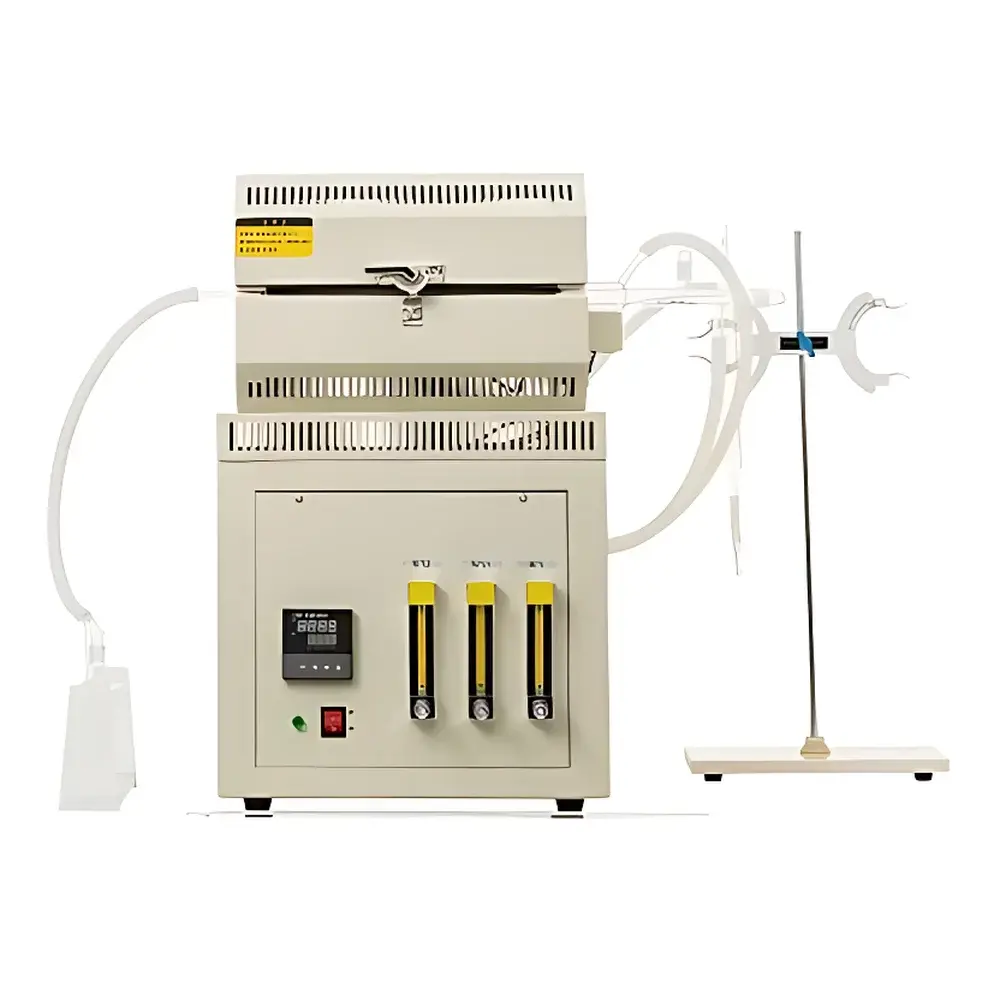
Zhuchi AOX-3 Adsorbable Organic Halogens (AOX) Combustion Furnace with Coulometric Detection
| Key | Principle: High-Temperature Combustion + Microcoulometric Titration |
|---|---|
| Range | 0.8–1000 µg/L |
| Accuracy | ±1% |
| Repeatability | ≤1% |
| LOD | 0.8 µg/L |
| Resolution | 0.01 µg |
| Max Temp | 1150 °C |
| Temp Stability | ±1 °C |
| Furnace Zone | 200 mm |
| Power | 1.5 kW, 220 V/50 Hz |
| Dimensions | 345×360×660 mm |
| Weight | 26 kg |
| Compliance | HJ/T 83–2001, ISO 9562:1989, GB/T 15959–1995 |
Overview
The Zhuchi AOX-3 Adsorbable Organic Halogens (AOX) Combustion Furnace is a dedicated high-temperature thermal oxidation system engineered for the quantitative determination of adsorbable organic halogens in environmental matrices. It operates on the internationally standardized combustion–microcoulometric titration principle: organic halogen compounds are first pre-concentrated onto activated carbon via column adsorption under nitrogen pressure, then thermally decomposed at up to 1150 °C in an oxygen-rich atmosphere. The resulting hydrogen halides (HX) are absorbed into an electrolyte solution and quantified via microcoulometric detection—providing trace-level sensitivity and high analytical reproducibility. Designed specifically for compliance with HJ/T 83–2001, ISO 9562:1989, and GB/T 15959–1995, the AOX-3 serves as the core thermal unit in complete AOX analysis workflows, interfacing seamlessly with external microcoulometers or ion chromatographs for final quantification.
Key Features
- Programmable high-temperature furnace with LTDE PID-controlled heating, enabling precise ramp/soak profiles (0–50 °C/min adjustable) and stable isothermal operation at ±1 °C accuracy.
- Ceramic fiber insulation chamber (φ40 × 300 mm) with dual semi-cylindrical structure, embedded high-resistance heating wire, and air-cooled metallic housing—ensuring rapid heat-up (<10 min to 1000 °C), energy efficiency, and thermal durability.
- Modular, openable furnace design permitting real-time visual monitoring of sample combustion and immediate access for maintenance or tube replacement.
- Integrated gas management architecture: dual oxygen inlet ports (inner/outer tube), nitrogen pressurization interface for adsorption columns, and optimized exhaust routing to absorption traps.
- Robust electrical architecture featuring branded solid-state relays, contactors, and K-type thermocouples with cold-junction compensation—validated for continuous 24/7 operation under laboratory QA/QC conditions.
- Low-voltage (220 V), 1.5 kW power configuration with dual-stage over-temperature protection (mechanical + electronic), meeting IEC 61010-1 safety requirements for Class II laboratory equipment.
Sample Compatibility & Compliance
The AOX-3 supports both liquid and solid environmental samples—including drinking water, surface/groundwater, wastewater, industrial effluents, seawater, pulp mill discharges, soils, sediments, sludges, and waste oils. Sample introduction is performed via standardized activated carbon column adsorption (per HJ/T 83–2001), followed by direct transfer of the loaded carbon into the quartz sample boat. The system accommodates sample masses from 5 to 1000 mg, ensuring flexibility across low- and high-concentration matrices. All operational parameters—including combustion temperature, gas flow rates, and adsorption duration—are fully configurable to meet method-specific requirements under ISO 9562, GB/T 15959, GB 8978–1996, and GB 3544–2008. Documentation includes full traceability to Chinese EPA standard protocols and alignment with GLP-aligned laboratory practice frameworks.
Software & Data Management
The AOX-3 operates as a hardware platform requiring external instrumentation for data acquisition and reporting. When paired with a compliant microcoulometer or ion chromatograph, it enables full audit-trail capability per FDA 21 CFR Part 11 (when configured with appropriate software). Optional PC-based control modules provide programmable temperature sequencing, real-time thermal profiling, event logging, and CSV export of run metadata—including start/stop timestamps, setpoint deviations, and fault codes. All firmware and calibration records adhere to ISO/IEC 17025 documentation standards, supporting laboratory accreditation audits for environmental testing laboratories (e.g., CNAS, UKAS, or A2LA).
Applications
- Regulatory monitoring of AOX in municipal and industrial wastewater discharges per national discharge permits.
- Compliance testing for pulp and paper manufacturing facilities subject to ECF/TCF bleaching process controls.
- Environmental impact assessment of chlorinated pesticide residues in groundwater and soil leachates.
- QA/QC verification of activated carbon treatment efficiency in drinking water plants.
- Research-scale investigation of halogenated disinfection by-products (DBPs) formation kinetics in simulated distribution systems.
- Validation of advanced oxidation processes (AOPs) targeting persistent organohalogen pollutants.
FAQ
What detection methods is the AOX-3 compatible with?
The AOX-3 is designed for use with either microcoulometric titration (per GB/T 15959–1995) or ion chromatography (per HJ/T 83–2001); users must supply the respective detector instrument.
Is purified oxygen required for optimal performance?
Yes—use of ≥99.999% pure oxygen eliminates the need for auxiliary gas scrubbing and improves halogen recovery reproducibility; technical grade (99.6%) O₂ may be used with optional inline purification.
Can the furnace be operated unattended overnight?
Yes—the dual over-temperature protection, programmable soak timers, and robust thermal insulation support validated 24-hour continuous operation in accredited labs.
What consumables must be sourced separately?
Users must supply analytical-grade activated carbon (or pre-packed adsorption columns), quartz combustion tubes, electrolyte solutions for coulometric cells, and certified reference materials for calibration verification.
Does the system include validation documentation?
Yes—factory calibration certificates, temperature uniformity mapping reports, and compliance statements against HJ/T 83–2001 and ISO 9562 are provided with each unit, along with SOP templates aligned with GLP principles.







