
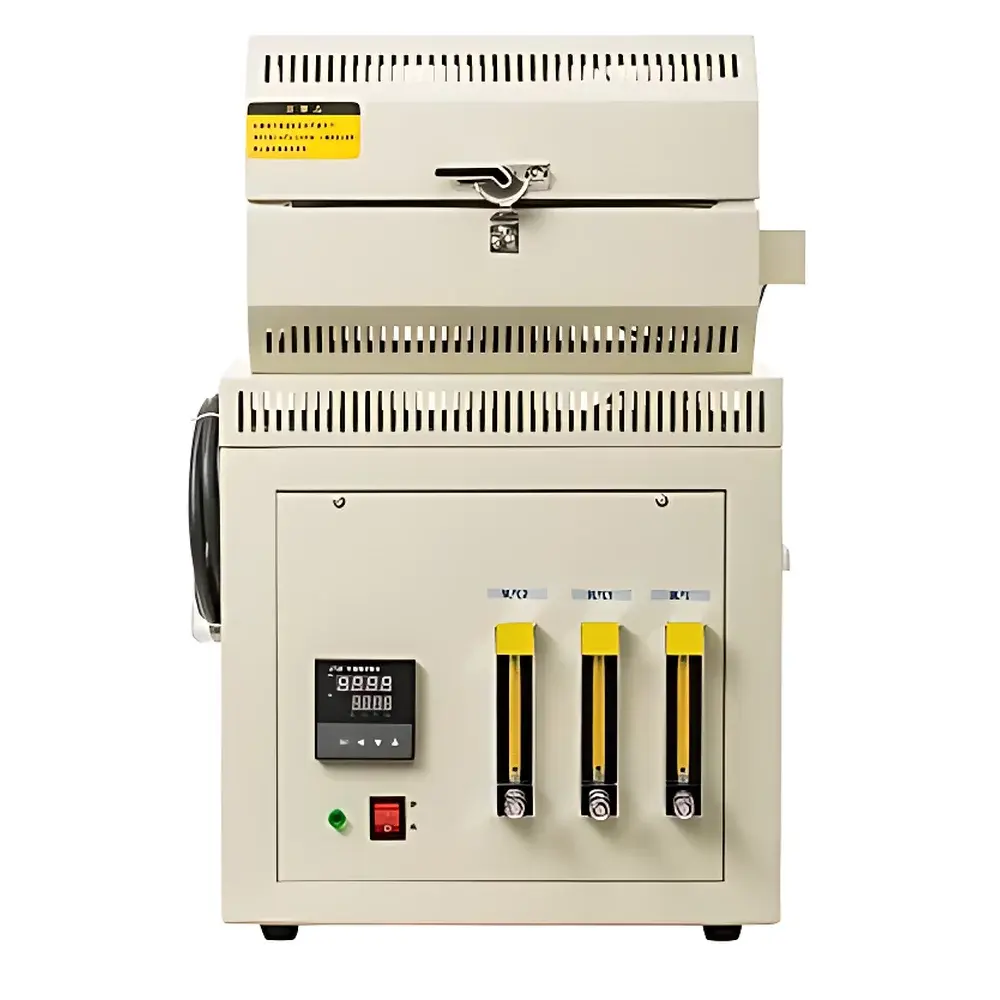
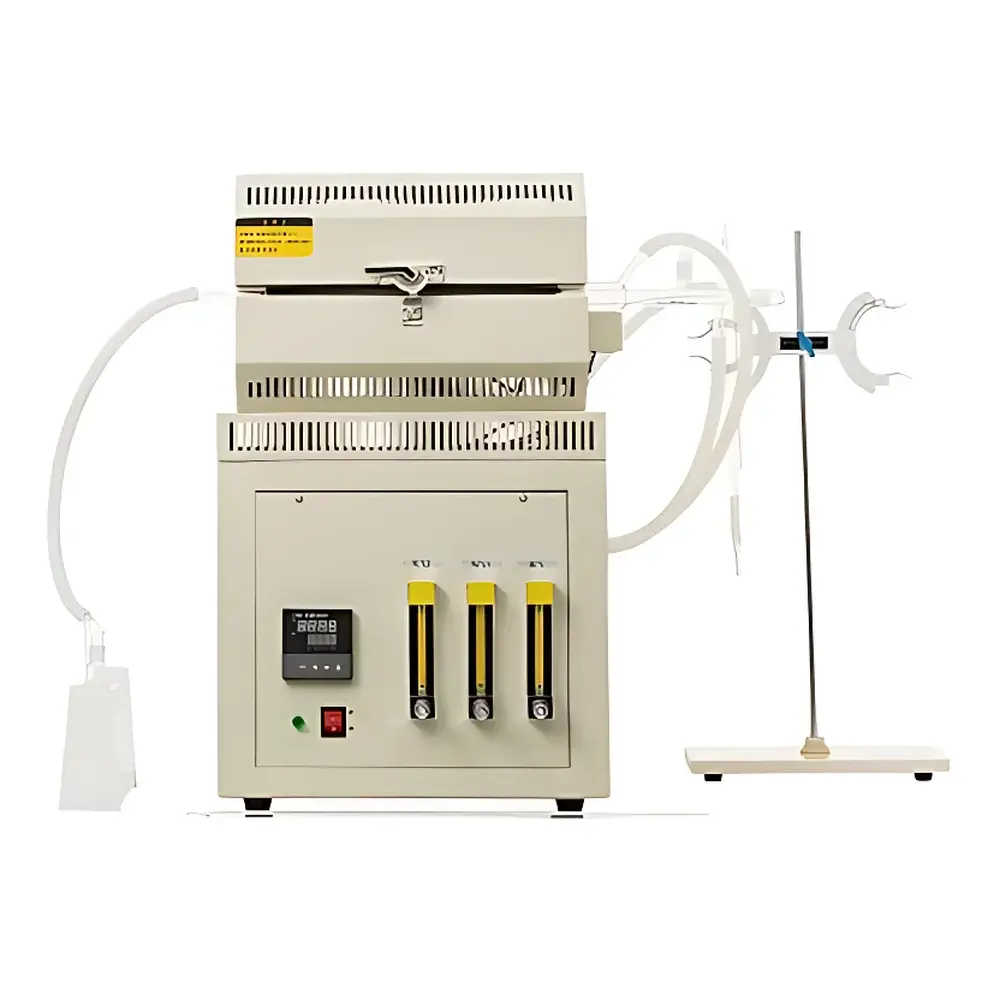
Zhuochi AOX-3 Adsorbable Organic Halogens (AOX) Analyzer
| Brand | Zhuochi |
|---|---|
| Origin | Zhejiang, China |
| Model | AOX-3 |
| Detection Principle | High-Temperature Combustion–Microcoulometric Titration |
| Measurement Range | 0.8–1000 µg/L |
| Accuracy | ±1% |
| Repeatability | ≤1% RSD |
| Detection Limit | 0.8 µg/L |
| Resolution | 0.01 µg |
| Combustion Temperature | Up to 1150 °C |
| Furnace Temperature Stability | ±1 °C |
| Heating Rate | Adjustable up to 50 °C/min |
| Furnace Chamber Dimensions | Ø40 × 300 mm |
| Power Supply | 220 V, 50 Hz, 1.5 kW |
| Net Weight | 26 kg |
| Compliance | HJ/T 83–2001, ISO 9562:1989, GB/T 15959–1995, GB 8978–1996, GB 3544–2008 |
Overview
The Zhuochi AOX-3 Adsorbable Organic Halogens (AOX) Analyzer is a dedicated high-temperature combustion system engineered for the quantitative determination of adsorbable organic halogen compounds—including chlorine, bromine, and iodine—in environmental water and solid matrices. It operates on the internationally validated principle of adsorption–combustion–microcoulometric detection: organic halogens are first concentrated onto activated carbon (via column adsorption under nitrogen pressure), then thermally decomposed at precisely controlled temperatures up to 1150 °C in an oxygen-rich atmosphere. The resulting halide ions (X−) are absorbed into an aqueous solution and quantified using either microcoulometric titration or ion chromatography—both methods fully compliant with ISO 9562:1989 and HJ/T 83–2001. Unlike standalone spectrometric or electrochemical analyzers, the AOX-3 is not a complete “black-box” instrument; rather, it functions as a standardized, modular combustion interface designed to integrate seamlessly with certified downstream detection platforms (e.g., ASTM D5907-compliant microcoulometers or EPA Method 515.3-compatible ion chromatographs). Its architecture reflects decades of method validation in regulatory environmental laboratories, where reproducibility, trace-level sensitivity, and operational robustness under continuous-shift conditions are non-negotiable requirements.
Key Features
- Programmable high-temperature furnace with PID-controlled LTDE automation, enabling precise ramp/soak profiles (adjustable heating rate: 1–50 °C/min; stability: ±1 °C)
- Ceramic fiber insulation chamber (Ø40 × 300 mm) with dual-zone resistive heating elements, optimized for thermal uniformity and rapid cooldown via hinged front access
- Integrated gas management system supporting regulated O2 (≥99.999% purity recommended) and N2 delivery for adsorption pressurization and carrier flow
- Dual-stage overtemperature protection (mechanical + electronic) and SSR-driven power regulation for GMP-aligned operational safety
- Modular accessory kit including quartz sample boats, custom AOX combustion tubes, absorption traps, and calibrated gas tubing sets—designed to minimize memory effects and cross-contamination
- Compact footprint (345 × 360 × 660 mm) and low-voltage operation (220 V, 1.5 kW), suitable for benchtop deployment in ISO/IEC 17025-accredited labs
Sample Compatibility & Compliance
The AOX-3 supports analysis of diverse environmental matrices per established regulatory protocols: drinking water, surface water, groundwater, wastewater, effluents, saline samples, pulp mill discharges, soils, sediments, sludges, and waste oils. Sample introduction employs standardized column adsorption (per HJ/T 83–2001 Section 6.2), with optional ultrasonic-assisted adsorption enhancement to improve activated carbon recovery efficiency (>95% typical). All hardware components—including combustion tubes, absorption vessels, and gas lines—are chemically inert (quartz, borosilicate glass, PTFE) to prevent halogen loss or artifact formation. The system meets full technical alignment with ISO 9562:1989 (Water quality — Determination of adsorbable organohalogens (AOX) — Microcoulometric method), GB/T 15959–1995, and supplementary Chinese discharge standards (GB 8978–1996, GB 3544–2008). While the AOX-3 itself does not generate final concentration reports, its combustion output is fully compatible with instruments subject to FDA 21 CFR Part 11 audit trails when paired with validated chromatographic or coulometric detectors.
Software & Data Management
The AOX-3 operates as a hardware platform without embedded data acquisition software. Temperature programming, ramp/hold sequences, and real-time thermal monitoring are managed via its integrated LTDE controller (display resolution: 1 °C; programmable time steps: 1 s to 99 h 59 min). For full GLP/GMP traceability, users must pair the system with third-party analytical instrumentation equipped with compliant data handling—such as ion chromatographs with electronic audit trails or microcoulometers meeting ASTM D5907 calibration verification requirements. Zhuochi provides detailed SOP documentation—including method transfer templates, calibration checklists, and blank correction workflows—aligned with ISO/IEC 17025 clause 7.7 (Ensuring validity of results). Optional remote diagnostics support enables secure firmware updates and parameter validation logs exportable in CSV format for laboratory information management systems (LIMS).
Applications
- Regulatory compliance testing for municipal and industrial wastewater dischargers under national emission permits
- Process monitoring in pulp and paper manufacturing, pharmaceutical synthesis, and chlorinated solvent production facilities
- Environmental impact assessments requiring AOX profiling of sediment cores or leachates from landfill sites
- Research-grade speciation studies coupling AOX-3 combustion with hyphenated techniques (e.g., IC-MS for halogen-specific fingerprinting)
- Method validation and interlaboratory comparison exercises coordinated by national metrology institutes
FAQ
Does the AOX-3 include a built-in detector?
No. The AOX-3 is a combustion module only. Quantification requires external instrumentation—either a microcoulometer (per GB/T 15959–1995) or an ion chromatograph (per HJ/T 83–2001).
What gas purity is required for optimal performance?
Oxygen ≥99.999% is strongly recommended to eliminate interference from CO2 and moisture, thereby avoiding post-combustion scrubbing steps and improving detection limit consistency.
Can the system handle solid samples directly?
Yes—soils, sludges, and sediments may be analyzed after Soxhlet extraction or alkaline digestion, followed by standard adsorption on activated carbon per ISO 9562 Annex B.
Is the furnace compatible with ASTM D5907?
The thermal profile, adsorption protocol, and detection interface fully satisfy ASTM D5907’s instrumental requirements when used with a certified microcoulometric detector.
What maintenance intervals are recommended for routine operation?
Quartz combustion tubes should be inspected after every 50 runs; absorption traps require replacement after each batch of 10 samples; furnace insulation integrity should be verified annually via thermal mapping per ISO/IEC 17025 clause 6.4.3.







