
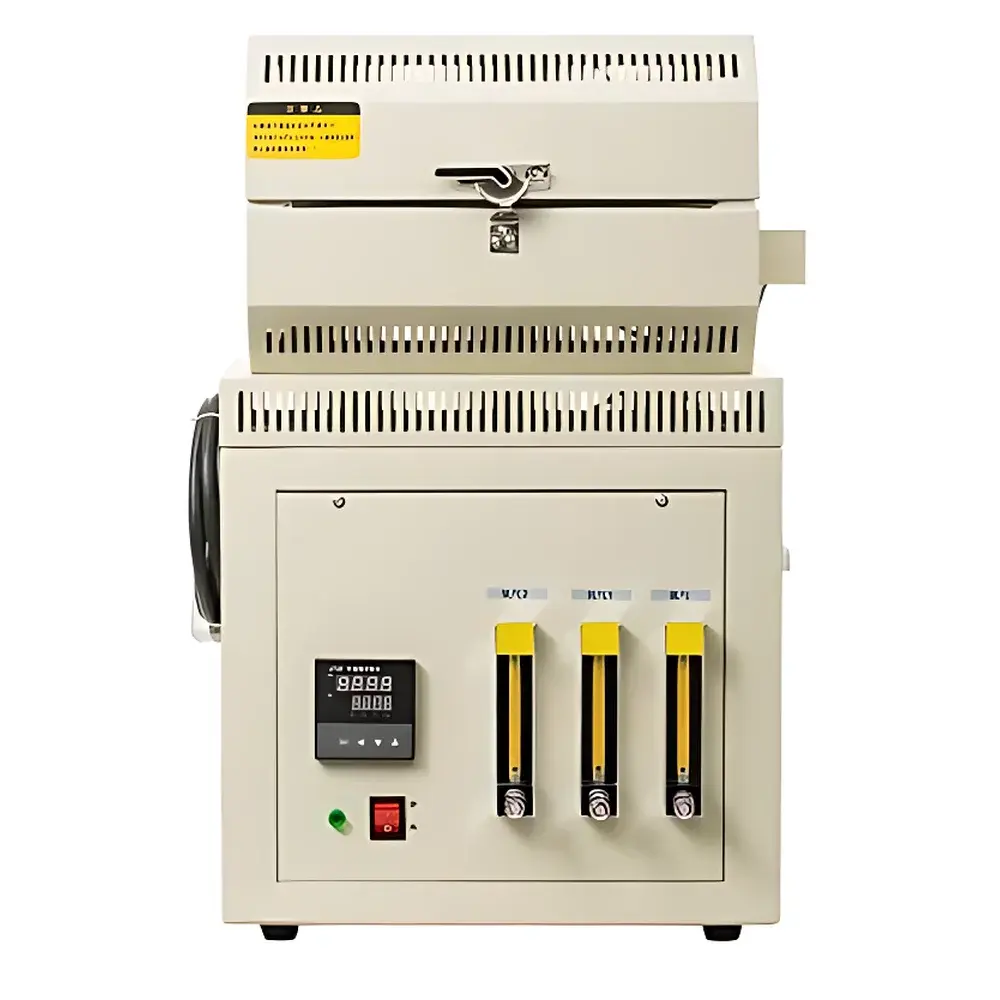
Zhuochi AOX-3 Halogen Analyzer (Combustion-Coulometric System)
| Brand | Zhuochi |
|---|---|
| Origin | Zhejiang, China |
| Model | AOX-3 |
| Detection Principle | High-Temperature Combustion Coupled with Microcoulometric Titration |
| Detection Range | 0.8–1000 µg/L |
| Accuracy | ±1% |
| Repeatability | ≤1% RSD |
| LOD | 0.8 µg/L |
| Resolution | 0.01 µg |
| Max Combustion Temperature | 1150 °C |
| Furnace Temp Control Stability | ±1 °C |
| Heating Rate | Adjustable up to 50 °C/min |
| Furnace Chamber | φ40 × 300 mm |
| Power Supply | 220 V, 50 Hz, 1.5 kW |
| Net Weight | 26 kg |
| Dimensions (W×D×H) | 345 × 360 × 660 mm |
Overview
The Zhuochi AOX-3 Halogen Analyzer is a dedicated high-temperature combustion system engineered for the quantitative determination of Adsorbable Organic Halogens (AOX) in environmental water and solid matrices. It operates on the internationally recognized combustion–microcoulometric titration principle: samples—pre-concentrated via activated carbon adsorption—are combusted at temperatures up to 1150 °C in an oxygen-rich atmosphere, converting all organic halogens (Cl, Br, I) into hydrogen halides (HX). These gaseous species are subsequently absorbed in an alkaline solution and quantified using a microcoulometric detector, delivering trace-level sensitivity and metrological traceability. Designed explicitly to comply with HJ/T 83–2001 (China), ISO 9562:1989, and GB/T 15959–1995, the AOX-3 serves as the core combustion module in standardized AOX workflows—intended for integration with either ion chromatography (IC) or microcoulometric detection systems. Its robust ceramic-fiber furnace architecture, programmable PID temperature control, and air-cooled thermal design ensure stable, reproducible combustion performance over extended duty cycles—including continuous 24-hour operation typical in high-throughput environmental testing laboratories.
Key Features
- High-precision programmable temperature controller (LTDE series) with PID + SSR regulation, enabling ramp/soak profiles and ±1 °C thermal stability across the full 100–1150 °C range
- Ceramic fiber composite furnace chamber with embedded high-resistance heating wire—low thermal mass, rapid heat-up (<10 min to operating temperature), and rapid cool-down via hinged opening design
- Dual-stage over-temperature protection: primary digital limit + secondary independent mechanical cutoff for operational safety and GLP-compliant instrument integrity
- Modular gas-handling architecture: optimized for 99.999% pure O2 supply; includes integrated wash-gas train (5 scrubbers), dual absorption bottles/tubes, and calibrated flow paths for quantitative HX capture
- Sample introduction flexibility: supports both nitrogen-pressure-driven column adsorption (per HJ/T 83–2001) and optional ultrasonic-assisted adsorption for enhanced activated carbon recovery efficiency
- Compact footprint (345 × 360 × 660 mm) and low-voltage (220 V) operation—designed for benchtop deployment without auxiliary cooling or exhaust ducting
Sample Compatibility & Compliance
The AOX-3 accommodates aqueous and solid-phase environmental specimens—including drinking water, surface water, groundwater, wastewater, effluent, seawater, pulp mill discharges, soils, sediments, sludges, and waste oils—following standardized pre-treatment per HJ/T 83–2001. Sample loading occurs via quartz boats or custom carriers compatible with standard AOX combustion tubes. All structural and functional specifications align with regulatory method requirements: ISO 9562:1989 (Water quality — Determination of adsorbable organic halogens (AOX) — Microcoulometric method), GB/T 15959–1995, and supplementary Chinese standards GB 8978–1996 (Integrated Wastewater Discharge Standard) and GB 3544–2008 (Standards for Wastewater from the Papermaking Industry). The system’s design enables full auditability under GLP and GMP frameworks, supporting 21 CFR Part 11–ready data acquisition when paired with compliant IC or coulometric detection hardware.
Software & Data Management
While the AOX-3 furnace itself operates as a standalone hardware module with analog temperature feedback and manual gas-flow control, it is fully compatible with third-party data acquisition systems. Optional PC-based control software (sold separately) provides real-time temperature logging, programmable combustion cycles, and timestamped event tracking—enabling full traceability for QA/QC documentation. When interfaced with a microcoulometer or ion chromatograph equipped with FDA 21 CFR Part 11–compliant software (e.g., Thermo Chromeleon, Metrohm MagIC Net), the complete analytical chain supports electronic signatures, audit trails, and secure user access controls required for accredited environmental testing laboratories.
Applications
- Regulatory compliance monitoring for AOX in municipal and industrial wastewater discharges
- Drinking water safety assessment in source-to-tap surveillance programs
- Environmental impact evaluation of chlorinated disinfection by-products (DBPs)
- Process validation in pulp & paper, pharmaceutical, and chemical manufacturing facilities
- Research-grade quantification of halogenated persistent organic pollutants (POPs) in sediment cores and biota tissues
- Method validation studies supporting ISO/IEC 17025 accreditation for environmental testing laboratories
FAQ
What detection methods is the AOX-3 compatible with?
The AOX-3 is designed for use with microcoulometric titration (per GB/T 15959–1995) or ion chromatography (per HJ/T 83–2001); users must supply the respective detector (coulometer or IC system) separately.
Does the system include activated carbon or sample preparation consumables?
No—activated carbon (analytical grade) and disposable sampling syringes are user-supplied per method requirements; the instrument includes two quartz sample boats, one quartz push rod, and all necessary gas tubing and absorption components.
Can the AOX-3 operate continuously for 24 hours?
Yes—the furnace’s thermal design, redundant safety circuitry, and air-cooling architecture support unattended, extended-duration operation typical of high-volume environmental labs.
Is nitrogen pressure required for sample adsorption?
HJ/T 83–2001 specifies nitrogen-pressure-driven column adsorption; however, the system also supports ultrasonic-assisted adsorption as a validated alternative to improve carbon recovery and reduce procedural variability.
What calibration and verification standards are recommended?
Certified reference materials such as potassium bromide (KBr) or sodium chloride (NaCl) solutions—traceable to NIST or equivalent national metrology institutes—are used for daily system suitability checks and calibration verification per ISO/IEC 17025 guidelines.







