
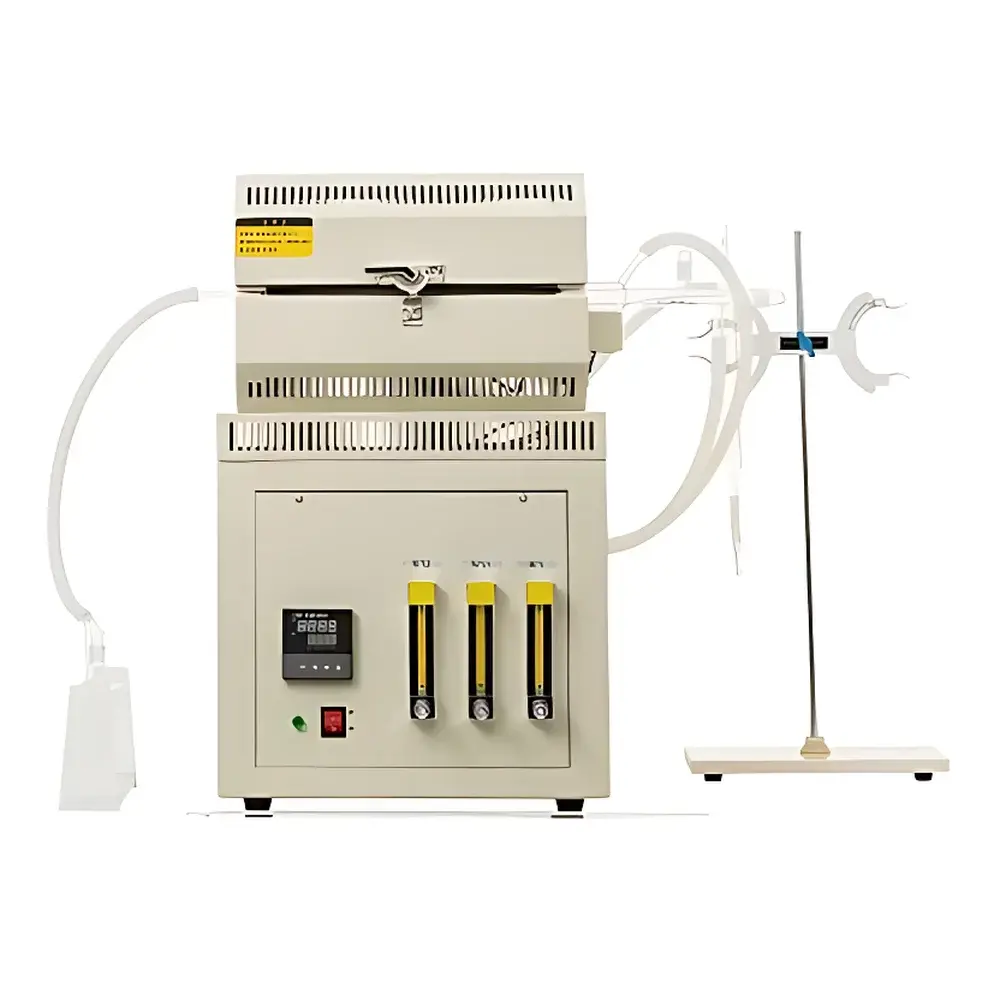
Zhuochi AOX-3 Integrated Organic Halogen Combustion Furnace for Adsorbable Organic Halides (AOX) Analysis
| Brand | Zhuochi |
|---|---|
| Origin | Zhejiang, China |
| Manufacturer Type | Authorized Distributor |
| Country of Origin | China |
| Model | AOX-3 |
| Price | USD 3,950 (FOB) |
| Detection Principle | High-Temperature Combustion Coupled with Microcoulometric Titration or Ion Chromatography |
| Detection Range | 0.8–1000 µg/L (as Cl⁻ equivalent) |
| Accuracy | ±1% |
| Repeatability (RSD) | ≤1% |
| Detection Limit | 0.8 µg/L |
| Resolution | 0.01 µg |
| Max Combustion Temperature | 1150 °C |
| Temperature Control Stability | ±1 °C |
| Heating Rate | Adjustable up to 50 °C/min |
| Furnace Chamber Dimensions | Ø40 × 300 mm |
| Power Supply | 220 V, 50 Hz, 1.5 kW |
| Net Weight | 26 kg |
Overview
The Zhuochi AOX-3 Integrated Organic Halogen Combustion Furnace is a purpose-built thermal oxidation system engineered for the quantitative determination of Adsorbable Organic Halides (AOX) in environmental water and solid matrices. It operates on the principle of high-temperature catalytic combustion (up to 1150 °C) followed by halogen capture in an alkaline absorption solution, enabling downstream quantification via microcoulometric titration or ion chromatography. Designed in strict compliance with internationally recognized standard methods—including ISO 9562:1989, GB/T 15959–1995, and HJ/T 83–2001—the AOX-3 serves as the core thermal module in standardized AOX workflows. Its robust ceramic fiber insulation, dual-zone resistive heating architecture, and programmable LTDE PID controller ensure precise, reproducible thermal profiles across extended operational cycles. Unlike standalone ovens, the AOX-3 integrates a built-in gas washing system, optimized sample introduction geometry, and modular absorption train compatibility—enabling seamless interfacing with commercial microcoulometers or IC systems without third-party adapters.
Key Features
- Programmable temperature control system (LTDE + PID + SSR) with ramp/soak capability, ±1 °C stability, and dual-stage overtemperature protection
- Ceramic fiber furnace chamber (Ø40 × 300 mm) with embedded high-resistance heating elements and air-cooled metallic housing for thermal efficiency and safety
- Modular gas handling configuration: dual oxygen inlets (inner/outer tube), nitrogen pressurization port for column adsorption, and integrated gas-washing bottle set (5 units)
- Dedicated AOX combustion tube and quartz sample boats designed for direct liquid/solid injection and high charcoal recovery (>95% typical under HJ/T 83–2001 conditions)
- Compact footprint (345 × 360 × 660 mm) and rapid thermal cycling (<10 min startup; ≤50 °C/min adjustable ramp rate)
- 24/7 continuous operation capability validated under GLP-aligned laboratory conditions; rated for >10,000 cycles at 1100 °C
- Compliance-ready mechanical design: accessible furnace chamber for real-time visual monitoring, sealed electrical compartment, and corrosion-resistant phosphated steel enclosure
Sample Compatibility & Compliance
The AOX-3 supports analysis of diverse environmental samples per regulatory method requirements: drinking water, surface water, groundwater, wastewater, industrial effluents, seawater, pulp mill discharges, soils, sediments, sludges, and used cooking oils. Sample preparation follows the column adsorption protocol specified in HJ/T 83–2001—using activated carbon (user-supplied) under controlled nitrogen pressure (0.1–0.3 MPa). Solid samples are homogenized and acidified prior to adsorption. All hardware components—including quartz push rods, rubber end caps, silicone tubing (15 mm OD), absorption tubes, and fixation stands—are dimensionally and chemically matched to ISO 9562 and GB/T 15959 specifications. The system meets structural and procedural prerequisites for audits under ISO/IEC 17025, EPA Method 1650 (modified), and EU Directive 2013/39/EU for priority hazardous substances. Documentation includes full traceability of materials, calibration certificate templates, and method validation checklists aligned with CNAS-CL01:2018.
Software & Data Management
While the AOX-3 furnace itself is hardware-controlled, optional PC-based software (sold separately) provides automated temperature profiling, run logging, and digital audit trails compliant with FDA 21 CFR Part 11 Annex 11 requirements. The interface records timestamped setpoints, actual temperatures, gas flow durations, and operator IDs—exportable in CSV or PDF for QA review. When coupled with a microcoulometer (e.g., Multi X 2000 series) or IC system (e.g., Thermo Scientific Dionex ICS-5000+), raw halide signal data can be imported for integrated peak integration, calibration curve generation (linear/range-weighted), and uncertainty propagation per GUM (JCGM 100:2008). All firmware updates are delivered via secure USB key with version-controlled release notes and change impact assessments.
Applications
The AOX-3 is deployed in municipal water quality labs, industrial environmental compliance units, contract testing laboratories (CTLs), and academic research facilities focused on halogenated pollutant fate and transport. Typical use cases include: monitoring AOX formation during chlorine disinfection of drinking water; assessing organohalogen load in pharmaceutical and pesticide manufacturing effluents; evaluating adsorption efficiency of activated carbon filters in advanced treatment trains; supporting REACH registration dossiers for halogen-containing substances; and conducting comparative studies on AOX removal kinetics in constructed wetlands or ozonation systems. Its adaptability to both microcoulometric and ion chromatographic detection modes allows method flexibility without hardware modification—reducing cross-method validation burden.
FAQ
Does the AOX-3 require external gas purification when using 99.999% pure oxygen?
No. With ultra-high-purity oxygen (≥99.999%), pre-combustion gas washing is unnecessary. The integrated wash bottles may be bypassed, simplifying setup and reducing carryover risk.
Can the AOX-3 accommodate solid samples without prior digestion?
Yes. Per HJ/T 83–2001, solids are suspended in deionized water, acidified to pH ≤2, and passed through the activated carbon column under nitrogen pressure. No microwave or acid digestion is required.
Is the furnace compatible with third-party microcoulometers?
Yes. The absorption train output (NaOH trap effluent) interfaces directly with any microcoulometric detector accepting aqueous halide solutions—no proprietary couplers needed.
What maintenance intervals are recommended for sustained accuracy?
Quartz combustion tubes should be inspected after every 200 runs; replace if discoloration or microfractures appear. Ceramic fiber insulation requires no routine replacement but must be visually checked quarterly for compression or cracking.
Does the system support unattended overnight operation?
Yes. The dual overtemperature cutoffs, automatic cooldown sequencing, and non-volatile memory retention enable safe 16-hour unattended batch runs—validated in multiple ISO 17025-accredited labs.







