
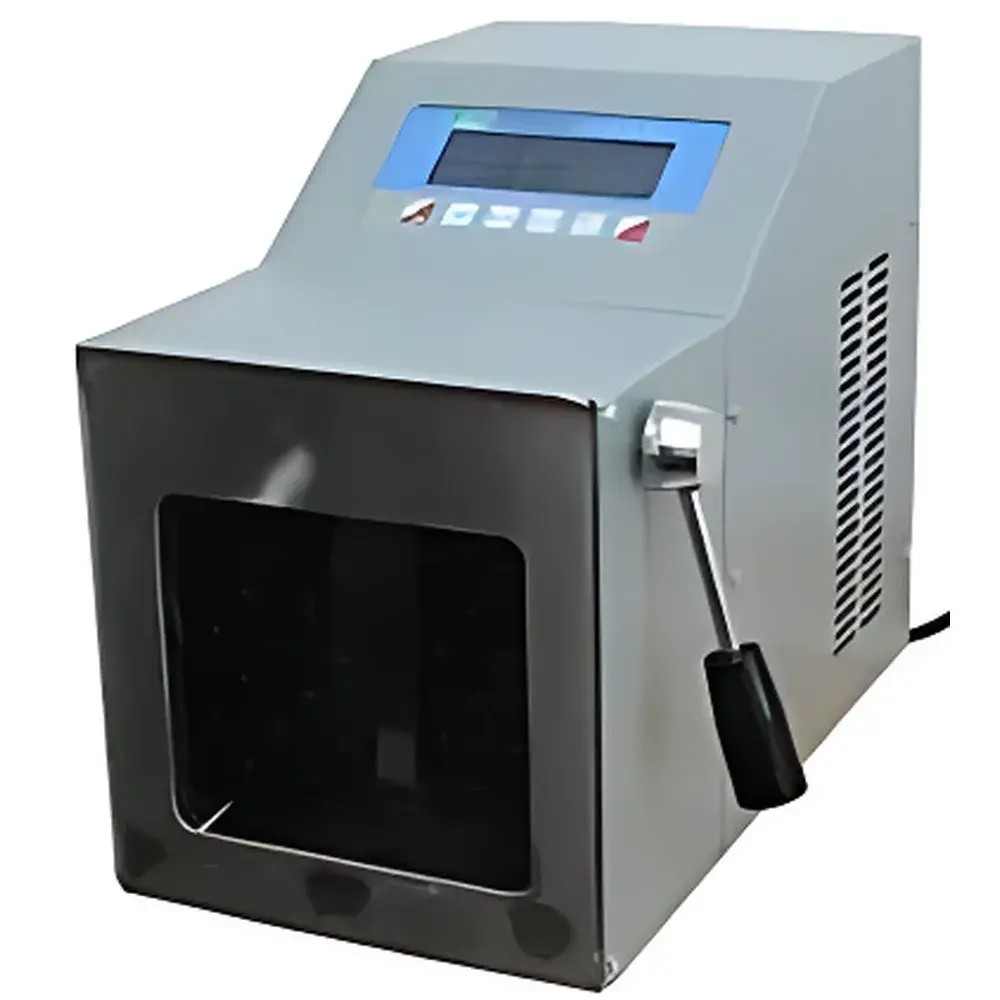
ZiQi ZBM-400A / ZBM-400B / ZBM-400C Stomacher-Type Aseptic Homogenizer
| Brand | ZiQi |
|---|---|
| Origin | Shanghai, China |
| Manufacturer Type | Direct Manufacturer |
| Country of Origin | China |
| Model | ZBM-400A / ZBM-400B / ZBM-400C |
| Instrument Type | Stomacher-type (Pulsed Impact) |
| Dimensions (W×D×H) | 420 × 245 × 340 mm |
| Sample Volume Range | 3–400 mL |
| Display | 4.3-inch Touchscreen |
| Programmable Protocols | 8 stored programs |
| Impact Frequency | 3–12 impacts/sec |
| Impact Duration | 0.1–99 min 59 sec or continuous |
| Adjustable Impact Gap | 0–50 mm |
| Bag Size Compatibility | 17 × 30 cm sterile filter bags |
| Chamber Material | Stainless steel with anti-corrosion coating |
| Safety Features | Auto-stop anti-pinch, soft-start, audible prompt, full-opening safety door with tempered glass viewport |
| Power Supply | 220 V AC |
| Power Consumption | 200 W (ZBM-400A), 220 W (ZBM-400B), 500 W (ZBM-400C) |
| UV Disinfection (ZBM-400B & ZBM-400C) | 253.7 nm germicidal wavelength |
| Heating Function (ZBM-400C only) | Ambient to 60 °C |
| Net Weight | 18 kg (A/B), 19 kg (C) |
Overview
The ZiQi ZBM-400 Series Stomacher-Type Aseptic Homogenizer is an engineered solution for standardized, contamination-free sample homogenization in microbiological and analytical laboratories. Operating on the principle of controlled mechanical impact—commonly referred to as stomaching—the instrument subjects samples sealed within single-use sterile filter bags to rhythmic, bidirectional pulsing forces between two stainless-steel plates. This method achieves efficient release of microorganisms from solid matrices (e.g., food particulates, tissue fragments, or environmental swabs) without compromising cell viability or inducing thermal degradation. Unlike rotor-stator or bead-beating systems, the ZBM-400 series avoids direct contact between the sample and instrument surfaces, eliminating cross-contamination risk and eliminating the need for post-run decontamination of internal components. Its design complies with core requirements for aseptic processing under GLP and ISO/IEC 17025-accredited environments, particularly where reproducibility, operator safety, and traceability are critical.
Key Features
- Three configurable variants: ZBM-400A (standard), ZBM-400B (integrated UV-C disinfection at 253.7 nm), and ZBM-400C (UV-C + programmable heating up to 60 °C for thermotolerant pathogen recovery or selective enrichment)
- 4.3-inch capacitive touchscreen interface supporting eight user-defined homogenization protocols with independent control over impact frequency (3–12 Hz), duration (0.1–99:59 min), and impact gap (0–50 mm)
- Soft-start motor control and automatic anti-pinch detection ensure operator safety and prevent bag rupture during initialization or overload conditions
- Full-opening front door with tempered glass viewport enables real-time visual monitoring without interrupting operation
- Stainless-steel homogenization chamber with corrosion-resistant coating ensures long-term durability in high-humidity or chemically aggressive lab environments
- No sample contact with instrument internals—only disposable 17 × 30 cm sterile filter bags are used, meeting ASTM D7218 and ISO 6887-1 requirements for microbiological sampling
- Integrated audible prompts and status indicators provide immediate feedback on cycle completion, error conditions, or maintenance alerts
Sample Compatibility & Compliance
The ZBM-400 series accommodates heterogeneous samples ranging from 3 mL to 400 mL, including raw meat, poultry, seafood, dairy products, fruits, vegetables, baked goods, cosmetics, pharmaceutical powders, and clinical specimens (e.g., fecal suspensions or tissue biopsies). Its gentle yet effective impact profile preserves microbial integrity while achieving ≥95% recovery efficiency for common foodborne pathogens (e.g., Salmonella, Listeria monocytogenes, and E. coli O157:H7) as validated per AOAC Official Method 990.12 and ISO 6887-3. All models support audit-ready documentation when paired with laboratory information management systems (LIMS), and the ZBM-400B/C variants include UV dose logging capability aligned with USP environmental control guidelines. The system meets CE marking requirements for electrical safety (EN 61010-1) and electromagnetic compatibility (EN 61326-1).
Software & Data Management
While the ZBM-400 operates via embedded firmware rather than PC-dependent software, its touchscreen interface logs timestamped run records—including protocol ID, start/stop time, impact count, and fault codes—for local review and manual export via USB. Each stored program retains calibration-critical parameters (e.g., speed offset compensation and thermal drift correction for ZBM-400C), enabling consistent inter-laboratory performance. For regulated environments, optional RS-232 or Ethernet modules (available upon request) facilitate integration into 21 CFR Part 11-compliant workflows by enabling electronic signatures, audit trails, and remote parameter validation. Firmware updates are delivered via encrypted USB key to maintain data integrity and cybersecurity standards.
Applications
- Microbial enumeration and pathogen isolation in food safety testing (ISO 6887, FDA Bacteriological Analytical Manual)
- Preparation of homogenates for ELISA, PCR, and MALDI-TOF MS analysis in clinical and veterinary diagnostics
- Standardized extraction of endotoxins or allergens from complex matrices per ISO 11357 and AOAC 2012.01
- Environmental monitoring of water, soil, and surface swabs in pharmaceutical cleanrooms (EU GMP Annex 1)
- Routine QC testing of raw materials and finished products in cosmetics and nutraceutical manufacturing (ISO 22716)
FAQ
What sterile bag specifications are required for optimal performance?
The ZBM-400 series is validated exclusively with 17 × 30 cm polyethylene/polyamide composite filter bags featuring 80 µm pore size and integrated filter mesh—compatible with ISO 6887-1 Annex A specifications.
Can the ZBM-400C’s heating function be disabled during non-thermal protocols?
Yes. The heating module operates independently and can be deactivated in any program, allowing full use of stomaching functionality without temperature modulation.
Is routine calibration required, and what does it entail?
Annual verification of impact frequency accuracy (±0.2 Hz tolerance) and temperature uniformity (±1.5 °C across chamber volume for ZBM-400C) is recommended using NIST-traceable instrumentation; no user-accessible calibration adjustments are provided.
How does the UV-C disinfection cycle integrate with daily workflow?
The ZBM-400B/C automatically initiates a 15-minute UV-C exposure sequence post-cycle if enabled, with sensor-verified irradiance output logged alongside operational data for compliance reporting.
Does the instrument support IQ/OQ/PQ documentation packages?
Yes—ZiQi provides vendor-issued Installation Qualification (IQ) and Operational Qualification (OQ) templates; Performance Qualification (PQ) must be executed in situ per site-specific SOPs and matrix validation protocols.



