
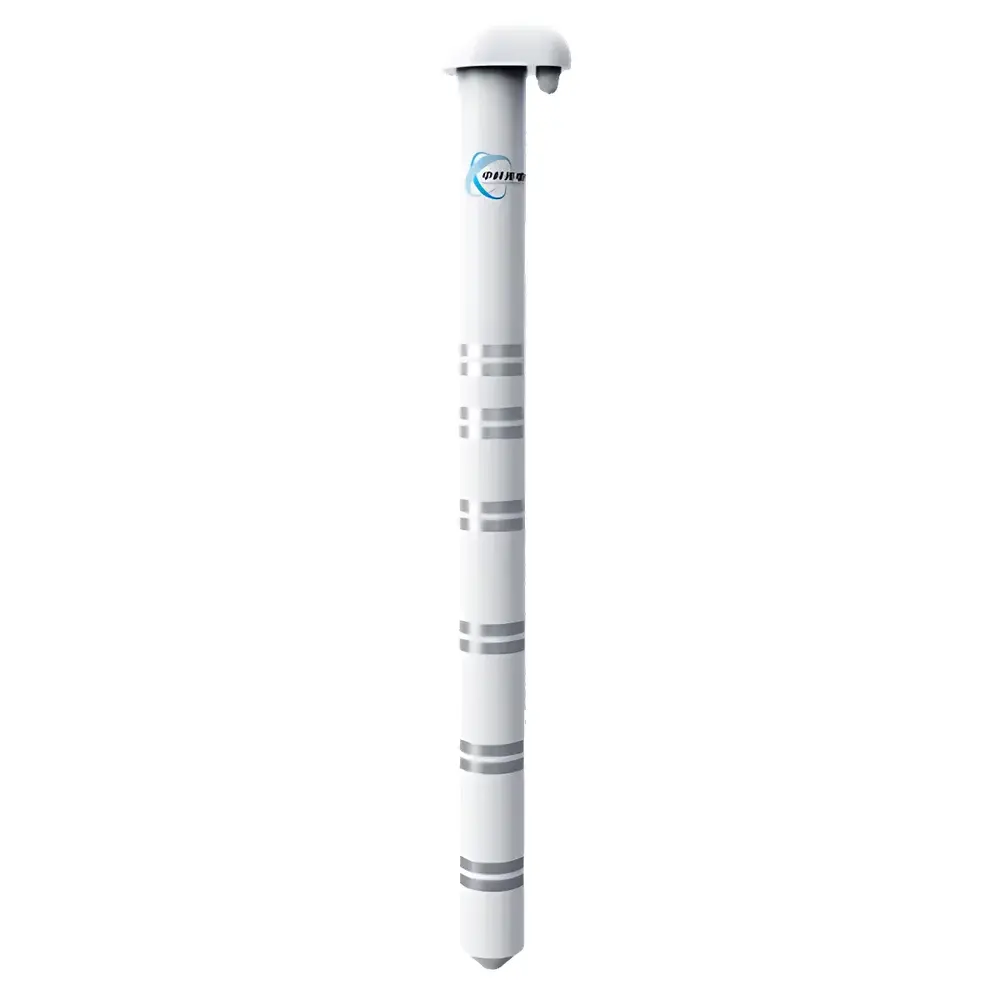
ZKGD-WFF-STAM-1000 Soil Temperature and Moisture Profiling System by CASP
| Brand | CASP |
|---|---|
| Origin | Jiangsu, China |
| Manufacturer Type | Direct Manufacturer |
| Country of Origin | China |
| Model | ZKGD-WFF-STAM-1000 |
| Instrument Type | Multi-parameter Soil Profiling Analyzer |
| Measurement Principle | Passive Capacitive Sensing & Precision Thermistor Array |
| Calibration | Factory-calibrated, field-zero calibration not required |
| Installation | Vertical insertion into undisturbed soil profile |
| Protection Rating | IP68-rated outer casing |
| Structural Design | Reinforced dual-wall stainless-steel probe housing |
Overview
The ZKGD-WFF-STAM-1000 Soil Temperature and Moisture Profiling System is an engineered solution for high-fidelity, depth-resolved monitoring of soil physical properties across agricultural, ecological, hydrological, and climate research applications. Designed around a vertically integrated multi-sensor architecture, the system employs passive capacitive dielectric sensors for volumetric water content (θv) and high-stability platinum resistance thermometers (PRTs) or NTC thermistors for temperature profiling — all embedded at fixed, pre-calibrated depths within a single robust probe. Unlike intrusive TDR or neutron probe methods, the ZKGD-WFF-STAM-1000 operates without soil displacement or electromagnetic excitation, ensuring measurement integrity in heterogeneous, rocky, or organically rich profiles. Its core principle relies on stable dielectric permittivity–water content relationships validated against gravimetric standards per ASTM D5734 and ISO 11274, with thermal response times optimized to <60 s (90% step change) per layer.
Key Features
- Multi-depth profiling capability: Standard configuration supports up to 10 discrete sensing layers (customizable from 3 to 16), spaced at user-defined intervals (e.g., 10 cm, 20 cm, 50 cm) along a single vertical axis.
- Passive, non-perturbing measurement: No external power required at sensor nodes; eliminates electromagnetic interference and preserves native soil structure and hydraulic continuity.
- Reinforced dual-wall probe housing: Constructed from marine-grade 316 stainless steel with abrasion-resistant polymer overmolding, rated IP68 for continuous submersion and resistant to mechanical impact from tillage equipment, livestock traffic, or frost heave.
- Factory-traceable calibration: Each sensor layer undergoes individual gravimetric and temperature-controlled chamber validation; calibration coefficients are stored onboard and applied automatically during data acquisition.
- Low-maintenance deployment: No field recalibration, electrolyte replacement, or electrode cleaning required; designed for unattended operation over 5+ years in temperate and semi-arid climates.
- Integrated signal conditioning: On-probe analog-to-digital conversion minimizes noise susceptibility over long cable runs (up to 200 m standard, extendable).
Sample Compatibility & Compliance
The ZKGD-WFF-STAM-1000 is validated for use in mineral soils (sand to clay loam), volcanic ash, peat (up to 85% organic matter), and amended substrates including biochar-amended and compost-blended media. It complies with ISO 10381-3 (soil sampling — Part 3: Guidance on sampling of soil gas and soil moisture), ASTM D7221 (standard test method for determining soil water retention curves), and supports GLP-aligned data collection workflows. Sensor materials meet RoHS Directive 2011/65/EU and are inert to common agrochemical residues (glyphosate, neonicotinoids, urea-based fertilizers). Probe geometry adheres to FAO-recommended minimum disturbance criteria for long-term eddy covariance and lysimeter co-location studies.
Software & Data Management
Data acquisition is supported via RS-485 Modbus RTU or SDI-12 protocols, enabling seamless integration with Campbell Scientific CR series loggers, Decagon EM50G, or third-party SCADA platforms. CASP’s optional SoilProfile Manager™ software (v3.2+) provides time-series visualization, layer-wise anomaly detection, thermal diffusivity estimation, and automated export to CF-NetCDF format compliant with the International Soil Moisture Network (ISMN) metadata schema. Audit trails, user-access controls, and electronic signatures satisfy FDA 21 CFR Part 11 requirements when deployed in regulated agronomic trials or environmental impact assessments.
Applications
- Root-zone water dynamics modeling for precision irrigation scheduling (FAO-56, SWAP, HYDRUS-1D input)
- Soil thermal regime characterization in permafrost-affected regions and seasonal frost monitoring
- Carbon flux studies requiring concurrent θv and T profiles to parameterize Q10 models
- Validation of satellite-derived soil moisture products (e.g., SMAP, Sentinel-1 SAR backscatter inversion)
- Long-term ecological research (LTER) sites requiring minimal maintenance and high inter-annual repeatability
- Regulatory compliance monitoring for landfill cover systems and constructed wetland performance assessment
FAQ
Is field recalibration required after installation?
No. The system is factory-calibrated using traceable reference standards and does not require zero-point or slope adjustment under normal operating conditions.
Can the probe be installed in rocky or gravelly soil?
Yes — the reinforced housing and tapered tip allow direct auger-assisted insertion into soils containing up to 30% coarse fragments (40% stoniness.
What is the maximum operational depth range?
Standard configurations support profiling from 0.1 m to 2.0 m; custom probes extend to 5.0 m with pressure-compensated thermal elements.
Does the system support real-time telemetry?
Yes, when paired with compatible cellular or LoRaWAN-enabled data loggers; CASP provides certified firmware modules for integration with The Things Network and AWS IoT Core.
How is data integrity ensured during power outages or communication gaps?
Onboard non-volatile memory retains ≥30 days of high-resolution (15-min interval) profile data; timestamps are synchronized via GPS or NTP upon reconnection.







