

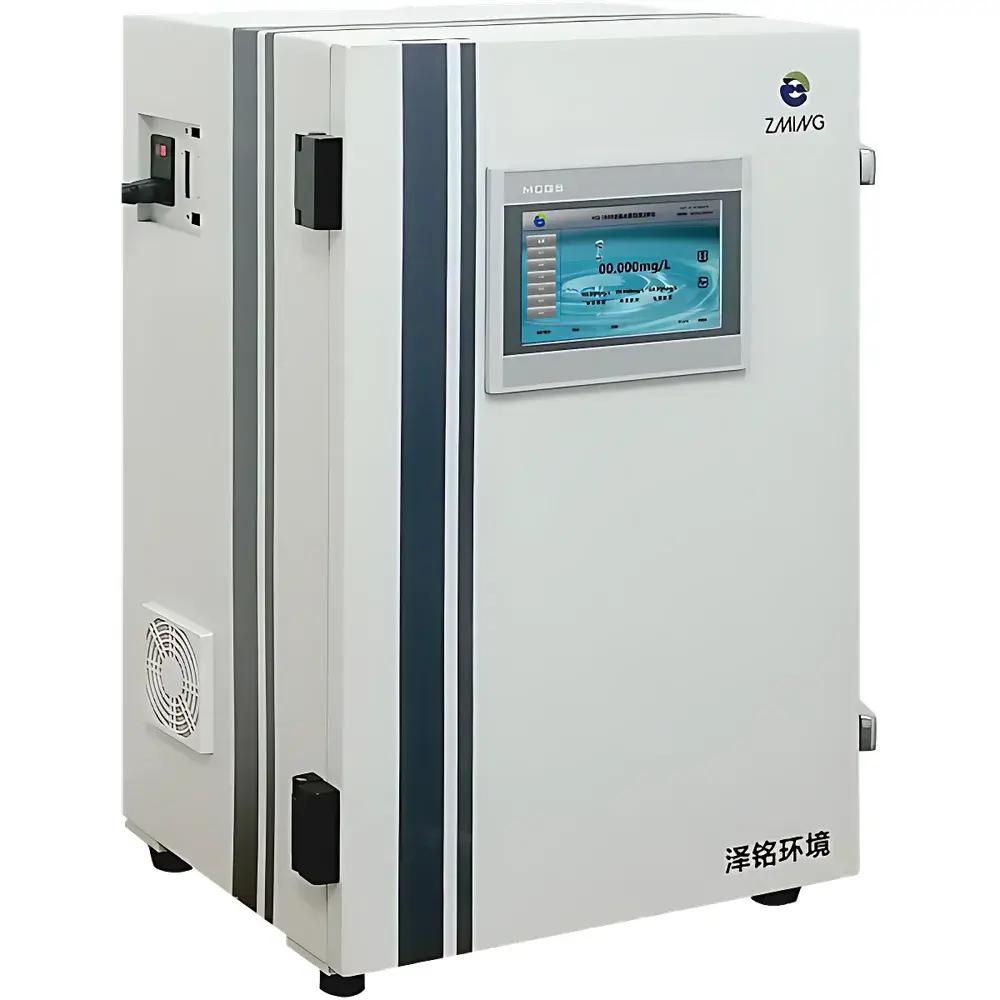
Zming Environmental HQ-3600(NO₃) Online Nitrate-Nitrogen Analyzer
| Brand | Zming Environmental Technology Co., Ltd. |
|---|---|
| Origin | Jiangsu, China |
| Manufacturer Type | Authorized Distributor |
| Country of Origin | China |
| Model | HQ-3600(NO₃) |
| Instrument Type | Online Analyzer |
| Measurement Principle | UV Photometric Colorimetry |
| Measurement Range | 0–2 mg/L NO₃⁻-N (adjustable, scalable per user requirement) |
| Accuracy | ±10 % of reading |
| Detection Limit | 0.05 mg/L NO₃⁻-N |
| Resolution | 0.001 mg/L NO₃⁻-N |
Overview
The Zming Environmental HQ-3600(NO₃) Online Nitrate-Nitrogen Analyzer is a dedicated, continuous-monitoring instrument engineered for reliable quantification of nitrate-nitrogen (NO₃⁻-N) in diverse aqueous matrices. It employs UV photometric colorimetry — a well-established, interference-minimized optical method wherein nitrate absorbs ultraviolet light at characteristic wavelengths (typically 220 nm), while concurrent measurement at a reference wavelength (e.g., 275 nm) compensates for organic absorbance and turbidity effects. This dual-wavelength correction strategy enables robust performance in challenging environmental samples, including high-turbidity river water, estuarine influents, and partially treated industrial effluents. Designed for unattended operation over extended deployment cycles, the HQ-3600(NO₃) integrates modular fluidics, embedded thermal regulation, and real-time diagnostic monitoring to meet the operational demands of regulatory-grade environmental surveillance networks.
Key Features
- UV-based dual-wavelength photometric detection with automatic turbidity compensation, eliminating the need for pre-filtration in most natural water applications
- Proprietary digestion-free optical measurement pathway — avoids chemical reagents, high-temperature digestion, and associated maintenance overhead
- Capacitive volumetric metering system for precise, repeatable aspiration of sample and calibration standards (RSD < 1.5 % across 100 consecutive injections)
- Digital temperature control module with programmable setpoint (ambient to 60 °C), ensuring consistent optical path stability and reaction environment reproducibility
- Comprehensive hardware self-diagnostic suite: real-time leak detection, power-loss recovery with data retention, flow path obstruction alert, and lamp intensity monitoring with predictive lifetime estimation
- IP65-rated enclosure with corrosion-resistant wetted materials (PFA, PEEK, borosilicate glass), suitable for outdoor cabinet or direct-stream installation
Sample Compatibility & Compliance
The HQ-3600(NO₃) demonstrates validated performance across a broad spectrum of water types: freshwater (rivers, lakes, reservoirs), brackish estuaries (up to 15 ppt salinity), drinking water distribution systems, municipal wastewater effluents, and industrial process discharges. It complies with fundamental design requirements outlined in ISO 15839:2012 (Water quality — Specifications and performance testing of online analyzers) and supports audit-ready operation under GLP and GMP-aligned environmental monitoring programs. While not certified to US EPA Method 353.2 or ISO 10304-1, its measurement principle aligns with the photometric principles referenced in those standards. Data integrity is maintained via internal timestamped logging and configurable alarm thresholds traceable to NIST-traceable nitrate standards.
Software & Data Management
The analyzer operates with an embedded Linux-based firmware platform supporting Modbus TCP/RTU, RS-485, and optional 4–20 mA analog output. Configuration, calibration, and diagnostics are managed via a secure web interface (HTTPS) accessible from local networks or through authorized remote VPN tunnels. All measurement events, calibration logs, error codes, and diagnostic snapshots are stored onboard with 30-day circular buffer retention. Export formats include CSV and XML, compatible with SCADA systems (e.g., Ignition, Siemens Desigo) and centralized water quality data platforms such as WISKI or Aquarius. Audit trails record operator actions, parameter changes, and calibration verifications — fulfilling basic requirements for 21 CFR Part 11-compliant environments when deployed with appropriate IT governance controls.
Applications
- Continuous monitoring of nitrate-N at national surface water quality stations (e.g., China’s National Surface Water Monitoring Network)
- Real-time discharge compliance verification for municipal wastewater treatment plants and food-processing facilities
- Nutrient loading assessment at river mouths and coastal zones to support eutrophication modeling
- Performance evaluation of constructed wetlands and denitrification bioreactors
- Early-warning detection in drinking water source protection zones and inter-basin water transfer corridors
- Process control feedback in advanced oxidation or ion-exchange-based nitrate removal units
FAQ
Does the HQ-3600(NO₃) require chemical reagents or catalysts during operation?
No — it performs reagent-free UV photometric analysis. No persulfate digestion, cadmium reduction, or chromogenic reagents are used.
Can the instrument be calibrated remotely?
Yes — zero and span calibrations can be initiated via the web interface using preloaded standard solutions; full calibration reports are auto-generated and timestamped.
What maintenance intervals are recommended for unattended operation?
Routine maintenance includes quarterly optical window cleaning, biannual lamp replacement (rated life ≥ 2,000 h), and annual verification against certified reference materials.
Is the analyzer compatible with existing telemetry infrastructure?
Yes — native Modbus TCP support enables seamless integration with most industrial RTUs, PLCs, and cloud-based IoT gateways without protocol translation hardware.
How does the system handle high-suspended-solids water (e.g., stormwater runoff)?
The integrated dual-wavelength algorithm corrects for scattering-induced absorbance; however, for sustained operation in >100 NTU samples, optional inline filtration (50 µm stainless steel mesh) is recommended upstream.
Related Products







