
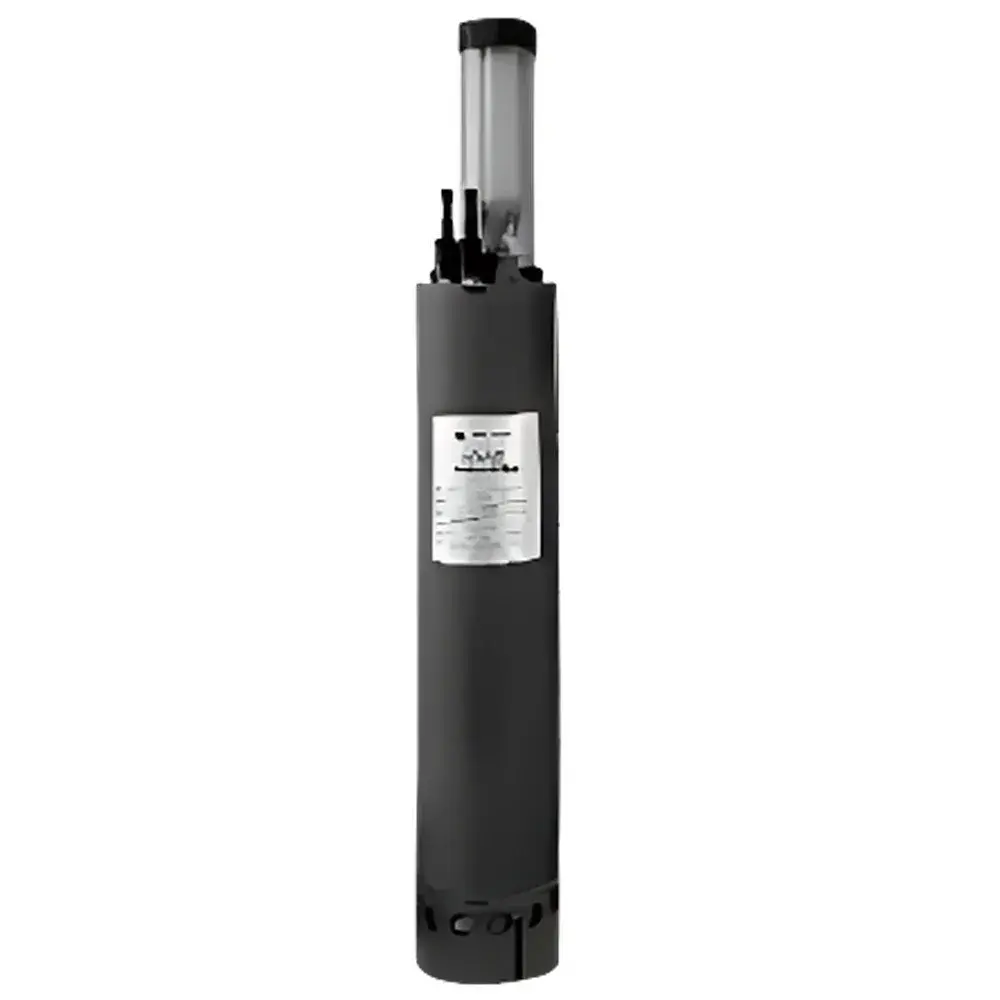
Zming Environmental HQ-8200 In-situ Total Phosphorus Water Quality Analyzer
| Brand | Zming Environmental Technology Co., Ltd. |
|---|---|
| Origin | Jiangsu, China |
| Manufacturer Type | Authorized Distributor |
| Country of Origin | China |
| Model | HQ-8200 |
| Pricing | Available Upon Request |
Overview
The Zming Environmental HQ-8200 is an in-situ, submersible water quality analyzer engineered for continuous, real-time monitoring of total phosphorus (TP) concentration in natural aquatic environments—including rivers, lakes, estuaries, coastal seawater, and reservoirs. It operates on the standardized spectrophotometric method per Chinese national standard HJ 670–2013 (equivalent to ISO 15681-1:2003 and APHA 4500-P E), utilizing high-efficiency potassium persulfate UV digestion followed by molybdenum blue colorimetry. A built-in turbidity compensation algorithm corrects optical interference from suspended solids, enabling reliable TP quantification in highly turbid waters (up to 1000 NTU). The instrument is fully submersible, rated to 100 m depth (IP68), and designed for long-term deployment on buoys, moored platforms, floating stations, or shore-based telemetry systems. Its low-power architecture supports direct 12 V DC operation—compatible with solar-charged battery banks—making it suitable for remote, off-grid monitoring sites requiring unattended operation over extended periods.
Key Features
- Submersible design with 100-meter operational depth rating and integrated pressure-compensated housing
- Onboard turbidity sensor (0–1000 NTU range) with adaptive measurement mode that dynamically adjusts integration time and LED intensity based on real-time optical scattering conditions
- Integrated environmental monitoring suite: temperature (±0.2 °C), relative humidity (±3% RH), and leak detection via capacitive fluid-sensing electrodes
- Handheld Bluetooth-enabled display module for field commissioning, calibration verification, and diagnostic troubleshooting without physical access to the main unit
- Fast thermal digestion system with programmable ramp-heating profile (up to 120 °C), reducing cycle time to ≤15 minutes per TP measurement
- Detection limit of 0.005 mg/L (5 ppb) TP with repeatability <3% RSD (n=6, at 0.1 mg/L standard)
- Modular reagent cartridge system with RFID-tracked consumables; supports ≥300 measurements per cartridge
Sample Compatibility & Compliance
The HQ-8200 is validated for use with freshwater, brackish water, and marine matrices (salinity up to 35 ppt). It meets performance criteria outlined in GB/T 32217–2015 (Water Quality – Determination of Total Phosphorus – Spectrophotometric Method after Persulfate Digestion) and aligns with EPA Method 365.1 and ISO 15681-1 for method equivalence. All wetted components are constructed from marine-grade 316 stainless steel, PTFE-lined flow cells, and chemically inert sapphire optical windows to ensure corrosion resistance and minimal biofouling. Data integrity complies with GLP principles, including timestamped audit logs, operator ID tracking, and non-erasable calibration history. Firmware supports optional 21 CFR Part 11-compliant user authentication and electronic signature modules for regulated environmental reporting.
Software & Data Management
The analyzer communicates via RS-485 (Modbus RTU) or optional cellular/LTE-M telemetry. Zming’s proprietary AquaLink™ software provides remote configuration, real-time data visualization, automated QC flagging (e.g., drift >5%, signal-to-noise ratio <10), and scheduled maintenance alerts. Raw absorbance spectra (700–900 nm), digestion temperature profiles, and turbidity-corrected absorbance values are stored locally (8 GB internal flash) and transmitted as CSV/JSON payloads. Data export supports integration with SCADA, WQX, and EPA STORET formats. Firmware updates are delivered over-the-air (OTA) with SHA-256 signature verification.
Applications
- Long-term trophic state assessment in eutrophic lakes and reservoirs
- Dynamic nutrient flux quantification at riverine discharge points and estuarine mixing zones
- Regulatory compliance monitoring for TP in rural drinking water source protection zones
- Baseline survey and impact evaluation in nearshore marine ecosystems, including aquaculture zones and coral reef proximity studies
- Real-time early-warning detection of anthropogenic phosphorus loading events (e.g., agricultural runoff, wastewater bypass)
FAQ
What is the recommended calibration frequency for regulatory-grade monitoring?
Calibration verification using NIST-traceable phosphate standards is recommended every 7 days; full multi-point calibration every 30 days under continuous operation.
Can the HQ-8200 simultaneously measure total phosphorus and ammonia nitrogen?
Yes—the dual-parameter configuration (TP + NH₃-N) shares the same fluidic path and power supply; OPA fluorescence detection for ammonia nitrogen operates in parallel with molybdenum blue spectrophotometry for TP.
Is anti-fouling maintenance required during deployment?
The system includes a programmable wiper mechanism and optional ultrasonic transducer module (add-on) for periodic optical window cleaning; typical maintenance interval is 30–60 days depending on site-specific biofouling pressure.
Does the instrument support external trigger inputs for synchronized sampling?
Yes—TTL-compatible external trigger input allows synchronization with meteorological stations, flow meters, or sediment trap deployments.
How is data security ensured during wireless transmission?
All LTE/4G transmissions use TLS 1.2 encryption; local storage employs AES-256 encryption with hardware-based key management.







