
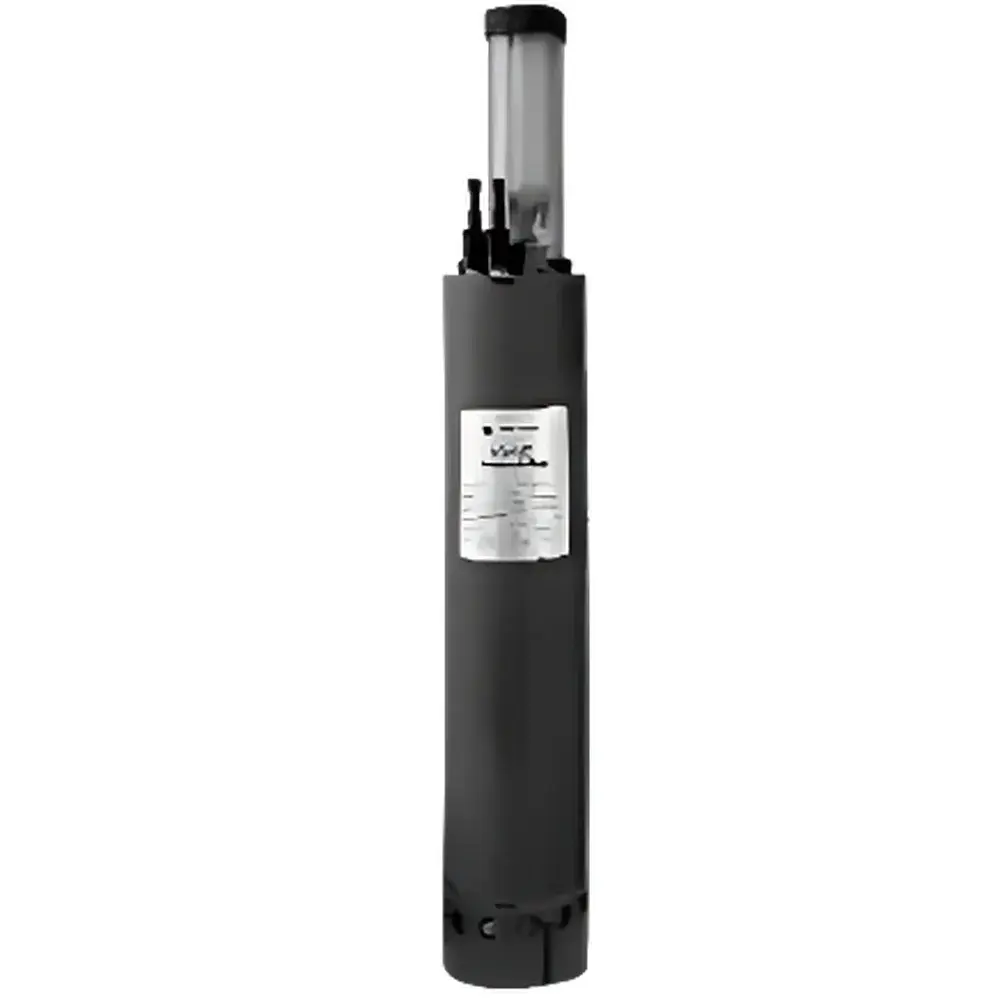
Zming Environmental HQ-8600 In-situ Total Nitrogen Water Quality Analyzer
| Brand | Zming Environmental Technology Co., Ltd. |
|---|---|
| Origin | Jiangsu, China |
| Manufacturer Type | Authorized Distributor |
| Country of Origin | China |
| Model | HQ-8600 |
| Pricing | Upon Request |
| Measurement Parameter | Total Nitrogen (TN) |
| Measurement Principle | Potassium Persulfate Oxidation + Spectrophotometry |
| Range | 0–2 mg/L and 0–10 mg/L (dual-range auto-switching) |
| Detection Limit | Sub-ppb level (≤0.001 mg/L) |
| Maximum Deployment Depth | 100 m |
| Integrated Sensors | Turbidity, Temperature, Humidity, Leak Detection |
| Sample Interface | In-situ submersible probe with integrated digestion chamber |
| Power Supply | 12–24 V DC |
| Communication | RS-485 / Modbus RTU, optional 4G/LoRaWAN telemetry |
Overview
The Zming Environmental HQ-8600 In-situ Total Nitrogen Water Quality Analyzer is an engineered solution for continuous, unattended, real-time monitoring of total nitrogen (TN) in natural and anthropogenic aquatic environments. It employs the standardized potassium persulfate oxidation method—aligned with ISO 11905-1 and EPA Method 351.2—followed by spectrophotometric quantification at 220 nm and 275 nm (dual-wavelength correction). Unlike laboratory-based or flow-through analyzers requiring sample extraction and transport, the HQ-8600 performs full digestion and detection directly in situ, eliminating sampling bias, preserving labile nitrogen species (e.g., organic N, nitrate, nitrite, ammonium), and ensuring high temporal fidelity. Its compact, pressure-rated housing (IP68, 100 m water depth rating) enables direct deployment on buoys, moored platforms, riverbank stations, and coastal observatories without auxiliary infrastructure.
Key Features
- Submersible in-situ design with integrated high-efficiency UV-enhanced persulfate digestion reactor—enabling complete oxidation of refractory organic nitrogen compounds under field conditions.
- Dual-range optical detection system (0–2 mg/L and 0–10 mg/L) with automatic range switching and drift compensation, optimized for oligotrophic lakes and eutrophic estuaries alike.
- Real-time turbidity measurement (0–1000 NTU) with adaptive algorithm: dynamically adjusts digestion time, light path gain, and baseline correction to maintain accuracy across highly variable suspended solids loads.
- Onboard environmental monitoring suite: integrated PT100 temperature sensor (±0.1 °C), capacitive humidity sensor (±3% RH), and capacitive leak detection circuitry—providing diagnostic integrity validation for long-term deployments.
- Handheld touchscreen interface (5.5″, sunlight-readable LCD) with local configuration, calibration logging, and real-time spectral preview—reducing dependency on remote software during field commissioning.
- Rapid thermal digestion module: achieves complete oxidation in ≤15 minutes at 120 °C, significantly reducing cycle time versus conventional 30–60 min protocols while maintaining stoichiometric recovery (>98.5% for Kjeldahl N reference standards).
Sample Compatibility & Compliance
The HQ-8600 is validated for use in freshwater (lakes, reservoirs, rivers), brackish estuaries (up to 25 ppt salinity), and nearshore marine environments. It complies with core regulatory frameworks governing environmental monitoring: its analytical methodology conforms to ISO 11905-1 (water quality — determination of total nitrogen — part 1: semi-automated and automated methods using persulfate digestion), and supports data traceability requirements per ISO/IEC 17025:2017 for accredited laboratories. All firmware logs include timestamped audit trails for calibration events, reagent consumption, fault codes, and sensor diagnostics—facilitating GLP-compliant reporting and FDA 21 CFR Part 11–aligned electronic record retention when paired with Zming’s secure cloud platform.
Software & Data Management
The analyzer operates natively via embedded Linux firmware supporting Modbus RTU over RS-485 for integration into SCADA, telemetry gateways, or custom IoT architectures. Optional 4G LTE-M or LoRaWAN modules enable encrypted payload transmission (AES-128) to Zming’s cloud portal, where users access time-series dashboards, automated QA/QC flagging (e.g., drift >5% over 7 days triggers alert), and downloadable CSV/NetCDF exports. Raw absorbance spectra (200–350 nm, 1 nm resolution) are stored onboard for retrospective reprocessing. Firmware updates are delivered OTA with SHA-256 signature verification, and all configuration changes require role-based authentication.
Applications
- Long-term trophic state assessment in stratified lakes and reservoirs—capturing diel and seasonal TN dynamics without manual sampling artifacts.
- Estuarine nutrient flux quantification at river mouths, supporting TMDL modeling and hypoxia forecasting.
- Rural drinking water source surveillance—detecting agricultural runoff spikes (e.g., post-rainfall nitrate surges) with sub-hourly resolution.
- Marine environmental baseline studies for offshore wind farm permitting and aquaculture zone management.
- Validation of satellite-derived chlorophyll-a and CDOM products through coincident in-situ TN time series.
FAQ
What is the recommended maintenance interval for the HQ-8600 in continuous deployment?
Routine cleaning of the optical window and digestion chamber is advised every 30 days in high-turbidity environments; reagent cartridge replacement occurs every 90 days at standard 1-hr measurement intervals.
Does the system support multi-parameter co-monitoring beyond total nitrogen?
Yes—the base unit includes turbidity, temperature, and humidity sensors; optional add-on modules for pH, dissolved oxygen, and conductivity are available via the same mechanical and electrical interface.
How is calibration traceability ensured?
Factory calibration uses NIST-traceable potassium nitrate standards; field recalibration is performed via two-point standard addition with certified reference materials (CRM), with all calibration coefficients and uncertainty budgets logged in the device’s internal database.
Can the HQ-8600 operate autonomously for extended periods without external power?
When paired with a 50 Ah LiFePO₄ battery and 20 W solar panel, the system supports >60 days of operation at 1-hr measurement frequency in temperate climates, with low-power sleep mode between cycles.







