
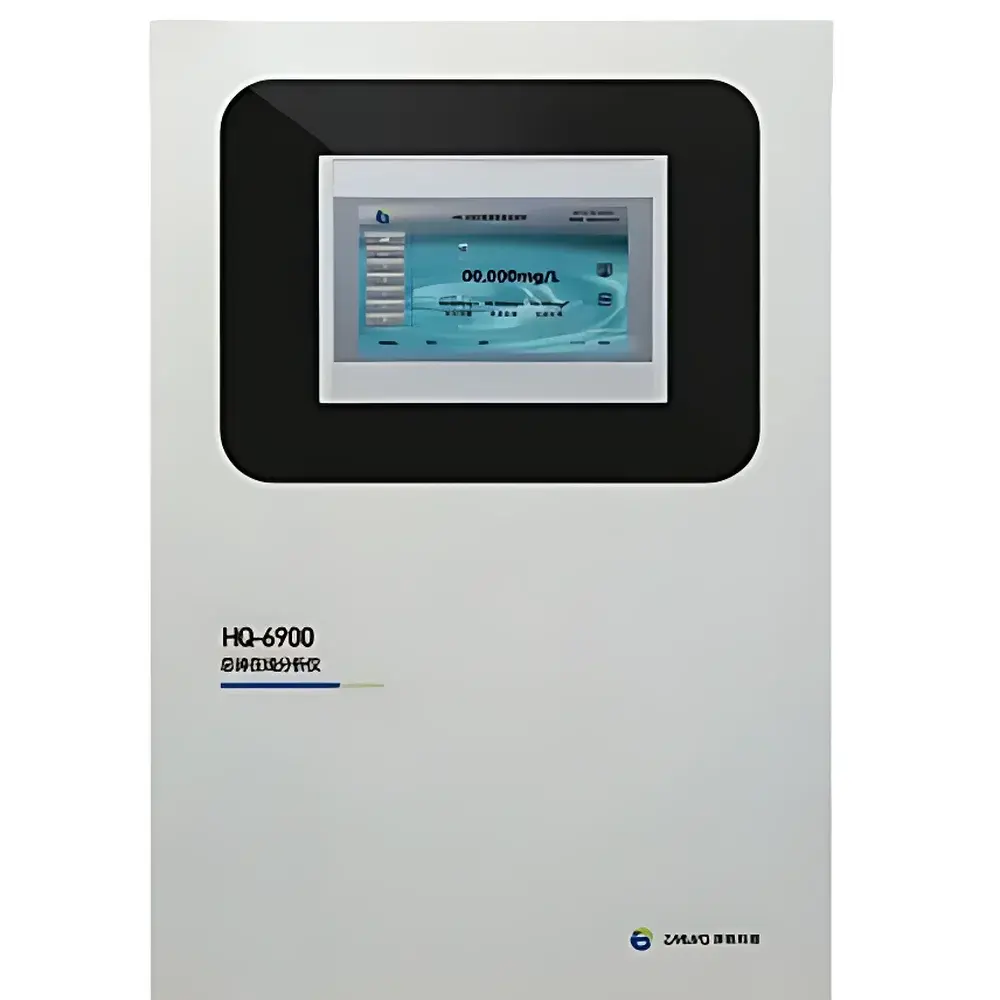
Zming Environmental HQ-6900 Total Arsenic Online Analyzer
| Brand | Zming Environmental Technology Co., Ltd. |
|---|---|
| Origin | Jiangsu, China |
| Manufacturer Type | Authorized Distributor |
| Country of Origin | China |
| Model | HQ-6900 |
| Price | Upon Request |
| Measurement Principle | Arsenic-Platinum Blue Spectrophotometry |
| Detection Limit | 0.01 mg/L |
| Range | (0–2) mg/L and (0–10) mg/L (expandable) |
| Repeatability | ≤5.0% |
| Cycle Time | ≤60 min |
| MTBF | ≥720 h |
| Output Interfaces | RS232 / RS485, 4–20 mA analog |
| Ambient Temp | 5–40 °C |
| Humidity | ≤85% RH |
| Power Supply | AC (220 ± 25) V, 50 ± 0.5 Hz |
| Rated Power | 100 W |
Overview
The Zming Environmental HQ-6900 Total Arsenic Online Analyzer is a fully automated, benchtop-integrated analytical system engineered for continuous, unattended quantification of total arsenic in aqueous environmental matrices. It employs the validated arsenic-platinum blue spectrophotometric method—based on the catalytic reduction of arsenate to arsine gas, followed by complexation with platinum chloride to form a stable, measurable chromophore at 590 nm. This methodology complies with core principles outlined in EPA Method 200.7 (ICP-OES reference), ISO 17294-2:2016 (water quality — elemental analysis by ICP-MS), and supports alignment with regulatory frameworks requiring trace metal monitoring under national water quality standards (e.g., China’s GB 3838-2002, US EPA Clean Water Act Section 304(a)). Designed for deployment in fixed-site monitoring stations or mobile laboratory trailers, the HQ-6900 delivers robust performance in variable ambient conditions while maintaining metrological integrity across extended operational cycles.
Key Features
- Low detection limit of 0.01 mg/L total arsenic, enabling compliance monitoring against stringent regulatory thresholds (e.g., WHO guideline value of 0.01 mg/L)
- Two selectable measurement ranges: (0–2) mg/L and (0–10) mg/L, with optional range extension via hardware calibration kit
- High selectivity against common interferents—including Fe³⁺, Cu²⁺, NO₃⁻, Cl⁻, turbidity (up to 200 NTU), and color (absorbance ≤0.5 AU at 590 nm)—achieved through proprietary reagent formulation and dual-wavelength correction algorithm
- Minimal reagent consumption: 0.5–2.5 µg per analysis cycle, reducing operational cost and hazardous waste generation
- Fast reaction kinetics: complete color development within 1–5 minutes post-sample introduction
- Integrated diagnostics: automatic zero/span calibration, real-time reagent level monitoring with low-fluid alarm, self-diagnostic fault logging, and auto-range switching based on signal saturation threshold
- Modular architecture with front-access service panels, facilitating field maintenance without specialized tools
Sample Compatibility & Compliance
The HQ-6900 accepts raw, filtered (≤5 µm), or pre-acidified (HNO₃, pH <2) water samples from diverse sources including surface water (rivers, lakes, reservoirs, coastal estuaries), municipal wastewater effluents, agricultural runoff, and industrial discharges (e.g., semiconductor, mining, and electroplating outfalls). It meets functional requirements for Class III online analyzers per HJ/T 353–2007 (China’s Technical Specification for Online Monitoring Systems of Water Pollutants) and supports data integrity practices aligned with ISO/IEC 17025:2017 Clause 7.7 (result reporting) and GLP-compliant audit trails when integrated with certified SCADA platforms. No sample digestion is required for dissolved arsenic; total arsenic determination includes particulate-bound fraction following optional onboard UV/persulfate oxidation module (accessory).
Software & Data Management
Embedded firmware provides local control via 7-inch resistive touchscreen interface with multilingual UI (English, Chinese, Spanish). Data output conforms to Modbus RTU (RS485) and ASCII-based serial protocols (RS232), enabling seamless integration into third-party supervisory control systems (e.g., Ignition SCADA, Siemens Desigo CC). Analog 4–20 mA outputs are galvanically isolated and configurable per range segment. Internal non-volatile memory stores ≥30 days of minute-level timestamped results (concentration, absorbance, temperature, error codes). Remote firmware updates and diagnostic log export are supported via secure FTP over Ethernet (optional Wi-Fi module). Audit trail functionality records all user actions (calibration, range change, manual override) with ISO 8601 timestamps—supporting traceability requirements under FDA 21 CFR Part 11 when deployed in regulated wastewater treatment facilities.
Applications
- Real-time compliance monitoring at national surface water quality monitoring stations
- Effluent discharge tracking for industries subject to arsenic emission limits (e.g., smelters, glass manufacturing, pesticide production)
- Early warning detection in drinking water source protection zones adjacent to historic mining areas
- Research-grade longitudinal studies on arsenic speciation dynamics in paddy field irrigation systems
- Performance validation of arsenic removal technologies (e.g., adsorption columns, coagulation-filtration units) in pilot-scale wastewater treatment plants
FAQ
What sample pretreatment is required prior to analysis?
No filtration or acidification is mandatory for routine operation; however, samples with suspended solids >50 mg/L should be filtered through a 5-µm membrane to prevent flow cell clogging. Acid preservation (to pH <2 with ultrapure HNO₃) is recommended for storage stability beyond 24 hours.
Can the HQ-6900 differentiate between arsenite (As(III)) and arsenate (As(V))?
No—the instrument reports total inorganic arsenic. Speciation requires coupling with an upstream HPLC-ICP-MS system or offline hydride generation separation. The HQ-6900’s reagent chemistry reduces both As(III) and As(V) quantitatively to arsine.
Is the system compatible with remote cloud-based data platforms?
Yes—via optional MQTT or HTTP POST integration kits, enabling direct upload to AWS IoT Core, Microsoft Azure IoT Hub, or custom LIMS environments using TLS 1.2 encryption.
What is the recommended maintenance interval for the optical flow cell?
Cleaning with 10% v/v HCl solution is advised every 30 days under continuous operation; quartz cuvette replacement is specified at 12-month intervals or after 5,000 measurement cycles, whichever occurs first.
Does the analyzer meet electromagnetic compatibility (EMC) requirements for industrial deployment?
Yes—it complies with IEC 61326-1:2020 (industrial environment) for ESD, radiated RF immunity, and fast transient burst testing, with CE marking valid for EU market placement.
Related Products







