
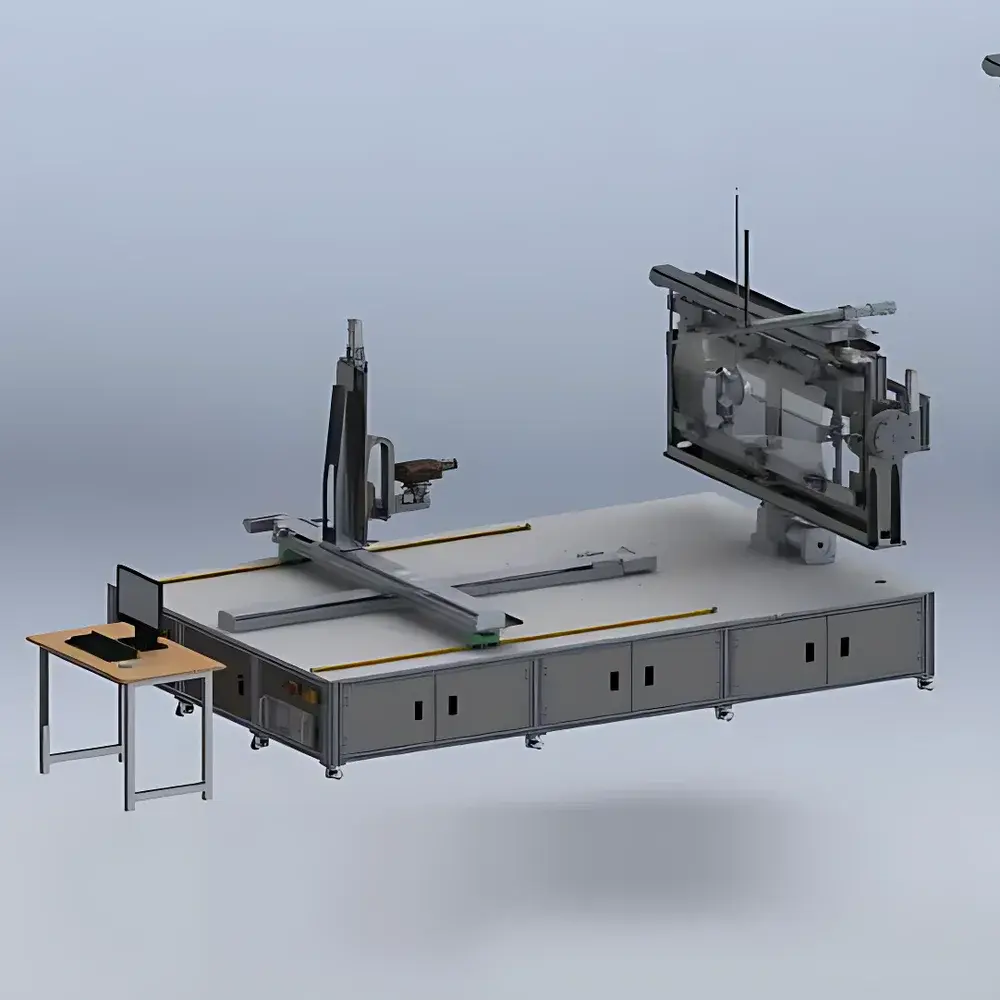
ZOLIX Automotive Glass Transmittance and Reflectance Measurement System
| Brand | ZOLIX |
|---|---|
| Origin | Beijing, China |
| Manufacturer Type | Authorized Distributor |
| Product Origin | Domestic (China) |
| Model | Reflectance-Transmittance Measurement System |
| Price Range | USD 7,000 – 70,000 |
Overview
The ZOLIX Automotive Glass Transmittance and Reflectance Measurement System is a fully integrated, computer-controlled optical characterization platform engineered for precise, repeatable quantification of spectral transmittance (T%), spectral reflectance (R%), and CIE colorimetric coordinates (e.g., CIE 1931 x,y; L*a*b*) of automotive glazing materials. The system operates on the principle of double-beam spectrophotometric measurement combined with calibrated imaging photometry: a stabilized broadband light source illuminates the sample from controlled incident angles (0°–45° configurable), while a high-sensitivity CCD spectrometer captures both transmitted and reflected spectral radiance across the visible range (380–780 nm) with 1 nm optical resolution. A motorized XYZ-θφ precision stage enables automated spatial mapping of large-area curved or flat glass substrates—critical for evaluating non-uniformities in laminated, heated, or electrochromic automotive windshields and side windows.
Key Features
- Motorized 5-axis motion control system with linear positioning accuracy ±0.01 mm and angular resolution < 0.1°, enabling reproducible alignment across complex curvature profiles.
- Modular optical architecture supporting both normal-incidence and oblique-angle (up to 45°) reflectance measurements per ISO 13666 and ASTM E903.
- Dual-source illumination: thermally stabilized halogen lamp for transmittance and pulsed xenon lamp for reflectance—minimizing thermal drift and spectral artifact.
- Traceable calibration using NIST-traceable white reference standard (certified reflectance >99% @ 400–700 nm) and calibrated neutral density filters.
- Automated pass/fail classification based on user-defined thresholds for T%, R%, ΔE*ab, and luminous transmittance (Y), compliant with UNECE Regulation No. 43 and GB/T 26819–2011.
- Real-time spectral data acquisition at up to 10 Hz frame rate, synchronized with stage motion for continuous line-scan or grid-based mapping.
Sample Compatibility & Compliance
The system accommodates flat and doubly curved automotive glass panels up to 2.5 m × 1.8 m (customizable). It supports laminated, tempered, IR-reflective, hydrophobic-coated, and HUD-integrated substrates—including those with embedded antennas or conductive oxide layers. All optical components comply with IEC 61000-4 electromagnetic immunity standards. Measurement protocols adhere to ISO/CIE joint guidelines for colorimetry (CIE Publication 15:2018), spectral responsivity validation per CIE TC 2-47, and optical safety requirements outlined in EN 62471. Data integrity meets GLP audit requirements through timestamped metadata embedding, electronic signature support, and 21 CFR Part 11–compliant software audit trails (optional module).
Software & Data Management
ZOLIX OptiScan v4.2 software provides full instrument orchestration via USB 3.0 and Ethernet interfaces. The GUI supports multi-parameter batch analysis, spectral overlay comparison, spatial false-color mapping (T%, R%, ΔL*, Δa*, Δb*), and export to CSV, XML, or industry-standard .jdx formats. Raw spectra are stored with full metadata (wavelength calibration coefficients, integration time, slit width, ambient temperature/humidity logs). Version-controlled method templates ensure inter-laboratory reproducibility. Data export modules include direct integration with LIMS platforms (via HL7 or ASTM E1482) and automated report generation compliant with ISO/IEC 17025 documentation requirements.
Applications
- Quality assurance of OEM and Tier-1 automotive glazing: verification of luminous transmittance (>70% for windshields per FMVSS 205), solar heat rejection (SHGC), and anti-glare reflectance limits (<15% at 550 nm).
- R&D evaluation of smart glass technologies: real-time monitoring of transmission hysteresis in PDLC, SPD, and EC devices under voltage sweep.
- Regulatory compliance testing for global markets: UN ECE R43, China GB 9656, Japan JIS D 5101, and EU Directive 2007/46/EC Annex XV.
- Failure analysis of delamination, coating degradation, or edge fogging via spectral deviation mapping across 100+ measurement points per panel.
- Optical design validation for HUD combiner performance, including ghost image intensity, virtual image clarity, and wavelength-dependent efficiency.
FAQ
Does the system support measurement of curved glass with radius as small as 500 mm?
Yes—the θφ rotational axes and dynamic focus compensation algorithm maintain diffraction-limited spot size across radii down to 300 mm.
Can raw spectral data be exported without proprietary software?
Yes—CSV and XML exports contain full wavelength-intensity arrays with SI-unit metadata; no vendor lock-in for third-party analysis.
Is factory recalibration required annually?
No—system self-diagnosis and daily reference checks against the NIST-traceable standard satisfy ISO/IEC 17025 interim verification requirements; formal recalibration recommended every 24 months.
What is the minimum measurable reflectance with signal-to-noise ratio >100:1?
0.05% R (at 550 nm, 1 s integration, f/4 optics), validated per CIE TC 2-34 low-reflectance protocol.
Is the software validated for GMP environments?
Yes—21 CFR Part 11-compliant mode includes role-based access control, biometric login options, and immutable audit trail logging (optional IQ/OQ/PQ documentation package available).







