
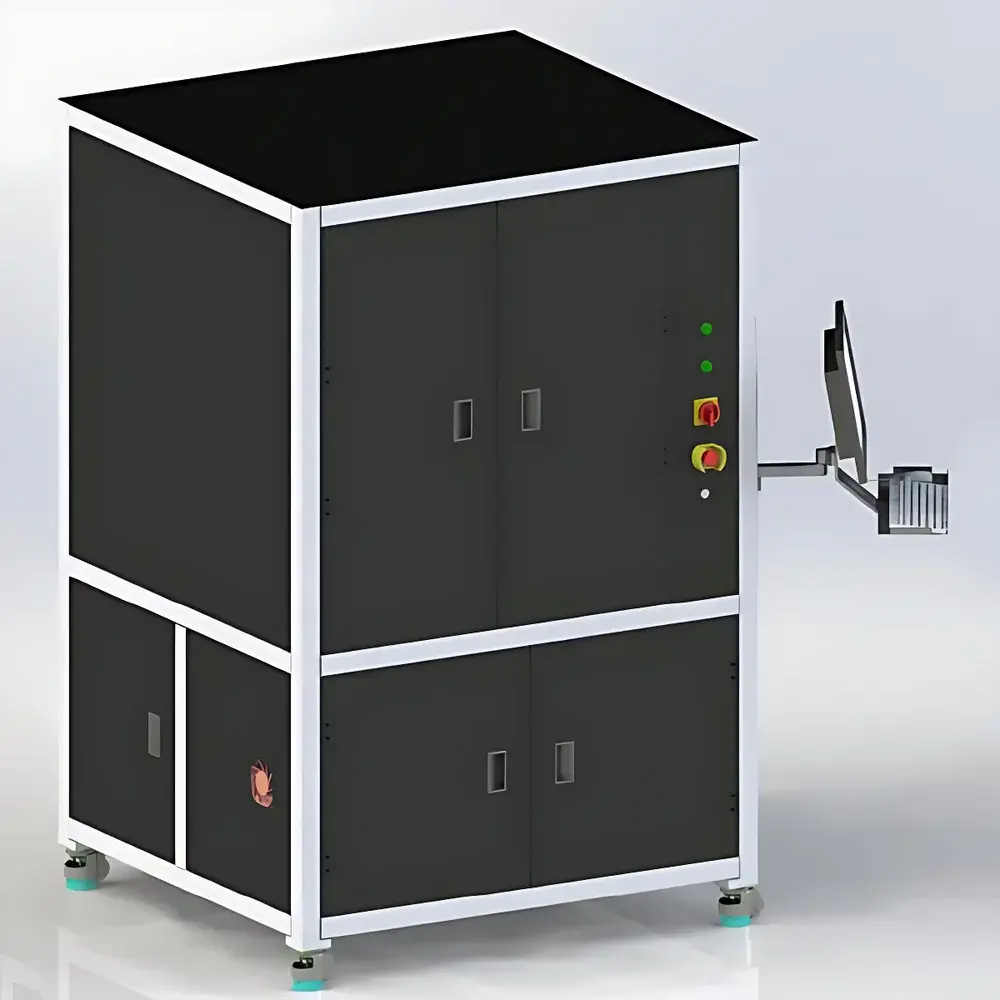
ZOLIX Automotive Welcome Light Automated Inspection System
| Brand | ZOLIX |
|---|---|
| Origin | Beijing, China |
| Manufacturer Type | Authorized Distributor |
| Country of Origin | China |
| Model | Welcome Light Automated Inspection System |
| Price Range | USD 7,000 – 70,000 |
Overview
The ZOLIX Automotive Welcome Light Automated Inspection System is a turnkey optical metrology platform engineered for high-precision photometric and chromatic evaluation of automotive welcome light modules. Built upon a calibrated imaging luminance meter integrated within a light-tight enclosure (dark box), the system combines programmable multi-axis motion control, industrial-grade embedded computing, and purpose-built inspection software to deliver repeatable, traceable, and standards-aligned measurements. It operates on the principle of spatially resolved digital radiometry — capturing full-field luminance (cd/m²) and chromaticity (CIE x,y or u′,v′) distributions across the projected pattern, enabling quantitative assessment of photometric performance and visual defect detection in a single acquisition cycle. Designed for Tier-1 suppliers and OEM R&D labs, the system supports both offline validation and inline integration via industrial communication protocols (e.g., EtherNet/IP, Modbus TCP).
Key Features
- Imaging-based photometric measurement with spatial resolution down to 0.1 mm/pixel at standard working distance, enabling pixel-level uniformity analysis of projected logos and beam patterns.
- High-accuracy motion subsystem: Linear axis driven by precision ground ball screw (repeatability ±0.01 mm); rotary axis with angular resolution <0.1°, facilitating precise angular alignment and multi-pose scanning of asymmetric lamp housings.
- Full-spectrum CCD/CMOS sensor with NIST-traceable calibration, supporting CIE 1931 XYZ color space conversion, correlated color temperature (CCT) calculation (2000 K–20,000 K), and DUV metric computation.
- Automated pass/fail classification based on user-defined thresholds for luminance deviation (±5% typical), chromaticity delta-E (ΔEu’v’ ≤ 0.003), and geometric distortion tolerance (e.g., logo edge sharpness, pattern symmetry).
- Region-of-interest (ROI) definition engine allowing custom polygonal, circular, or grid-based measurement zones — essential for evaluating discrete LED segments or localized hotspots in complex optical designs.
- Integrated audit trail functionality compliant with GLP and ISO/IEC 17025 documentation requirements, including timestamped raw image capture, operator ID logging, and calibration certificate linkage.
Sample Compatibility & Compliance
The system accommodates welcome light assemblies up to 300 mm × 300 mm × 150 mm (W×D×H), including projector-type, reflector-type, and hybrid LED+microlens modules. Fixture adaptability is ensured via modular mounting plates and kinematic alignment pins. All photometric measurements adhere to the foundational principles of CIE Publication 127:2007 (Measurement of LEDs) and ISO/CIE 11664-1:2019 (Colorimetry — Part 1: CIE standard colorimetric observers). Software output reports are structured to support internal quality audits and supplier qualification per IATF 16949 clause 8.5.1.2 (Control of production process). Optional configuration includes FDA 21 CFR Part 11-compliant electronic signature and data integrity modules for regulated environments.
Software & Data Management
The proprietary ZOLIX LightInspect™ software provides a unified interface for test sequence programming, real-time image preview, statistical process control (SPC) charting, and batch report generation (PDF/CSV/XLSX). Measurement data is stored in an ACID-compliant SQLite database with immutable record hashing; historical datasets support trend analysis across shifts, batches, or supplier lots. Raw image archives include EXIF metadata (exposure time, lens F-number, sensor gain) and embedded calibration coefficients. Export interfaces support MES integration via RESTful API and OPC UA server mode. Audit logs record all parameter changes, result overrides, and calibration events — retaining full traceability for ISO 9001 Clause 7.1.5.2 (Measurement traceability).
Applications
- Validation of beam pattern conformity against OEM drawing specifications (e.g., contour fidelity, cut-off line geometry, logo aspect ratio).
- Quantitative assessment of luminance uniformity (min/max ratio, RMS deviation) and chromaticity homogeneity across illuminated areas.
- Detection of micro-defects including LED pixel dropout, lens micro-scratches, adhesive haze, solder joint anomalies, and reflector coating inconsistencies — identified via gradient-based anomaly segmentation algorithms.
- Thermal drift characterization through sequential measurements at stabilized ambient (23±1°C) and elevated temperatures (e.g., 60°C chamber integration).
- Support for Design Verification Testing (DVT) and Production Part Approval Process (PPAP) documentation packages, including MSA (Gage R&R) studies per AIAG MSA 4th Edition.
FAQ
What photometric standards does the system comply with?
It implements core methodologies from CIE 127:2007, ISO/CIE 11664 series, and IES LM-79 where applicable. Full compliance documentation is provided with each calibration certificate.
Can the system integrate with existing factory automation networks?
Yes — optional EtherNet/IP, Profinet, or Modbus TCP gateways enable PLC handshake signals (e.g., part present, inspection start, NG alarm) and bidirectional data exchange with MES/SCADA.
Is NIST-traceable calibration included with purchase?
A full factory calibration report with uncertainty budget (k=2) is delivered at shipment. Annual recalibration services are available through ZOLIX-certified service centers in Asia, Europe, and North America.
How is measurement repeatability verified?
System repeatability is validated per ISO 5725-2:2019 using a reference luminance target under identical environmental conditions over 30 consecutive cycles — typical luminance CV ≤ 0.8%, chromaticity Δu′v′ ≤ 0.0015.
Does the software support multi-language UI and report localization?
English and Chinese UI languages are standard; German, Japanese, and Korean language packs are available as licensed options. Report templates support localized units, terminology, and regulatory disclaimers.







