
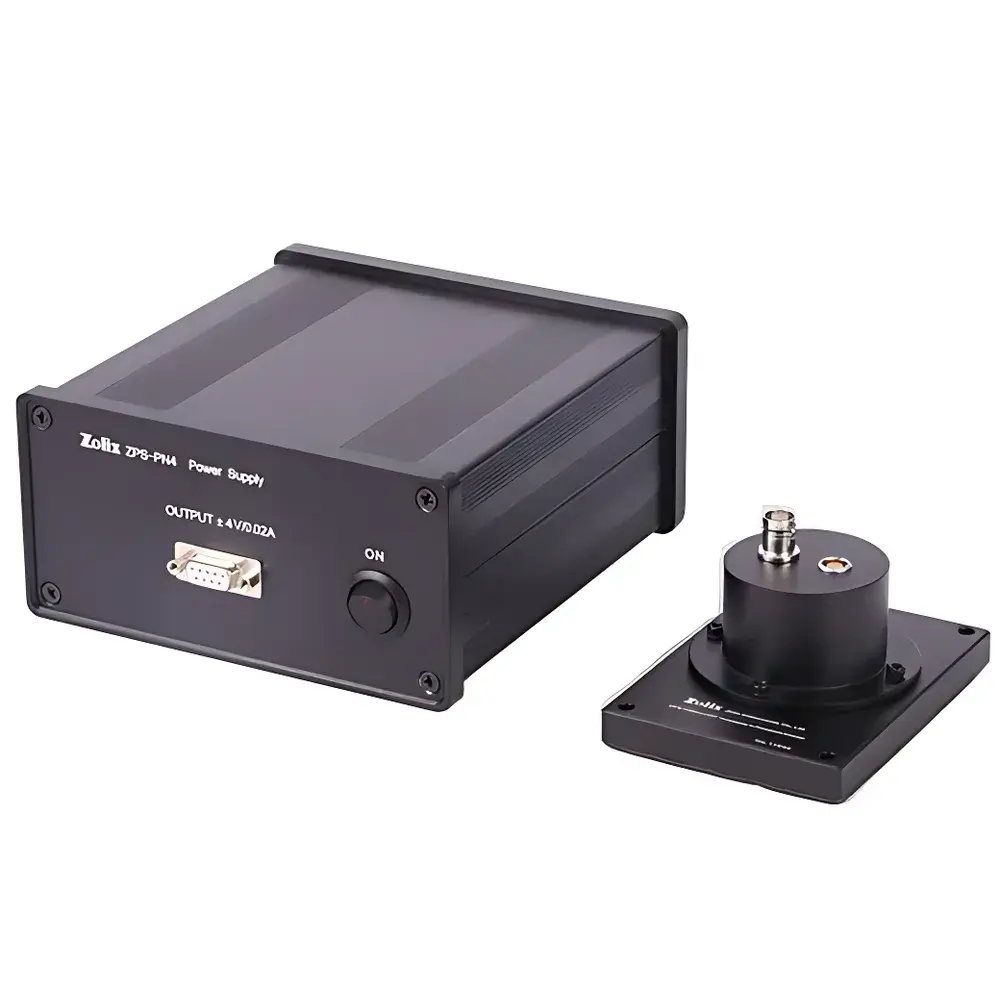
ZOLIX DPe Series Room-Temperature Pyroelectric Detector
| Brand | ZOLIX |
|---|---|
| Model | DPe Series |
| Type | Room-Temperature Pyroelectric Detector |
| Origin | Beijing, China |
| Manufacturer | ZOLIX (Producer) |
| Spectral Range | 2–16 µm (DPe16) / 2–22 µm (DPe22) |
| Active Area | 1.65 × 1.65 mm² |
| Photosensitive Diameter | 3.7 mm |
| Window Material Options | A4 (for DPe16), A3 (for DPe22) |
| Responsivity | 2.75 × 10⁵ V/W (typ., 10 Hz, 500 K blackbody) |
| Detectivity (D*) | 4.32 × 10⁸ cm·Hz¹ᐟ²/W (typ., 10 Hz, 1 Hz bandwidth) |
| NEP | 3.82 × 10⁻¹⁰ W/Hz¹ᐟ² (typ.) |
| Feedback Resistance | 10 GΩ |
| Feedback Capacitance | 200 ± 50 fF |
| Operating Voltage | ±2.2 to ±8 V |
| Operating Temperature | –10 to +50 °C |
| Output Polarity | Positive (P) |
| Required Signal Conditioning | Lock-in amplifier (e.g., DCS500PA recommended) |
| Optimal Modulation Frequency | ~10 Hz |
| Output Mode | Voltage |
Overview
The ZOLIX DPe Series is a line of room-temperature pyroelectric detectors engineered for cost-effective, high-fidelity infrared (IR) spectral measurements in laboratory and industrial spectroscopy systems. Unlike cryogenically cooled photon detectors, the DPe series operates uncooled—eliminating the need for liquid nitrogen or thermoelectric coolers—while maintaining robust performance across mid- to long-wave infrared (MWIR to LWIR) bands. Its core sensing element consists of a thin-film lead zirconate titanate (PZT) pyroelectric material, precisely deposited and patterned to maximize absorption efficiency within the active area. This architecture enables rapid thermal response to modulated IR radiation, generating a surface charge proportional to the rate of temperature change—principle governed by the pyroelectric effect. As such, the detector requires optical chopper modulation and synchronous detection (typically via lock-in amplification) to extract weak DC-coupled IR signals from noise. The DPe series is optimized for use in Fourier-transform infrared (FTIR) spectrometers, dispersive grating spectrometers, gas analyzers, and laser power monitoring setups where ambient-temperature operation, wide spectral coverage, and stable baseline performance are critical.
Key Features
- Uncooled operation: No cryogenic cooling required; functional across –10 °C to +50 °C ambient range.
- High responsivity: Up to 2.75 × 10⁵ V/W at 10 Hz (500 K blackbody source), enabling low-flux IR detection without signal averaging.
- Low noise floor: Typical NEP of 3.82 × 10⁻¹⁰ W/Hz¹ᐟ² supports detection of sub-mW IR power levels under standard modulation conditions.
- Wide spectral bandwidth: Configurable window options (A3: 2–22 µm; A4: 2–16 µm) allow tailoring to specific application windows while preserving broadband response.
- Stable thermal coefficient: Minimal drift in responsivity over temperature due to matched thermal expansion design between PZT film and substrate.
- Integrated transimpedance amplifier stage: Onboard 10 GΩ feedback resistor and 200 ± 50 fF capacitor ensure voltage-mode output with predictable gain and bandwidth characteristics.
- Standardized mechanical interface: Compact housing with SMA or BNC output connector, compatible with OEM integration into spectrometer optical benches and modular detector mounts.
Sample Compatibility & Compliance
The DPe series is compatible with any chopped or pulsed IR source emitting within its specified spectral range—including globar sources, quantum cascade lasers (QCLs), CO₂ lasers, and synchrotron beamlines. Its flat, uniform photosensitive area (1.65 × 1.65 mm²) ensures consistent spatial response for collimated or focused beams up to Ø3.7 mm. All units are manufactured under ISO 9001-certified quality control procedures. While not intrinsically certified for hazardous environments, the detector complies with IEC 61000-6-3 (EMC emission) and IEC 61000-6-2 (immunity) standards for laboratory instrumentation. For regulated environments (e.g., pharmaceutical QC labs), the DPe series may be deployed as part of a validated FTIR system compliant with USP , ASTM E1421, or ISO 17025 requirements—provided full system-level calibration traceability to NIST or equivalent national metrology institutes is maintained.
Software & Data Management
The DPe detector itself is analog-output only and does not include embedded firmware or digital interfaces. However, when paired with a lock-in amplifier such as the ZOLIX DCS500PA, it integrates seamlessly into common spectroscopic data acquisition workflows. The DCS500PA provides dual-phase demodulation, automatic gain control, real-time FFT analysis, and USB/Ethernet connectivity compatible with LabVIEW™, MATLAB®, Python (via PyVISA), and third-party spectroscopy platforms (e.g., OPUS, GRAMS). Raw voltage outputs are linear with incident IR power under constant modulation frequency and duty cycle—enabling quantitative radiometric calibration using NIST-traceable blackbody sources. Audit trails, calibration logs, and parameter history can be maintained externally through host software adhering to FDA 21 CFR Part 11 guidelines when used in GLP/GMP environments.
Applications
- Mid-IR absorption spectroscopy for organic compound identification and quantification (e.g., polymers, pharmaceuticals, environmental pollutants).
- Gas phase analysis of CO, CO₂, CH₄, NOₓ, and SF₆ using characteristic vibrational bands.
- Laser power and energy monitoring for QCLs and tunable IR lasers in R&D and process control.
- Thermal emission studies in materials science, including emissivity mapping and thin-film characterization.
- OEM integration into portable FTIR analyzers, combustion diagnostics systems, and industrial process monitors.
- Calibration reference channel in dual-beam spectrometers requiring matched thermal stability and spectral flatness.
FAQ
What modulation frequency should I use for optimal SNR?
The DPe series exhibits peak signal-to-noise ratio near 10 Hz under typical blackbody illumination (500 K, 1 Hz bandwidth). Performance degrades above ~50 Hz due to RC roll-off and reduced thermal time constant coupling efficiency.
Can I use the DPe detector without a lock-in amplifier?
No. Pyroelectric detectors generate AC-coupled charge signals only in response to *changing* irradiance. A chopper-modulated source and synchronous detection (lock-in) are mandatory for stable DC-equivalent output.
How do I select the appropriate window material?
A4 windows transmit 2–16 µm and offer higher transmission in the 8–12 µm atmospheric window; A3 extends to 22 µm but exhibits lower transmission beyond 16 µm. Selection depends on your source spectrum and target absorption features.
Is the detector sensitive to polarization or angle of incidence?
The PZT film exhibits minimal polarization dependence. However, >±15° angle of incidence may reduce effective responsivity due to Fresnel reflection losses—especially with coated windows. Normal incidence is recommended for calibration-grade work.
Does the DPe series support vacuum or purged environments?
Yes. The hermetically sealed TO-8 package is rated for dry nitrogen purge or moderate vacuum (≤10⁻² mbar). Avoid condensing humidity or corrosive atmospheres to preserve window integrity and electrode stability.






