
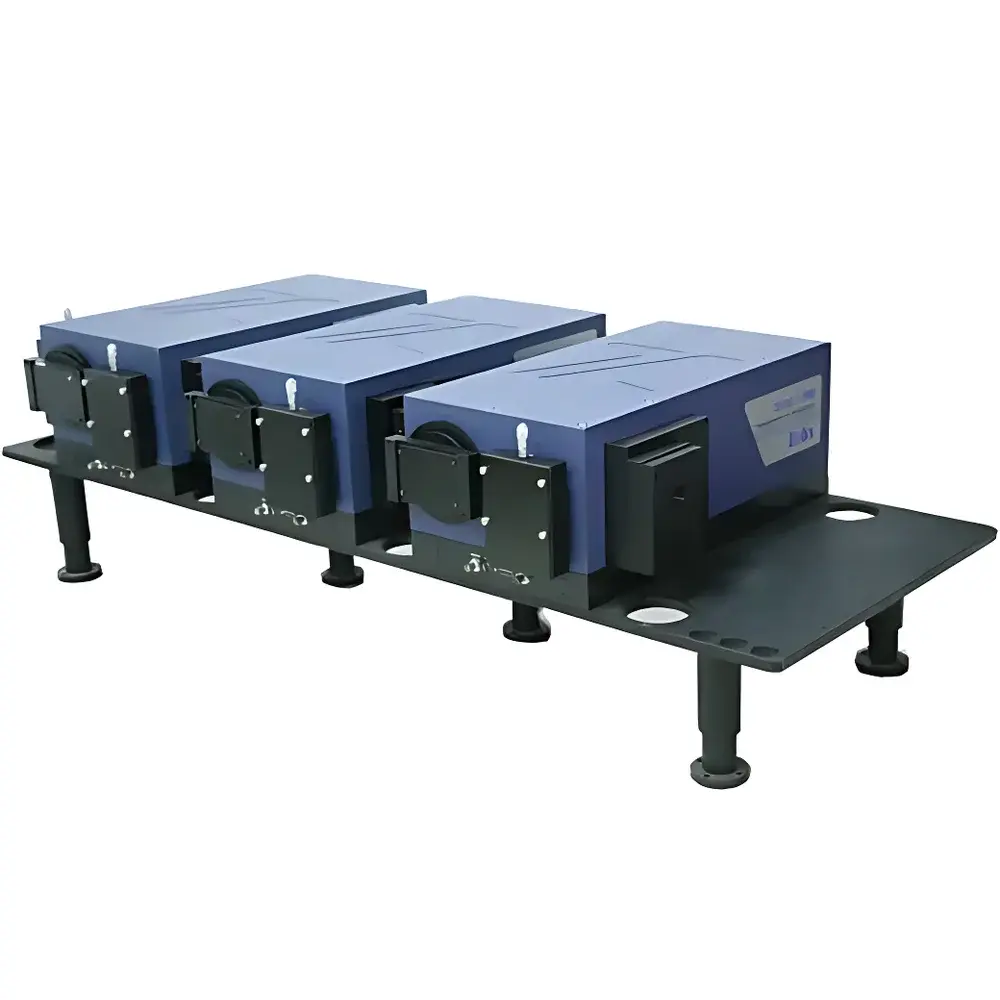
ZOLIX Finder Ultimate “Micro-Vibration” Triple-Stage Raman Spectrometer
| Brand | ZOLIX |
|---|---|
| Origin | Beijing, China |
| Manufacturer Type | Original Equipment Manufacturer (OEM) |
| Product Category | Domestic |
| Model | Finder Ultimate |
| Instrument Type | Confocal Micro-Raman Spectrometer |
| Spectral Range | 200–1000 nm |
| Spectral Resolution | ≤1 cm⁻¹ |
| Spatial Resolution | Lateral 1 µm, Axial 2 µm |
| Minimum Wavenumber | 15 cm⁻¹ |
| Spectral Reproducibility | ±0.1 cm⁻¹ |
Overview
The ZOLIX Finder Ultimate “Micro-Vibration” Triple-Stage Raman Spectrometer is a high-performance confocal micro-Raman system engineered for ultra-sensitive, fluorescence-suppressed resonance Raman measurements—particularly in the ultraviolet (UV) and visible spectral regions. It employs a triple-stage imaging-corrected spectrograph architecture (e.g., Omni-λ180Di + Omni-λ500i or Omni-λ500Di + Omni-λ500i configurations), eliminating reliance on notch or edge filters and enabling full laser wavelength flexibility without optical realignment. The system operates on the principle of resonance Raman scattering: when the excitation laser frequency overlaps with an electronic absorption band of the analyte, specific vibrational modes experience enhancement factors of 10⁴–10⁶, permitting detection of weak signals from trace surface species, isolated transition metal centers, or low-concentration intermediates in catalytic synthesis. UV excitation (244 nm, 266 nm, 325 nm) is strategically leveraged to circumvent autofluorescence—especially critical for porous materials (e.g., AlPO-5, Ti-MCM-41), biological macromolecules, and wide-bandgap oxides (TiO₂, ZrO₂)—where visible excitation induces overwhelming background emission.
Key Features
- Triple-stage imaging-corrected spectrograph design ensures high throughput, minimal stray light, and intrinsic wavelength calibration stability across UV–NIR excitation ranges
- Confocal microscope platform optimized for Raman—not adapted from standard microscopy—featuring motorized XYZ stage, precision objective turret, and integrated laser coupling optics
- Deep-cooled, back-illuminated scientific CCD detector (200–1000 nm responsivity) with thermoelectric cooling to –70 °C, delivering high quantum efficiency and low dark current for long integration acquisitions
- Modular laser compatibility: factory-integrated options include 244 nm (≥30 mW), 266 nm (≥30 mW), 325 nm (≥30 mW), 532 nm (≥50 mW), all TEM₀₀; optional narrow-linewidth tunable lasers (UV–NIR) support precise resonance wavelength mapping
- No re-alignment required when switching excitation wavelengths—optical path remains invariant due to monochromator-based filtering architecture
- Low-wavenumber capability down to 15 cm⁻¹ (extendable to <10 cm⁻¹ with optional ultra-low-wavenumber module), validated on crystalline L-cystine and phonon modes of 2D materials
Sample Compatibility & Compliance
The Finder Ultimate accommodates solid powders, single crystals, thin films, liquid cells, and biological tissues mounted on standard microscope slides or specialized sample holders (e.g., cryo-stages, heating stages). Its UV-compatible optics and vacuum-tight spectrograph housing prevent ozone-induced degradation and moisture-related signal drift. The system supports GLP/GMP-aligned workflows: spectral acquisition timestamps, user authentication logs, and detector gain/temperature metadata are embedded in raw data files (FITS or HDF5 format). While not pre-certified for FDA 21 CFR Part 11, its software architecture permits configuration of audit trails, electronic signatures, and version-controlled method templates—enabling compliance readiness for regulated environments in pharmaceutical development or catalyst QA/QC labs.
Software & Data Management
ZOLIX SpectraPro Suite v5.x provides instrument control, real-time spectral preview, multi-point mapping, and advanced post-processing (baseline correction via asymmetric least squares, peak deconvolution using Voigt profiles, multivariate curve resolution). All spectra are saved with embedded EXIF-like metadata—including laser power (measured at sample plane), grating position, slit width, integration time, and environmental temperature. Batch processing supports ASTM E1840-compliant wavenumber calibration validation using NIST-traceable polystyrene or silicon standards. Export formats include ASCII (.txt), JCAMP-DX, and vendor-neutral .spc for third-party chemometric tools (e.g., MATLAB, Python SciPy, Unscrambler).
Applications
- Catalysis Research: Identification of isolated Ti⁴⁺ sites in Ti-MCM-41 frameworks; in situ monitoring of molecular sieve precursor condensation and crystallization kinetics
- Materials Science: Surface-phase discrimination in TiO₂ polymorphs (anatase vs. rutile); strain analysis in graphene and transition metal dichalcogenides
- Life Sciences: Conformational fingerprinting of proteins and nucleic acids under native conditions; label-free detection of oxidative stress markers in single cells
- Nanotechnology: Defect characterization in carbon nanotubes and quantum dots; plasmon-enhanced Raman mapping of hybrid nanostructures
- Geochemistry & Forensics: Non-destructive mineral phase identification in microparticles; pigment analysis in historical artifacts
FAQ
What excitation wavelengths are supported without hardware modification?
244 nm, 266 nm, 325 nm, and 532 nm lasers are fully integrated with calibrated optical paths. Tunable lasers require optional fiber-coupled input modules.
Can the system achieve sub-15 cm⁻¹ wavenumbers?
Yes—when equipped with the ultra-low-wavenumber module, the system achieves reliable signal acquisition down to 5 cm⁻¹, verified using rotational Raman bands of nitrogen gas.
Is spectral calibration traceable to NIST standards?
Yes—calibration routines include automated alignment against Si (520.7 cm⁻¹), polystyrene (1001 cm⁻¹), and neon emission lines; calibration certificates reference NIST SRM 2241 and 2242.
How is fluorescence suppression quantified in practice?
Signal-to-background ratio (SBR) comparisons across 244 nm, 325 nm, and 532 nm excitations on AlPO-5 show >10³-fold reduction in broadband fluorescence intensity at 244 nm versus 532 nm, while preserving Raman peak integrity.
Does the system support time-resolved Raman measurements?
Not natively—but the CCD’s programmable shutter and external TTL triggering enable pump-probe synchronization with picosecond laser systems when integrated via third-party timing controllers.



