
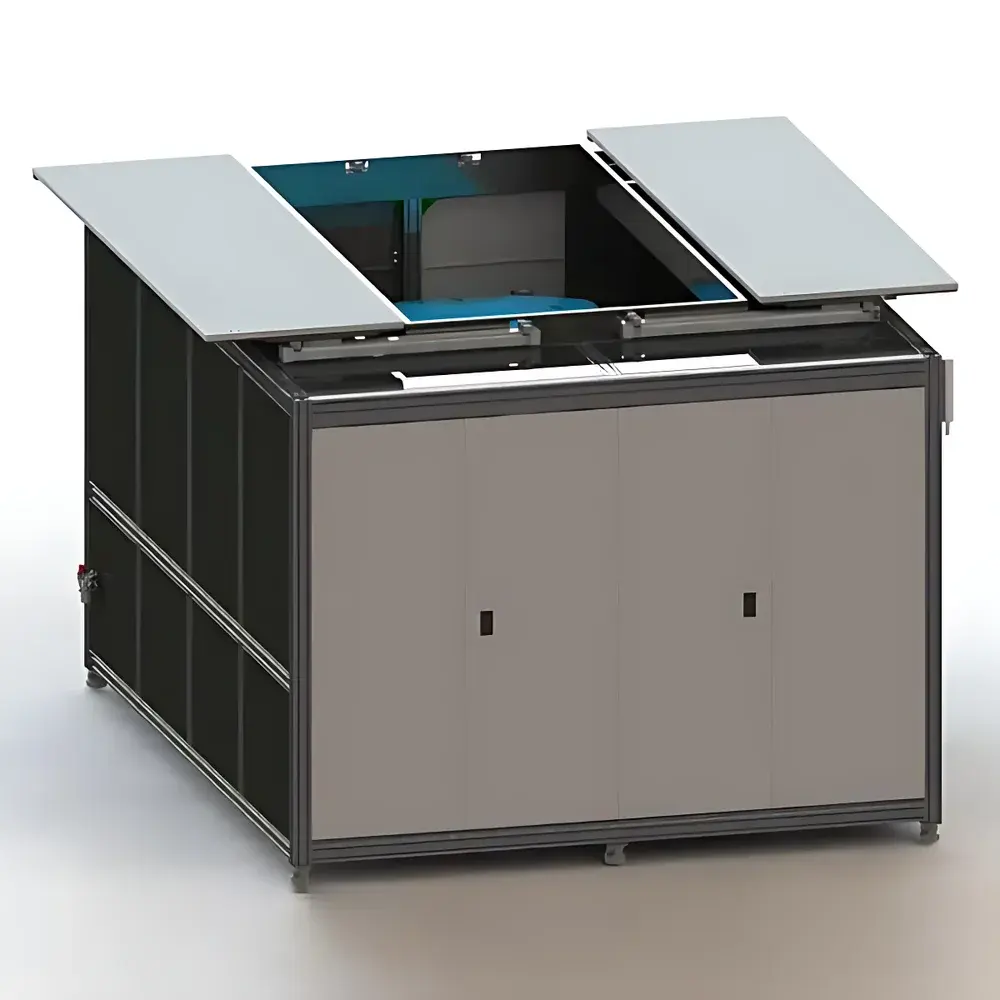
ZOLIX Integrated Automotive Ambient Lighting Assembly Automated Measurement System
| Brand | ZOLIX |
|---|---|
| Origin | Beijing, China |
| Manufacturer Type | Authorized Distributor |
| Product Origin | Domestic (China) |
| Model | Assembly Auto-Measurement System |
| Price Range | USD 7,000 – 70,000 |
| Motion Stage Accuracy | ±0.01 mm |
| Max Test Area | 2000 mm × 1500 mm |
| Measurement Parameters | Luminance, Luminance Distribution, Chromaticity (CIE x,y & u'v'), Chromaticity Uniformity, Defect Detection (pixel-level anomaly), Antenna Resistance (4-wire Kelvin) |
| Data Traceability | Full Audit Trail with Timestamped Metadata |
| Automation | Automatic Power-on/Power-off via Relay-Controlled Socket & Motorized Connector Actuation |
| Software | Region-of-Interest (ROI) Customization, Arbitrary Shape Definition, Large-Area Image Mosaic & Photometric Calibration Integration |
Overview
The ZOLIX Integrated Automotive Ambient Lighting Assembly Automated Measurement System is a turnkey photometric and electro-optical test platform engineered for precision characterization of automotive interior ambient lighting modules. Built around a light-tight darkroom environment, the system combines a calibrated imaging luminance meter (ILM), high-resolution CCD sensor, motorized multi-axis motion stage, industrial control computer, and deterministic motion control firmware into a unified hardware-software architecture. It operates on fundamental principles of digital radiometry and colorimetry—capturing spatially resolved luminance (cd/m²) and chromaticity (CIE 1931 xy or CIE 1976 u’v’) data across extended planar surfaces, while simultaneously performing electrical continuity and antenna resistance verification using four-wire Kelvin sensing. Designed explicitly for Tier-1 suppliers and OEM R&D labs, the system supports both offline validation during development and inline-ready deployment in pilot production lines—ensuring consistent compliance with internal lighting performance specifications and industry benchmarks such as SAE J1383, ISO 15008, and UNECE R149 Annex 11.
Key Features
- Sub-10 µm positional repeatability achieved via high-rigidity linear stages with closed-loop servo feedback and optical encoder resolution ≤ 0.5 µm per step.
- Scalable darkroom enclosure accommodating assemblies up to 2000 mm × 1500 mm; modular wall panels with RF-shielded gaskets and NIST-traceable black velvet lining (reflectance < 0.5% @ 400–700 nm).
- Imaging luminance meter calibrated against a primary standard lamp traceable to NIM (National Institute of Metrology, China); dynamic range: 0.001–10⁶ cd/m² with <±2% linearity error across full scale.
- Automated electrical interface actuation: motor-driven connector arm performs repeatable mating/unmating of FAKRA, USCAR-2, or LVDS interfaces; integrated relay bank enables controlled power sequencing per pin group.
- Real-time pass/fail classification engine: user-defined thresholds applied per ROI for luminance min/max, Δu’v’ deviation, pixel defect count, and contact resistance tolerance (e.g., <50 mΩ for antenna paths).
- Software-supported geometric flexibility: polygonal, elliptical, or freehand ROIs; automatic edge detection for backlight boundary identification; mosaic stitching of >100 overlapping frames with photometric normalization.
Sample Compatibility & Compliance
The system accommodates rigid PCB-mounted LED arrays, flexible printed circuit (FPC)-based light guides, injection-molded diffuser housings, and hybrid opto-mechanical assemblies incorporating embedded antennas or touch-sensitive zones. All mechanical fixtures are non-marring and pneumatically adjustable to avoid stress-induced photometric drift. Data acquisition adheres to GLP-compliant workflows: each measurement session generates a ZIP archive containing raw ILM images (16-bit TIFF), calibrated photometric maps (EXR format), resistance logs (CSV with timestamp, channel ID, temperature compensation flag), and full system configuration snapshots. Audit trails meet FDA 21 CFR Part 11 requirements—including electronic signatures, operator ID binding, and immutable log rotation—enabling direct integration into enterprise QMS platforms such as ETQ Reliance or MasterControl.
Software & Data Management
The proprietary ZOLIX LightTest Suite v4.x provides a role-based GUI with three operational modes: Development (scriptable Python API access), Production (locked-down operator interface with barcode-triggered job loading), and Calibration (NIST-maintained reference tile mapping and sensor degradation monitoring). Raw image data undergoes fixed-pattern noise correction, vignetting compensation, and CIE tristimulus transformation using pre-characterized spectral response matrices. Export options include PDF reports compliant with AIAG CQI-23, Excel-based statistical summaries (Cp/Cpk, Ppk), and XML schemas compatible with MES systems via RESTful webhooks. All datasets are stored in AES-256 encrypted SQLite databases with automatic daily offsite backup to configurable NAS or S3-compatible object storage.
Applications
- Validation of angular luminance distribution for compliance with driver distraction thresholds (SAE J1757-1).
- Quantification of chromaticity shift across thermal soak cycles (−40°C to +85°C) using synchronized environmental chamber triggers.
- Detection of micro-defects including solder voids, phosphor delamination, and silicone bubble artifacts at ≥50 µm resolution.
- Correlation of antenna impedance variation with housing warpage measured via structured-light 3D scan overlay.
- Statistical process control (SPC) charting of luminance uniformity index (LUI = Lmin/Lmax) across production batches.
FAQ
Does the system support third-party calibration certificates?
Yes—ZOLIX provides optional NIST-traceable calibration documentation issued by CNAS-accredited laboratories (ISO/IEC 17025), including spectral irradiance, luminance, and resistance verification reports valid for 12 months.
Can the software interface with PLC-controlled conveyor lines?
Yes—the system includes dual Ethernet ports: one for standard TCP/IP communication with Rockwell ControlLogix or Siemens S7-1500 PLCs via Modbus TCP, and another for isolated factory network segmentation.
Is thermal management integrated for long-duration measurements?
The darkroom features active ventilation with PID-controlled exhaust fans and optional Peltier-cooled sensor mounting plates to stabilize CCD operating temperature within ±0.5°C over 8-hour sessions.
What file formats are supported for CAD-based ROI import?
STEP AP214, IGES, and DXF files can be imported to overlay physical part geometry onto the measurement coordinate system; alignment is performed via three-point fiducial matching.
How is electrical safety ensured during automated connector actuation?
All high-voltage paths (>30 VDC) are interlocked with door switches and current-limited via programmable power supplies; force-sensing resistors monitor insertion load to abort motion if >5 N threshold is exceeded.
Related Products







