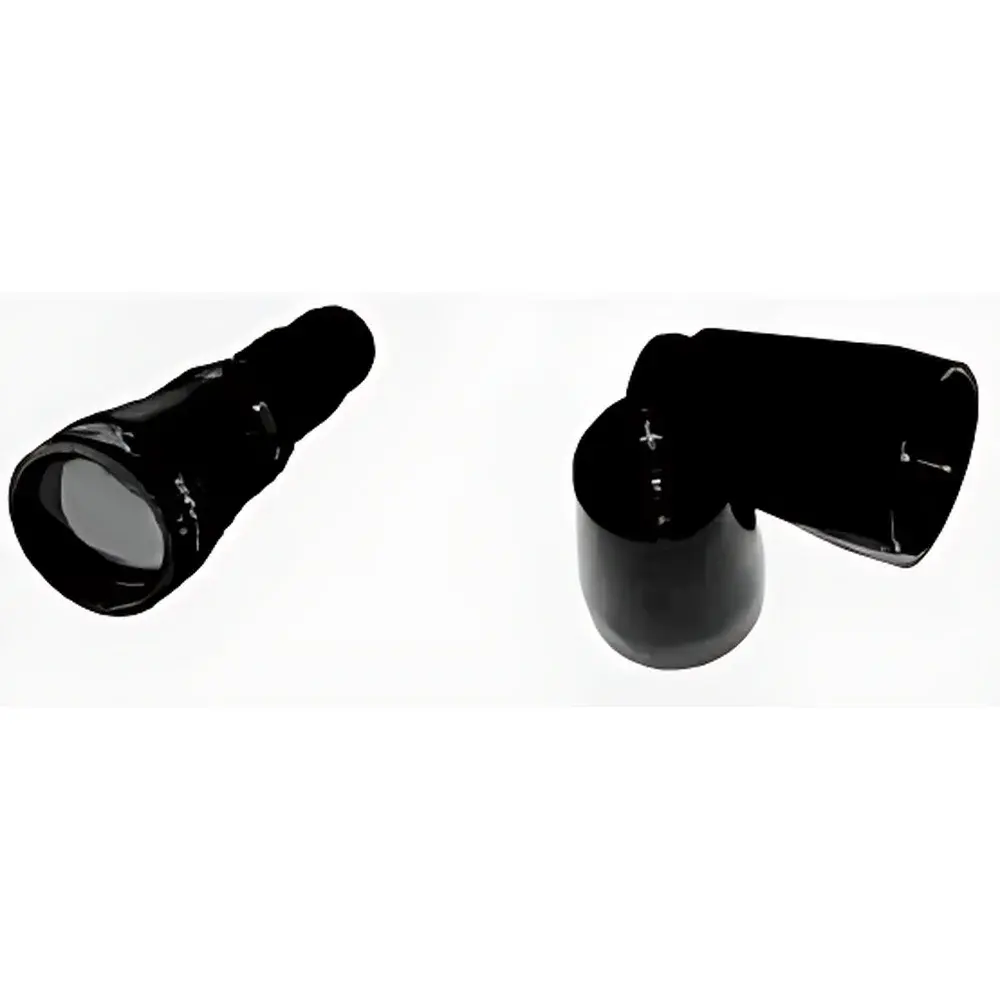
ZOLIX LBE Series Galilean Laser Beam Expander
| Brand | ZOLIX |
|---|---|
| Model | LBE Series |
| Optical Design | Galilean (2-element) |
| Wavelength Options | 532 nm, 632.8 nm, 1064 nm |
| Expansion Ratios | 2.5× to 10× |
| Max Input Aperture | 10 mm |
| Max Output Aperture | 40 mm |
| Transmission | >92%–>95% |
| Housing Material | Anodized Aluminum |
| Mounting Thread | M22×0.75 or M34×1 |
| Length | 80–188.5 mm |
| Diameter | 26–48 mm |
| Compliance | ISO 10110 optical surface specifications, RoHS-compliant coatings |
Overview
The ZOLIX LBE Series Galilean Laser Beam Expander is a precision-engineered optical component designed for stable, low-wavefront-distortion beam resizing in demanding laboratory and industrial laser applications. Based on the Galilean telescope configuration—comprising a negative (diverging) front element and a positive (converging) rear element—the LBE Series eliminates internal focus points, minimizing the risk of air breakdown, thermal lensing, and nonlinear effects when used with high-peak-power pulsed lasers. Unlike Keplerian designs, Galilean expanders maintain compact physical profiles while delivering diffraction-limited performance across visible and near-infrared wavelengths (532 nm, 632.8 nm, and 1064 nm). These units are optimized for two primary functions: (1) increasing beam diameter prior to focusing—thereby reducing focused spot size in accordance with the diffraction limit—and (2) improving beam collimation by lowering divergence angularly, which enhances propagation stability over extended working distances. Each unit is assembled under cleanroom conditions and aligned to meet ISO 10110 surface quality standards (scratch-dig ≤ 20–10), ensuring minimal scatter and high spatial coherence preservation.
Key Features
- Galilean two-lens architecture with no internal focus—enabling safe operation with Q-switched and ultrafast laser systems
- Multi-layer anti-reflection (AR) coatings optimized per wavelength band: >95% average transmission at 532 nm and 632.8 nm; >92% at 1064 nm
- Hard-anodized aluminum housings with precise kinematic mounting threads (M22×0.75 or M34×1) for repeatable integration into optical tables and OEM laser platforms
- Fixed-ratio models (LBE532-, LBE633-, LBE1064-) calibrated for ±0.5% magnification tolerance; variable-ratio LBEZ model supports continuous adjustment from 2.5× to 10× via axial translation mechanism
- Controlled wavefront error < λ/8 RMS @ 633 nm (measured interferometrically per ISO 10110-5)
- Robust mechanical design qualified for vibration environments per MIL-STD-810G, Method 514.6, Category 24
Sample Compatibility & Compliance
The LBE Series accommodates collimated input beams up to 10 mm in diameter and delivers output diameters scalable from 30 mm to 40 mm depending on expansion ratio and model. It is compatible with TEM00 and low-order multimode beams from CW diode-pumped solid-state (DPSS), HeNe, and fiber lasers. All AR coatings comply with ISO 9211-3 for environmental durability (adhesion, humidity, abrasion) and meet RoHS Directive 2011/65/EU requirements for restricted substances. Units intended for regulated environments—including ISO 13485-certified medical device manufacturing or GLP-compliant spectroscopy labs—support traceable calibration documentation upon request. While not inherently FDA 21 CFR Part 11 compliant (as a passive optical component), the LBE Series integrates seamlessly into validated optical subsystems where electronic audit trails are managed at the system level.
Software & Data Management
As a purely passive optical component, the ZOLIX LBE Series requires no firmware, drivers, or embedded software. However, its geometric and transmission specifications are fully documented in machine-readable format (CSV and JSON) for integration into optical design workflows using Zemax OpticStudio, CODE V, or FRED. ZOLIX provides downloadable raytrace files (.zmx, .cvp) for each standard model, enabling accurate modeling of beam propagation, M² impact, and pupil conjugation effects. For OEM customers integrating LBE units into automated alignment systems, mechanical drawings (STEP, IGES) and GD&T annotations—including coaxiality tolerances (<15 µm) and thread runout limits (<0.02 mm)—are supplied under NDA.
Applications
- Laser material processing: Pre-focusing beam expansion for high-resolution micromachining, thin-film ablation, and selective laser sintering
- Interferometry and metrology: Improving fringe contrast and measurement range in Michelson, Twyman–Green, and digital holographic setups
- Free-space optical communications: Enhancing link margin through reduced beam divergence and improved pointing stability
- Ultrafast science: Conditioning Ti:sapphire and Yb-fiber amplifier outputs prior to pulse compression or OPCPA stages
- Biophotonics: Enabling uniform illumination in confocal microscopy, optical trapping, and flow cytometry excitation paths
- Defense & aerospace: Beam conditioning for lidar transceivers, directed energy testbeds, and satellite-based laser ranging payloads
FAQ
What is the difference between Galilean and Keplerian beam expanders?
Galilean expanders use a diverging lens followed by a converging lens, producing a compact, focus-free path ideal for high-power lasers. Keplerian designs include an internal focus, making them susceptible to air ionization and thermal distortion at high intensities.
Can the LBE Series be used with femtosecond lasers?
Yes—provided the input beam is collimated and within specified diameter limits. Group delay dispersion (GDD) is negligible for standard fused silica elements below 100 fs pulse widths; custom chirped-mirror-corrected variants are available upon request.
Is there a version with motorized zoom functionality?
The manual LBEZ model offers continuous 2.5×–10× adjustment. Motorized versions with stepper-driven translation stages and encoder feedback (±0.1× repeatability) are offered as custom OEM configurations.
Do you provide wavefront error measurements for individual units?
Yes—certified interferometric test reports (per ISO 10110-5) are available as optional add-ons, including PV and RMS wavefront deviation, transmitted wavefront error maps, and beam displacement data.
Are custom wavelengths or coatings supported?
ZOLIX offers custom AR coatings for UV (266 nm), UV-VIS (355 nm), and SWIR (1550 nm) bands, subject to minimum order quantities and coating chamber scheduling. Custom mechanical interfaces (e.g., SM1-threaded, CF-flanged) are also supported.