
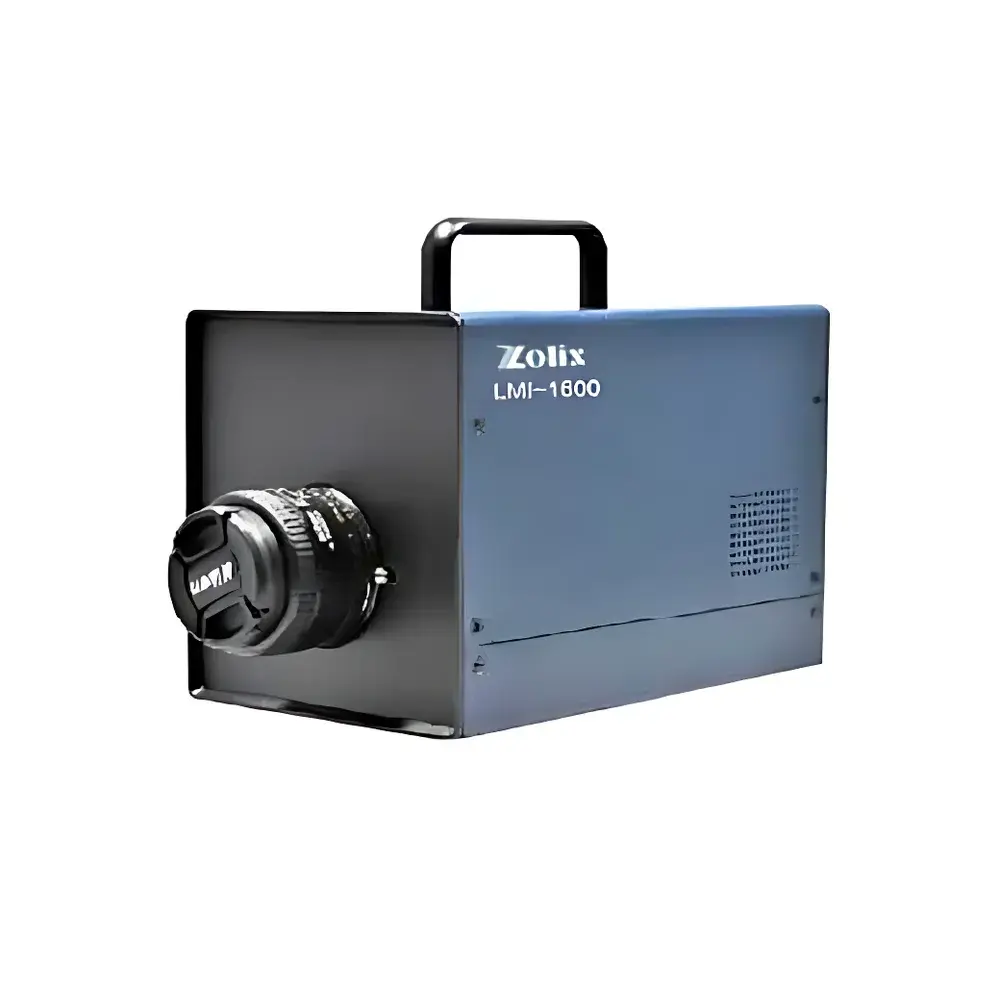
ZOLIX LMI Series Imaging Luminance Meter
| Brand | ZOLIX |
|---|---|
| Model | LMI Series |
| Detector Type | CMOS (varies by model: 1/1.2″ to Full-Frame) |
| Resolution Options | 2.28 MP to 60.92 MP |
| Pixel Size | 2.4–5.68 µm |
| Bit Depth | 16-bit |
| Dynamic Range | >1,000,000:1 (via multi-exposure or ND filters) |
| Cooling | Two-stage thermoelectric cooling (ΔT ≤ −45°C below ambient) |
| Exposure Time | 16 µs – 60 s |
| Luminance Range | 0.0001 – 100,000 cd/m² |
| Accuracy | ±3% |
| Repeatability | ±0.5% |
| Photometric Filter | CIE Y(λ) matching filter |
| Frame Rate | Up to 100 fps (LMI-200, full resolution) |
| Memory Buffer | 128 MB DDR (LMI-1600) |
| Interface | USB 3.0 / 2.0 |
| Lens Mount | C-mount |
| Compatible Lenses | 24 mm, 28 mm, 35 mm, 50 mm, 100 mm |
| Dimensions (W×H×D, body only) | 88 × 88 × 150 mm |
| Operating Temperature | 5–50 °C |
| Power Supply | AC adapter |
Overview
The ZOLIX LMI Series Imaging Luminance Meter is a high-precision, scientific-grade instrument engineered for quantitative spatial luminance measurement across industrial R&D, quality control, and photometric compliance testing environments. Based on calibrated CMOS imaging photometry, the system captures two-dimensional luminance distributions with pixel-level radiometric accuracy—enabling objective evaluation of brightness, uniformity, contrast, and glare characteristics of self-luminous and reflective light sources. Each model integrates a CIE 1931 photopic luminosity function (V(λ))-matched Y-filter, ensuring traceable alignment with human visual sensitivity and international photometric standards including CIE S 026/E:2015 and ISO/CIE 11664-3:2012. The series supports both single-shot and multi-exposure acquisition modes, coupled with neutral density (ND) filtration, to achieve an effective dynamic range exceeding 1,000,000:1—critical for evaluating high-contrast displays and automotive lighting systems where peak luminance and near-black performance must be assessed simultaneously.
Key Features
- Multi-resolution platform: Select from four core configurations (LMI-200, LMI-1600, LMI-2000, LMI-6100), each optimized for distinct trade-offs among spatial resolution, frame rate, readout noise, and field-of-view coverage.
- Scientific-grade sensor architecture: Back-illuminated (LMI-2000) and high-quantum-efficiency CMOS detectors with sub-electron read noise (LMI-2000: ≤1 e⁻ RMS), enabling low-light photometry without compromising signal fidelity.
- Thermoelectric stabilization: Dual-stage Peltier cooling maintains detector temperature up to 45°C below ambient, suppressing dark current drift and ensuring long-exposure stability required for precision photometry.
- Region-of-interest (ROI) analysis: Software-defined ROIs allow extraction of localized luminance statistics—mean, max, min, standard deviation—while excluding non-emissive or out-of-spec regions from computation.
- Real-time high-speed acquisition: LMI-200 delivers full-resolution (1900 × 1200) capture at up to 100 fps; LMI-1600 leverages 128 MB onboard DDR buffer for sustained burst capture independent of host PC performance.
- C-mount lens compatibility: Interchangeable lenses (24 mm to 100 mm) support flexible working distances and magnification, validated for telecentric and low-distortion photometric imaging per ISO 9037.
Sample Compatibility & Compliance
The LMI Series is designed for direct measurement of emissive surfaces under controlled illumination conditions, including LCD, OLED, MicroLED, and LED-based displays; automotive lighting (headlamps, DRLs, taillights, interior ambient lighting); avionics and dashboard instrumentation; backlit keyboards and membrane switches; and architectural and roadway lighting installations. All models comply with photometric calibration traceability to NIM (National Institute of Metrology, China) and support optional factory calibration certificates aligned with ISO/IEC 17025 requirements. When used with optional glare analysis software modules, measurements satisfy calculation methods defined in CIE 115:2010 (Road Lighting) and EN 12464-1:2021 (Lighting of Workplaces). Data export formats include CSV, TIFF (16-bit linear), and HDF5—compatible with third-party optical simulation tools (e.g., LightTools, TracePro) and statistical process control (SPC) platforms.
Software & Data Management
ZOLIX LumiView Pro software provides a complete photometric workflow—from real-time preview and auto-exposure optimization to batch analysis, report generation, and pass/fail mapping against user-defined uniformity thresholds (e.g., ΔL/L ≤ ±5%). The software implements audit-trail logging compliant with GLP principles and supports configurable user roles, electronic signatures, and data integrity safeguards. Exported datasets retain full metadata (exposure time, gain, lens ID, filter status, calibration timestamp), enabling retrospective traceability and FDA 21 CFR Part 11–compliant validation when deployed in regulated manufacturing environments. Raw image data is stored in lossless 16-bit format; processed results include luminance histograms, false-color heatmaps, and ISO-defined uniformity metrics (e.g., minimum/maximum ratio, center-to-corner drop).
Applications
- Display metrology: Mura detection, luminance uniformity mapping (e.g., ISO 13406-2), viewing angle characterization, and HDR tone-mapping verification.
- Automotive lighting certification: Photometric validation of ECE R149 (headlamps), SAE J1383 (signal lamps), and UNECE Regulation 128 (LED modules).
- Consumer electronics QA: Brightness grading of smartphone OLED panels, backlight leakage assessment, and keyboard character legibility testing under multiple ambient illuminances.
- Architectural lighting design: Vertical/horizontal illuminance mapping, discomfort glare index (UGR) calculation, and compliance reporting for LEED v4.1 and WELL Building Standard lighting credits.
- Cinema projection validation: Screen luminance uniformity, black level stability, and ANSI contrast ratio measurement per DCI-P3 and SMPTE RP 431-2.
FAQ
What photometric standards does the LMI Series support?
The system adheres to CIE 1931 V(λ) spectral response, with factory calibration traceable to national primary standards. It supports measurement protocols referenced in ISO/CIE 11664-3, CIE S 026/E:2015, and ASTM E308-22.
Can the LMI Series measure luminance under pulsed or PWM-driven LEDs?
Yes—via adjustable exposure timing (16 µs minimum) and external trigger synchronization (TTL input), enabling precise integration over single or multiple drive cycles.
Is remote operation and automation supported?
Full API access (C++, Python, .NET SDK) enables integration into automated test benches, robotic positioning systems, and CI/CD-enabled optical QA pipelines.
How is calibration maintained over time?
Each unit includes a removable NIST-traceable reference luminance source for daily verification. Optional annual recalibration services are available through ZOLIX-certified labs with ISO/IEC 17025 accreditation.
Does the system require darkroom conditions for low-luminance measurements?
While not mandatory, ambient light control (< 0.1 lux) is recommended for measurements below 0.01 cd/m² to maintain specified repeatability and minimize stray-light contribution.





