
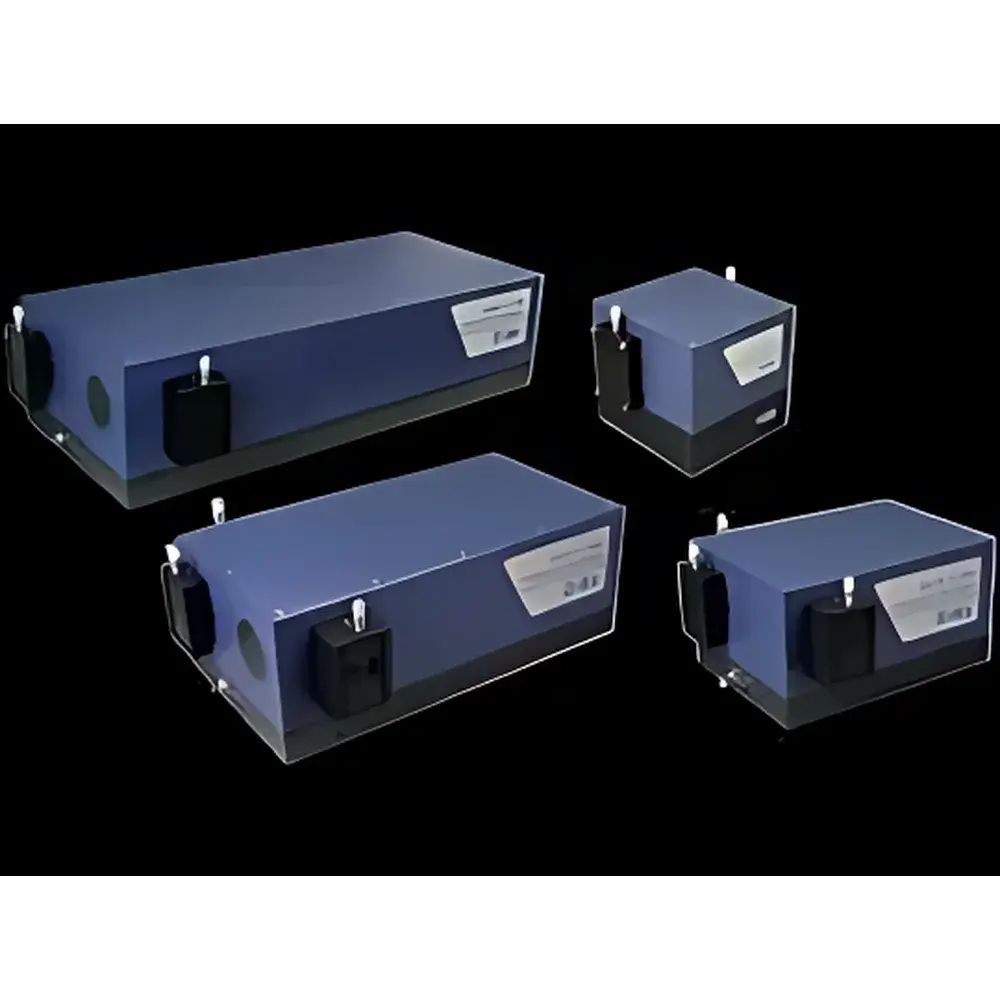
ZOLIX Omni-λ Series Czerny-Turner Grating Monochromator / Spectrometer
| Brand | ZOLIX |
|---|---|
| Origin | Beijing, China |
| Manufacturer Type | Original Equipment Manufacturer (OEM) |
| Product Category | Domestic |
| Model | Omni-λ |
| Instrument Type | Laboratory Benchtop Spectrometer |
| Operating Principle | Grating Scanning Monochromator |
| Wavelength Range | 300–2600 nm |
| Scan Speed | 400 nm/min |
| Data Sampling Interval | 0.1 nm |
| Sample Measurement Modes | Diffuse Reflectance / Transmission |
| Chemometrics Software | ZolixScanBasic V4 |
| Focal Length Options | 150 mm / 300 mm |
| Optical Design | Czerny-Turner |
| Grating Mount | Dual- or Triple-Grating Turret |
| Grating Sizes | 32×32 mm / 68×68 mm |
| IR-Optimized Optics | Gold-Coated Mirrors for >1 µm |
| Entrance/Exit Port Configuration | Motorized Dual Input/Dual Output |
| Slit Width Adjustment | 0.01–3 mm (manual), optional motorized |
| Slit Height Options | 2 mm / 4 mm / 14 mm |
| Resolution (1200 g/mm) | 0.4 nm (Omni-λ150) / 0.1 nm (Omni-λ300) |
| Wavelength Accuracy | ±0.25 nm (Omni-λ150) / ±0.2 nm (Omni-λ300) |
| Wavelength Repeatability | ±0.1 nm |
| Minimum Step Size | 0.01 nm (Omni-λ150) / 0.005 nm (Omni-λ300) |
| Focal Plane Dimensions | 25×10 mm (Omni-λ150) / 27×14 mm (Omni-λ300) |
| Optical Axis Height | 137.5 mm |
| Interface | Standard USB 2.0 (RS-232 optional) |
| Weight | 5 kg (Omni-λ150) / 15 kg (Omni-λ300) |
Overview
The ZOLIX Omni-λ Series is a modular, computer-controlled Czerny-Turner grating monochromator designed for high-flexibility spectral analysis across the ultraviolet, visible, and near-infrared (UV-VIS-NIR) regions—from 300 nm to 2600 nm. Engineered for precision spectroscopic system integration, it operates on the principle of mechanical grating scanning, where wavelength selection is achieved via precise rotation of a ruled or holographic diffraction grating within a fixed optical path. Its core architecture features a kinematically stable optical bench, gold-coated mirrors optimized for >1 µm reflectivity, and interchangeable grating turrets supporting dual- or triple-grating configurations. This enables seamless switching between spectral resolution, dispersion, and throughput requirements without realignment—critical for multi-technique platforms such as fluorescence, Raman, transmission/reflectance, absorption, and emission spectroscopy. Introduced in 2005 as the third-generation iteration, the Omni-λ series integrates a dedicated digital signal processor (DSP) for deterministic motion control, eliminating timing jitter in wavelength scanning and ensuring sub-nanometer positional repeatability.
Key Features
- Czerny-Turner optical layout with f/4.2 (Omni-λ150) or f/3.9 (Omni-λ300) relative aperture, delivering high throughput and minimal aberration across broad spectral bands.
- Modular grating turret accommodating up to three gratings (68×68 mm standard for Omni-λ300; 32×32 mm for Omni-λ150), each selectable under software command with <±0.01° angular reproducibility.
- Motorized dual-input/dual-output port configuration, enabling simultaneous coupling to multiple light sources and detectors—ideal for synchronous excitation/emission measurements or reference-beam normalization.
- Manually adjustable slit (0.01–3 mm width; 2/4/14 mm height options) with optional motorized actuation for automated bandwidth control and dynamic range optimization.
- USB 2.0 interface replacing legacy RS-232, supporting real-time data streaming at up to 480 Mbps and reducing host PC latency for time-resolved applications.
- DSP-based motion controller synchronizing grating rotation, filter wheel positioning, and slit actuation—ensuring coordinated hardware sequencing compliant with GLP/GMP instrument qualification protocols.
Sample Compatibility & Compliance
The Omni-λ supports both transmission and diffuse reflectance measurement geometries through standardized SMA905 or FC/PC fiber interfaces or direct free-space coupling. Its extended NIR coverage (up to 2600 nm) and gold-coated optics meet ASTM E1421-22 requirements for near-infrared spectrophotometric performance verification. The system complies with IEC 61326-1:2013 for electromagnetic compatibility in laboratory environments and conforms to RoHS Directive 2011/65/EU for hazardous substance restriction. When integrated into regulated workflows (e.g., pharmaceutical raw material ID per USP ), the ZolixScanBasic V4 software supports audit-trail-enabled operation and user-access-level management aligned with FDA 21 CFR Part 11 principles.
Software & Data Management
ZolixScanBasic V4 is a Windows-based acquisition and chemometrics platform providing full instrument control—including grating selection, wavelength scan definition, slit automation, and filter wheel sequencing. It exports spectral data in ASCII (.txt), CSV, and JCAMP-DX formats compatible with third-party analysis tools (e.g., MATLAB, Unscrambler X, Pirouette). The software includes baseline correction, smoothing, peak integration, and multivariate calibration modules (PLS, PCA) for quantitative modeling. All instrument parameter changes are timestamped and logged with operator ID, satisfying ALCOA+ data integrity criteria. Remote operation via TCP/IP is supported for integration into automated lab systems.
Applications
- Fluorescence spectroscopy: Excitation/emission mapping using dual-monochromator configurations (e.g., Omni-λ300 + Omni-λ300 cascade).
- Raman spectroscopy: High-throughput filtering of Rayleigh scatter with narrow-band rejection using matched grating pairs.
- NIR quality control: Quantitative analysis of moisture, protein, and lipid content in agricultural and pharmaceutical powders.
- Light source characterization: Spectral power distribution (SPD) measurement of LEDs, lasers, and broadband lamps per CIE S 025/E:2015.
- Thin-film optical monitoring: In-situ transmittance/reflectance tracking during physical vapor deposition (PVD) processes.
- Academic research: Customizable optical train assembly for pump-probe, hyperspectral imaging, or cavity-enhanced absorption setups.
FAQ
What wavelength calibration standards are recommended for routine verification?
NIST-traceable Hg-Ne and tungsten-halogen lamp sources are recommended; ZolixScanBasic V4 includes automated peak search and polynomial fit routines for wavelength calibration.
Can the Omni-λ be operated in zero-order bypass mode for broadband illumination?
Yes—motorized grating ejection allows direct beam passage through the entrance-to-exit port, preserving étendue for white-light applications.
Is vacuum purging supported for UV measurements below 200 nm?
No—standard models are air-path only; vacuum-compatible variants (Omni-λ-VAC) require custom quotation and modified housing seals.
What is the maximum allowable input irradiance before detector saturation or optical damage?
Depends on coupled detector; for typical Si CCDs, incident power should remain below 10 mW/mm² at focal plane; gold mirrors withstand >10 W/cm² CW exposure at >1 µm.
Does ZOLIX provide IQ/OQ documentation packages for GxP environments?
Yes—validated installation and operational qualification templates, including test protocols and acceptance criteria aligned with ISO/IEC 17025 and ASTM E2500, are available upon request.




