
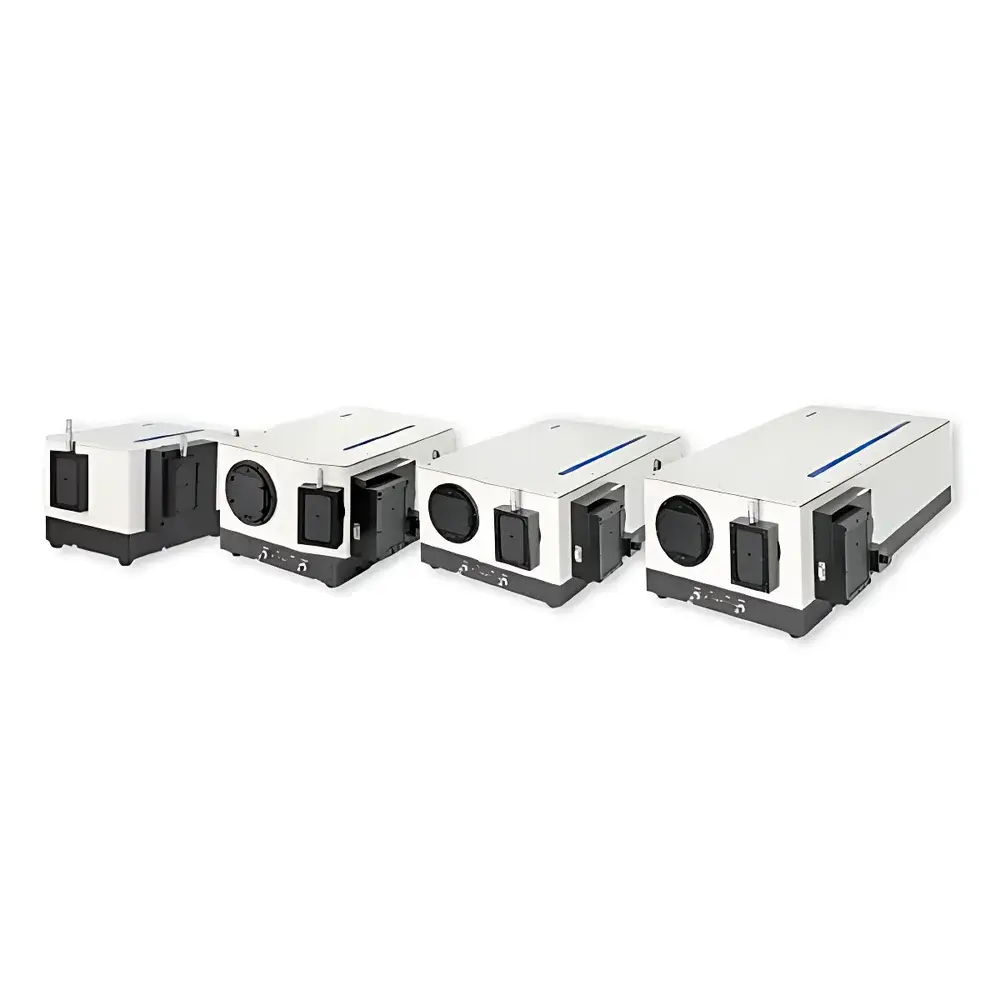
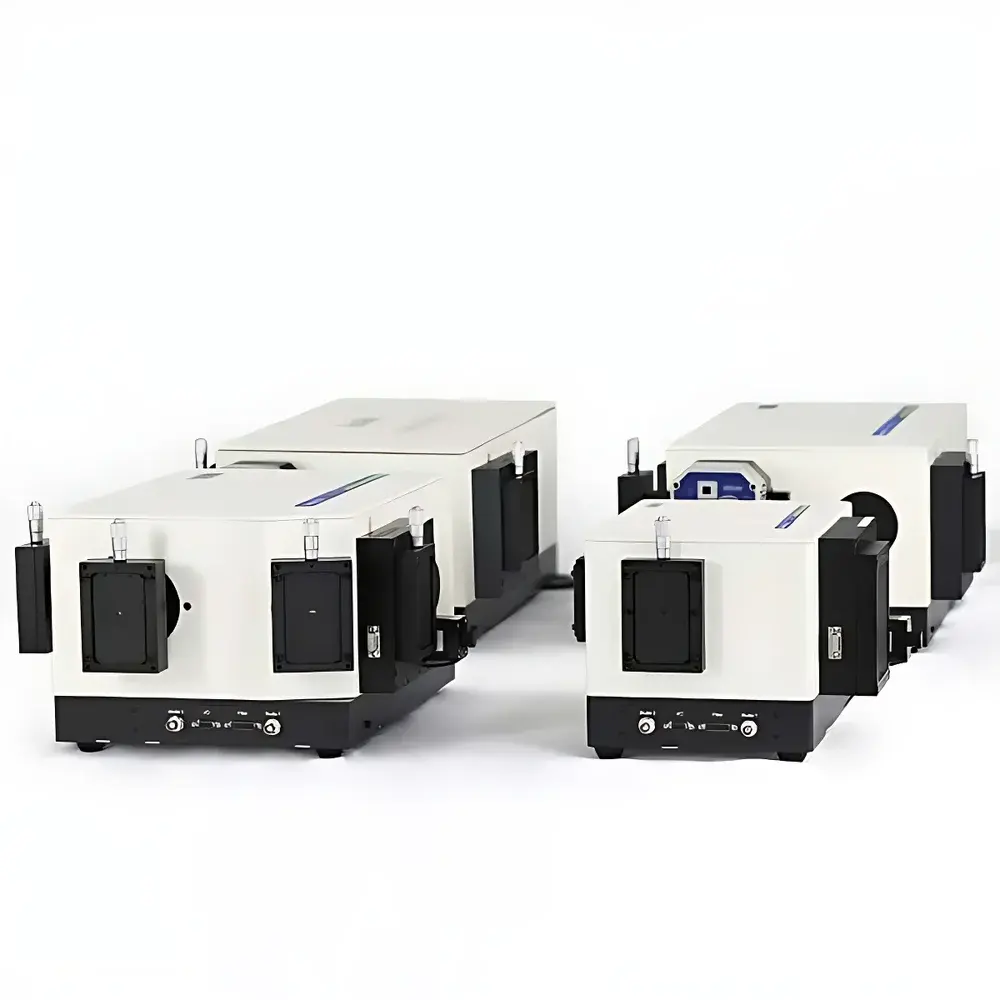
ZOLIX Omni-λ Series Czerny-Turner Imaging Grating Spectrometer
| Brand | ZOLIX |
|---|---|
| Origin | Beijing, China |
| Manufacturer Type | Original Equipment Manufacturer (OEM) |
| Product Category | Domestic |
| Model | Omni-λ Series |
| Application Systems | Transmission & Reflection Spectroscopy |
| Number of Gratings | Dual-grating turret |
| Spectral Resolution | 0.4 nm (FWHM, @1200 g/mm grating, 10 µm slit) |
| Linear Dispersion | 3.68 nm/mm |
| Wavelength Range | 400–1000 nm (standard configuration) |
| F-number | f/4.2 |
| Wavelength Accuracy | ±0.25 nm |
| Stray Light Level | ≤0.1% (typical), down to 1×10⁻⁵ with optimized gratings and baffling |
Overview
The ZOLIX Omni-λ Series is a high-performance, modular Czerny-Turner imaging spectrometer engineered for precision spectral analysis across research, industrial QA/QC, and academic laboratories. Based on an aberration-corrected toroidal mirror optical design and optimized for imaging fidelity, the instrument delivers uniform spectral focus across the detector plane—minimizing spatial distortion and enabling quantitative pixel-to-wavelength calibration essential for CCD- and sCMOS-based detection. Its dual-grating turret architecture supports rapid, software-controlled switching between gratings with differing groove densities and blaze wavelengths, allowing seamless coverage from ultraviolet (UV) through visible (VIS) to near-infrared (NIR) spectral regions (extending beyond 2.4 µm with optional gratings). The core optical path employs 68 × 68 mm ruled or holographic diffraction gratings—maximizing light throughput while maintaining mechanical stability under thermal and vibrational load. All wavelength scanning, grating selection, and exit port routing are executed via integrated DSP-based motion control, interfaced exclusively through high-speed USB 2.0—eliminating legacy RS-232 latency and enabling real-time synchronization with external triggers (e.g., pulsed lasers, shutter controllers).
Key Features
- Czerny-Turner optical layout with toroidal mirror correction for high-resolution, flat-field spectral imaging
- Dual-grating motorized turret with automatic indexing and positional repeatability better than ±0.005°
- Modular focal lengths: 200 mm, 320 mm, 500 mm, and 750 mm configurations available—each optimized for specific trade-offs between resolution, throughput, and spectral coverage
- Standard manual entrance/exit slits; motorized variable slits (10–3000 µm) optional for dynamic bandwidth control
- Multi-port architecture: Single-input/dual-output (300i/500i/750i models) supports simultaneous coupling to two detectors (e.g., Si CCD + InGaAs array)
- Lateral input port compatible with electronic shutters and fiber-optic couplers for time-resolved measurements
- Gilded optics option for NIR (>1 µm) applications, enhancing reflectivity above 95% in the 1–12 µm range
- Stray light suppression engineered to <1×10⁻⁵ via internal baffling, blackened surfaces, and optimized grating coatings
Sample Compatibility & Compliance
The Omni-λ spectrometer is designed as a core optical engine—not a standalone analytical system—but integrates seamlessly into custom-built spectroscopic platforms. It supports transmission, reflection, fluorescence, Raman, absorption, and emission spectroscopy when coupled with appropriate light sources (e.g., deuterium-halogen lamps, LEDs, tunable lasers) and detectors (PMTs, Si photodiodes, back-illuminated CCDs, InGaAs arrays). Its mechanical and electrical interfaces comply with standard optomechanical mounting conventions (e.g., SM1/SM2 threading, kinematic baseplates). While not certified to ISO/IEC 17025 or FDA 21 CFR Part 11 out-of-the-box, the instrument’s deterministic wavelength calibration, traceable to NIST-traceable reference lamps (e.g., Hg/Ar), supports GLP/GMP-compliant method validation when implemented within a documented system architecture. Full audit trail capability—including grating position history, slit width logs, and wavelength scan metadata—is enabled via the native ZolixSpectra software SDK.
Software & Data Management
Control and data acquisition are managed through ZolixSpectra—a cross-platform (Windows/macOS/Linux) application built on Qt and leveraging low-level USB HID protocols for deterministic timing. The software provides real-time spectrum preview, multi-scan averaging, dark-current subtraction, and pixel binning. Calibration routines include polynomial fitting (up to 5th order), spline interpolation, and reference-line matching against known emission lines. Export formats include ASCII (.txt), CSV, HDF5, and vendor-neutral .spe (WinSpec-compatible). An open API (C/C++, Python bindings) allows integration into LabVIEW, MATLAB, or custom Python-based automation frameworks—supporting automated batch acquisition, spectral library matching, and real-time peak tracking. Firmware updates are delivered via signed binary packages, ensuring integrity and version traceability.
Applications
- UV-VIS-NIR absorbance and transmittance measurements per ASTM E308 and ISO 11664-3
- Photoluminescence quantum yield (PLQY) systems using integrating spheres and calibrated reference standards
- Raman spectroscopy with notch or edge filters—especially in 785 nm and 1064 nm excitation configurations
- Thin-film optical characterization (n/k dispersion modeling) via variable-angle reflectance
- Plasma emission monitoring in semiconductor process tools (OES)
- LED and laser diode spectral profiling—including centroid wavelength, FWHM, and side-mode suppression ratio (SMSR)
- Environmental sensor development for gas-phase absorption (e.g., NO₂, SO₂, CH₄) using differential optical absorption spectroscopy (DOAS)
FAQ
What focal length should I select for highest spectral resolution?
For maximum resolution at a given slit width and grating density, choose the longest available focal length (750 mm). Resolution scales linearly with focal length and grating groove density but inversely with slit width.
Can the Omni-λ be used for Raman spectroscopy below 200 cm⁻¹?
Yes—when paired with a high-efficiency holographic grating (e.g., 1800 g/mm, 500 nm blaze) and a deep-cooled back-illuminated CCD, the 750 mm model achieves usable resolution down to ~50 cm⁻¹ with 785 nm excitation.
Is USB 2.0 sufficient for high-speed spectral acquisition?
Yes—full-frame readout from a 1024-pixel CCD typically completes in <15 ms, well within USB 2.0’s 480 Mbps theoretical bandwidth. Sustained streaming requires proper buffer management in host software.
How is wavelength calibration maintained over temperature drift?
The instrument includes internal thermal sensors and a compensation algorithm that adjusts calibration coefficients based on ambient temperature—validated across 15–35 °C operating range.
Are OEM integration services available for custom optical interfaces?
Yes—ZOLIX offers mechanical redesign, firmware customization, and API extension support under NDA for volume OEM deployments.





