
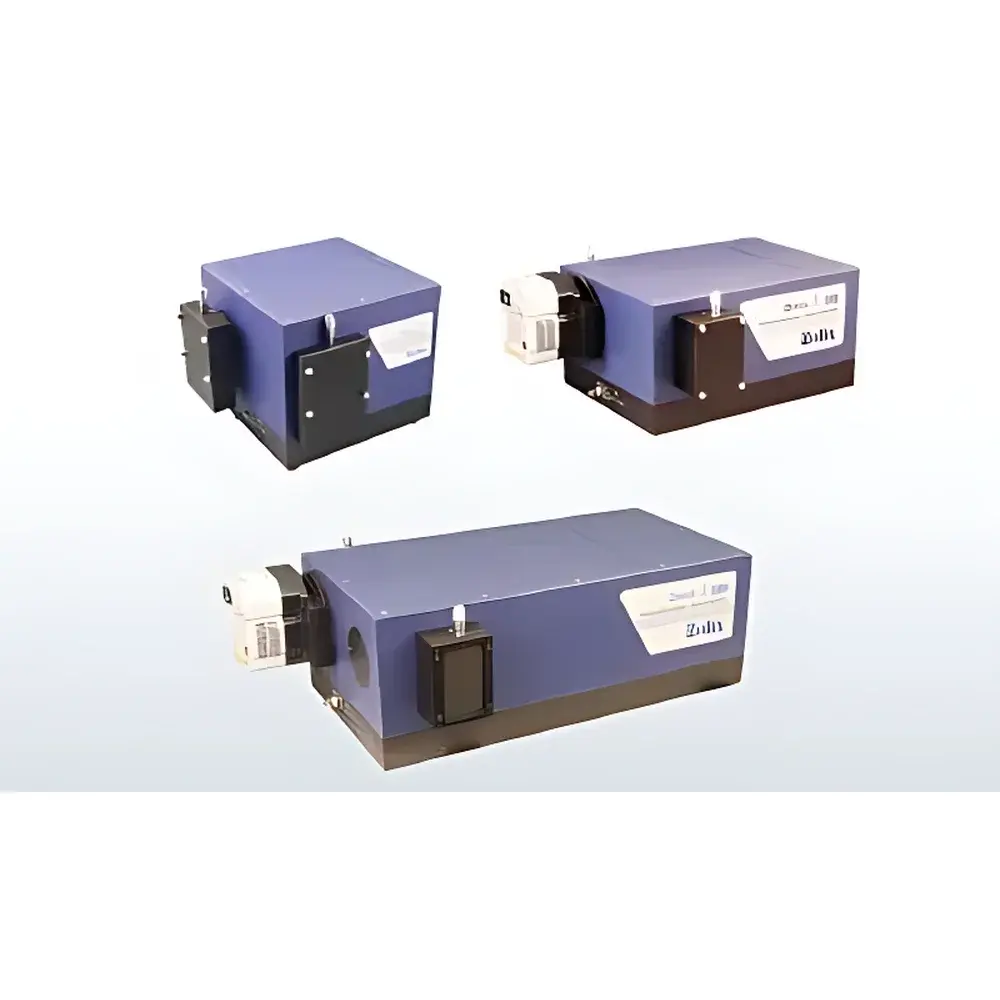
ZOLIX Omni-λ Series Imaging Monochromators / Grating Spectrometers
| Brand | ZOLIX |
|---|---|
| Origin | Beijing, China |
| Manufacturer Type | Original Equipment Manufacturer (OEM) |
| Product Category | Domestic |
| Model Series | Omni-λ Imaging Monochromator Series |
| Pricing | Available Upon Request |
| Focal Length Options | 180 mm, 320 mm, 500 mm, 750 mm |
| Optical Design | Czerny-Turner with Aspheric Image Correction |
| Grating Mount | Dual- or Triple-Grating Turret |
| Grating Sizes | 40×40 mm, 68×68 mm (or 68×84 mm) |
| Wavelength Range | UV–VIS–NIR (190–2500 nm), Optimized for IR (>1 µm) with Gold-Coated Optics |
| Stray Light Suppression | ≤1×10⁻⁵ |
| Control Interface | USB 2.0 (standard), RS-232 (optional) |
| Drive System | DSP-Based Motorized Control |
| Slit Options | Manual (0.01–3 mm width, 2/4/10/14 mm height) or Motorized Adjustable Slit |
| Detector Compatibility | PMT, CCD (26 µm pixel pitch), InGaAs, MCT |
| Entrance/Exit Port Configuration | Single or Dual Input/Output (software-selectable) |
| Typical Resolution (1200 g/mm grating) | 0.028–0.35 nm (CCD/PMT dependent) |
| Wavelength Accuracy | ±0.1–±0.2 nm |
| Wavelength Repeatability | ±0.01–±0.1 nm |
| Scan Step Size | 0.0025–0.01 nm |
| Focal Plane Dimensions | 30 mm (w) × 10–14 mm (h) |
| Optical Axis Height | 146.5 mm |
| Relative Aperture | f/4 to f/9.7 |
Overview
The ZOLIX Omni-λ Series Imaging Monochromators are precision-engineered grating-based spectroscopic instruments designed for high-fidelity spectral separation and wavelength selection across the ultraviolet, visible, and near-to-mid infrared (190–2500 nm) spectral regions. Built upon the classical Czerny-Turner optical configuration and enhanced with aspheric image correction optics, the Omni-λ platform minimizes astigmatism and field curvature—ensuring spatially coherent focusing of off-axis rays onto a planar focal surface. This imaging capability significantly improves signal throughput and spectral fidelity when coupled with array detectors such as CCDs or CMOS sensors, distinguishing it from conventional non-imaging monochromators. The series is available in four focal lengths (180 mm, 320 mm, 500 mm, and 750 mm), each optimized for specific trade-offs among resolution, throughput, and spectral coverage. All models support gold-coated optics for enhanced reflectivity beyond 1 µm, making them suitable for demanding NIR and IR applications including photoluminescence, Raman scattering, and absorption spectroscopy under controlled laboratory conditions.
Key Features
- Czerny-Turner optical layout with aspheric collimating and focusing mirrors for diffraction-limited imaging performance and minimized optical aberrations
- Dual- or triple-grating turret enabling rapid, software-controlled switching between gratings—supporting seamless coverage from UV to IR without realignment
- Large-format ruled or holographic gratings (40×40 mm and 68×68 mm / 68×84 mm) to maximize light collection efficiency and signal-to-noise ratio
- Gold-coated optical surfaces standard on IR-optimized configurations, delivering >95% reflectance at 2–5 µm wavelengths
- Stray light suppression ratio ≤1×10⁻⁵, achieved through optimized baffling, blackened internal surfaces, and multi-stage aperture control
- DSP-driven motorized drive system enabling precise wavelength scanning (minimum step size: 0.0025 nm), automated slit adjustment, and dual input/output port selection
- USB 2.0 interface as standard—providing plug-and-play connectivity, higher data transfer rates (>480 Mbps), and simplified integration into Windows- and Linux-based spectroscopy platforms
- Modular mechanical design supporting optional electronic shutter, motorized slits, and interchangeable entrance/exit configurations (single/dual input, single/dual output)
Sample Compatibility & Compliance
The Omni-λ Series is inherently sample-agnostic—it functions as an optical dispersion and selection engine rather than a direct measurement device. Its compatibility spans solid, liquid, and gaseous samples when integrated into larger analytical systems (e.g., fluorescence spectrometers, Raman microscopes, or custom-built transmission/reflectance setups). When configured with appropriate light sources (Xe lamps, lasers, LEDs, or thermal emitters) and detectors (PMTs, back-illuminated CCDs, InGaAs arrays, or liquid-nitrogen-cooled MCT), the instrument meets functional requirements for ISO/IEC 17025-compliant laboratories performing method validation per ASTM E275, ASTM E334, and ISO 13406-2. While not FDA-cleared as a standalone medical device, its architecture supports 21 CFR Part 11-compliant data acquisition workflows when paired with validated third-party spectroscopy software featuring audit trails, electronic signatures, and secure user access controls.
Software & Data Management
ZOLIX provides the OmniDriver™ SDK—a cross-platform (Windows/Linux) software development kit supporting native C/C++, Python, MATLAB, and LabVIEW APIs. The included OmniStudio™ application enables full instrument control: grating selection, wavelength scanning, slit width/height adjustment, port routing, and real-time spectrum preview. All operational parameters—including motor position logs, slit settings, grating ID, and timestamped wavelength calibration events—are recorded in structured ASCII or HDF5 format, ensuring traceability for GLP/GMP environments. Data export options include CSV, SPC, and JCAMP-DX formats compatible with commercial chemometrics and spectral analysis packages (e.g., GRAMS/AI, OriginPro, Igor Pro). Firmware updates are delivered via signed binary packages with SHA-256 checksum verification to maintain integrity and compliance readiness.
Applications
- Steady-state and time-resolved photoluminescence spectroscopy of quantum dots, perovskites, and organic semiconductors
- Confocal Raman microscopy with spatial filtering and high-throughput spectral acquisition
- UV-Vis-NIR absorbance and transmittance measurements of thin films, nanoparticles, and biological tissues
- Calibration source characterization (e.g., deuterium, tungsten-halogen, and LED-based standards)
- Plasma emission analysis in semiconductor process monitoring and laser-induced breakdown spectroscopy (LIBS)
- Custom OEM integration into OEM spectrometers, ellipsometers, and hyperspectral imaging systems
FAQ
What wavelength ranges are supported by the Omni-λ Series?
The base configuration covers 190–1100 nm using standard Al+MgF₂-coated optics; extended-range versions with gold-coated mirrors and IR-optimized gratings operate from 250 nm to 2500 nm.
Can the Omni-λ be used with a CCD array detector?
Yes—the imaging-corrected focal plane ensures uniform spectral sampling across the full 30 mm width, supporting both linear and area-array CCDs with pixel pitches down to 26 µm.
Is remote or automated operation supported?
Fully supported via USB 2.0 and the OmniDriver SDK; all motion axes (grating rotation, slit actuation, port selection) are programmable with sub-millisecond command latency.
How is wavelength calibration performed?
Factory calibration uses Hg/Ar/Ne spectral line standards; users may perform recalibration using built-in polynomial fitting tools or external reference lamps with NIST-traceable line positions.
What maintenance is required for long-term stability?
No routine optical alignment is needed; periodic verification of wavelength accuracy and stray light performance is recommended annually per ISO 10012 guidelines.




