
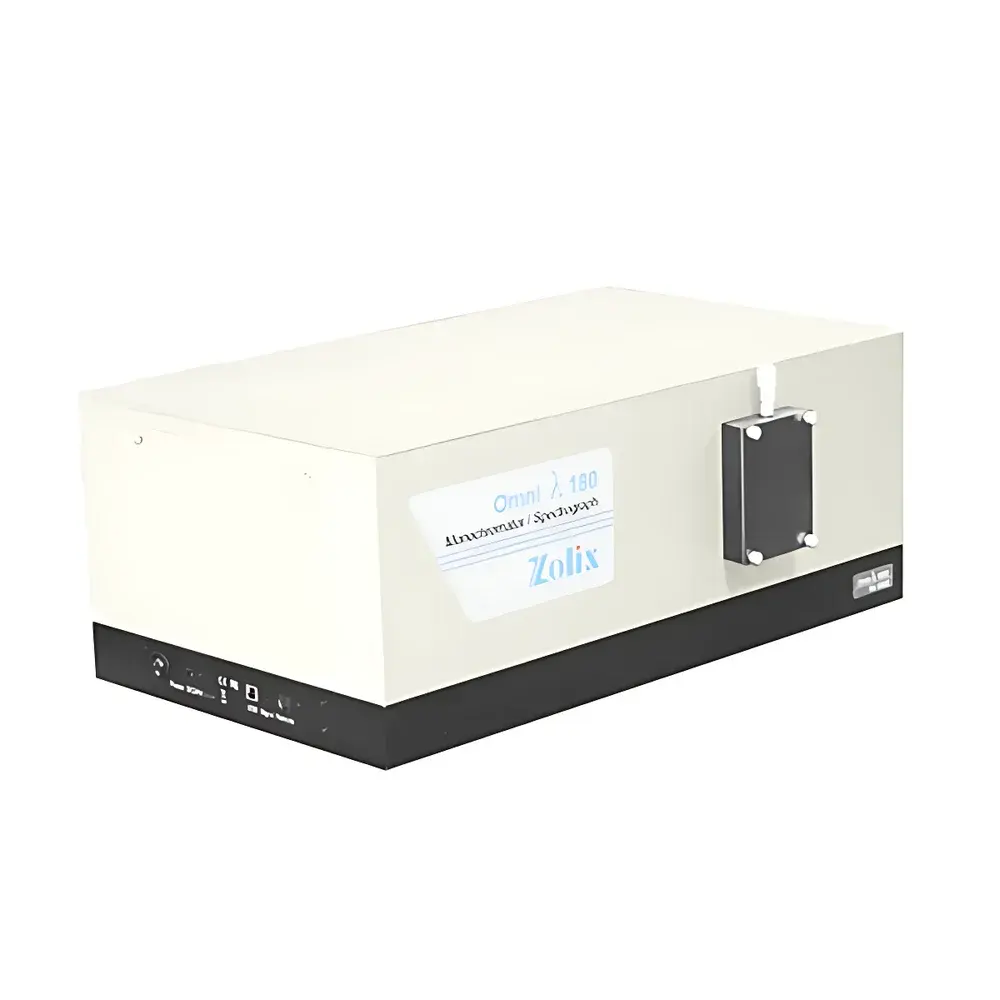
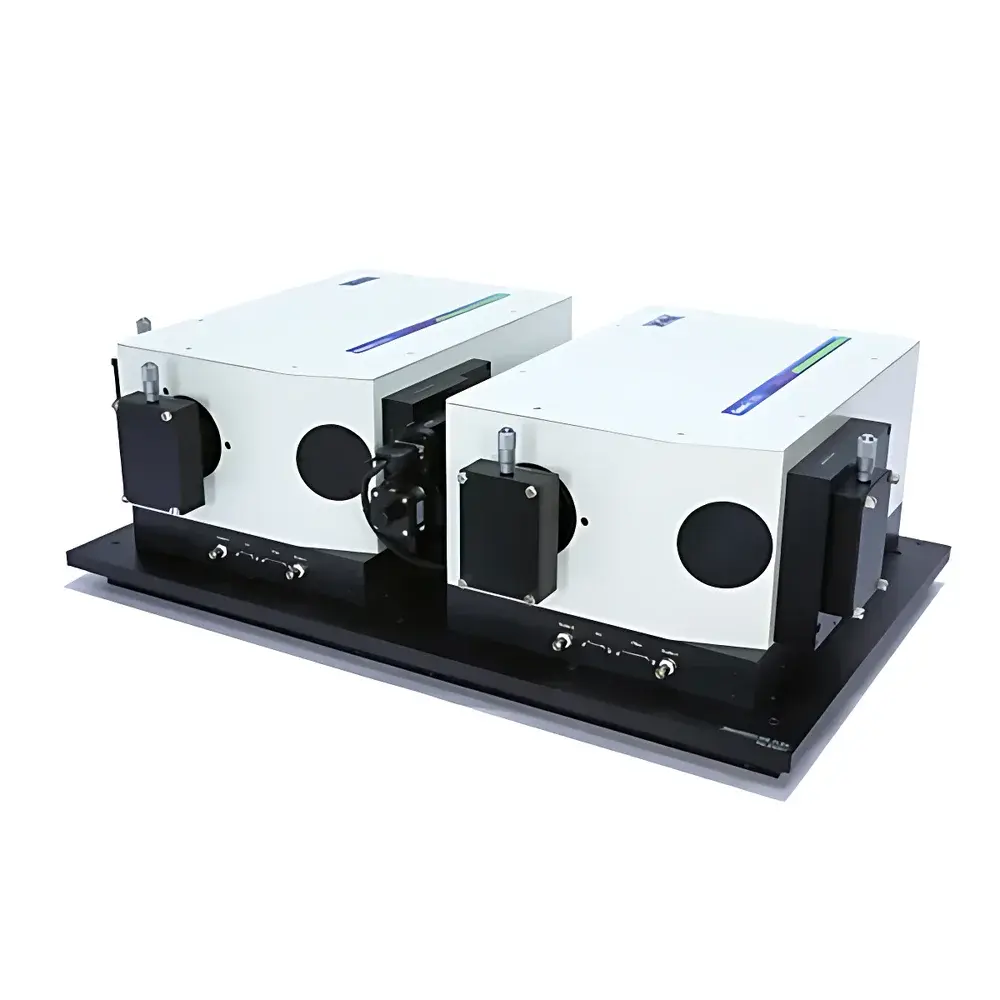
ZOLIX Omni-λ180D Dual-Stage Monochromator
| Brand | ZOLIX |
|---|---|
| Origin | Beijing, China |
| Manufacturer Type | Original Equipment Manufacturer (OEM) |
| Product Category | Domestic |
| Model | Omni-λ180D |
| Application System | Universal |
| Spectral Resolution | 0.25 nm |
| Linear Dispersion | 3.7 nm/mm |
| Wavelength Accuracy | ±0.2 nm |
| F-number | F/3.9 |
| Stray Light Level | <1×10⁻⁹ |
Overview
The ZOLIX Omni-λ180D Dual-Stage Monochromator is an optomechanically integrated, dispersion-subtractive monochromator engineered for ultra-low stray light performance and high spectral purity in demanding photometric and spectroscopic applications. Unlike conventional single-stage monochromators, the Omni-λ180D employs two identical Czerny–Turner optical stages—each with a 180 mm focal length—rigorously aligned and matched to achieve precise dispersion cancellation. In dispersion-subtractive configuration, only light following the nominal optical path experiences constructive recombination at the exit slit; all off-axis or scattered light undergoes destructive interference across the second stage, resulting in effective suppression of stray radiation. This architecture is fundamentally distinct from tandem monochromators used for resolution enhancement (dispersion-additive mode), and instead prioritizes signal fidelity over resolving power—making it especially suitable for weak-signal detection where background rejection is critical, such as Raman spectroscopy, spectral responsivity calibration of photodetectors, and low-light quantum efficiency measurements.
Key Features
- Dispersion-subtractive dual-stage optical design optimized for stray light suppression below 1×10⁻⁹ (measured at 500 nm with 1200 g/mm grating)
- Integrated mechanical housing with rigid aluminum alloy chassis ensuring thermal and mechanical stability during long-duration scans
- Dual-grating turret supporting automatic switching between UV, VIS, and NIR gratings (e.g., 1200 g/mm, 600 g/mm, 300 g/mm) via USB 2.0-controlled stepper motor
- Precision-machined entrance and exit slits with motorized width control (range: 10–3000 µm, resolution: 1 µm) enabling dynamic bandwidth adjustment
- F/3.9 input/output optics providing balanced throughput and resolution across 190–1100 nm spectral range
- USB 2.0 interface compliant with Windows-based ZOLIX SpectraMaster software for full remote operation—including wavelength scanning, grating selection, slit control, and hardware diagnostics
Sample Compatibility & Compliance
The Omni-λ180D is compatible with standard 25 mm diameter optical mounts and integrates seamlessly with common excitation sources (Xe arc lamps, deuterium/halogen broadband sources, supercontinuum lasers) and detection systems (PMTs, Si/InGaAs photodiodes, CCD/CMOS array detectors). Its optical design conforms to ISO 14785:2020 (spectrometers — terminology and performance parameters) and supports traceable calibration workflows per NIST-traceable standards. When deployed in metrology-grade detector calibration setups, the instrument meets requirements for uncertainty budgeting under ISO/IEC 17025:2017. Stray light specifications are validated using ASTM E275-20 (standard practice for describing and measuring performance of ultraviolet, visible, and near-infrared spectrophotometers), and system-level validation includes dark current mapping and linearity assessment per IEC 61223-3-6 for optical measurement devices.
Software & Data Management
ZOLIX SpectraMaster v4.x provides deterministic control of all hardware functions via USB HID protocol, with support for multi-threaded scan acquisition, real-time baseline correction, and export to CSV, HDF5, and JCAMP-DX formats. The software implements audit-trail logging compliant with FDA 21 CFR Part 11 requirements when configured with user authentication and electronic signature modules. Data timestamps are synchronized to system clock with microsecond precision, and spectral metadata—including grating identity, slit widths, integration time, and environmental sensor readings (optional temperature/humidity monitoring)—are embedded directly into exported files. API libraries (C/C++, Python, LabVIEW) enable integration into automated test benches and GLP/GMP-compliant laboratory information management systems (LIMS).
Applications
- Raman spectroscopy: Acts as a high-rejection notch filter to isolate inelastically scattered photons while rejecting Rayleigh line and laser plasma emission—particularly advantageous for low-frequency (<200 cm⁻¹) Raman modes where etalon effects and stray light dominate
- Photodetector spectral responsivity calibration: Enables NIST-traceable monochromatic irradiance generation with minimized uncertainty contributions from out-of-band leakage, especially critical in UV (900 nm) regions
- Tunable monochromatic source construction: Paired with stabilized broadband sources and optional fiber-coupled output, delivers calibrated spectral irradiance with <0.1% relative uncertainty across defined bandwidths
- Fluorescence lifetime decay analysis: Provides clean excitation bands for time-resolved photoluminescence studies where pump-probe isolation requires >OD9 suppression of residual excitation
- Optical filter characterization: Used in transmission/reflectance measurement setups requiring high dynamic range (>10⁹) to resolve deep stopband features of dielectric coatings and interference filters
FAQ
What is the fundamental difference between dispersion-additive and dispersion-subtractive configurations?
Dispersion-additive mode doubles linear dispersion and halves spectral bandwidth at fixed slit width—increasing resolution but also amplifying stray light. Dispersion-subtractive mode cancels dispersion vectors while preserving throughput path geometry, thereby suppressing stray light without sacrificing absolute wavelength accuracy.
Can the Omni-λ180D be used with CCD array detectors?
Yes, when operated in dispersion-additive mode (with appropriate optical reconfiguration), it functions as a high-resolution spectrograph; however, the standard Omni-λ180D is optimized for single-channel detection in dispersion-subtractive mode.
Is grating alignment user-serviceable?
No—optical alignment of the dual-stage system is performed at factory using interferometric verification and sealed against field adjustment to maintain stray light specification.
Does the instrument support external trigger synchronization?
Yes, TTL-compatible sync I/O ports enable hardware-gated acquisition synchronized to pulsed lasers or chopper wheels with jitter <50 ns.
How is wavelength calibration maintained over time?
The system supports multi-point Hg/Ne/Ar lamp calibration routines with polynomial fitting; recalibration intervals are recommended every 6 months or after mechanical shock events, per ISO/IEC 17025 maintenance guidelines.






