
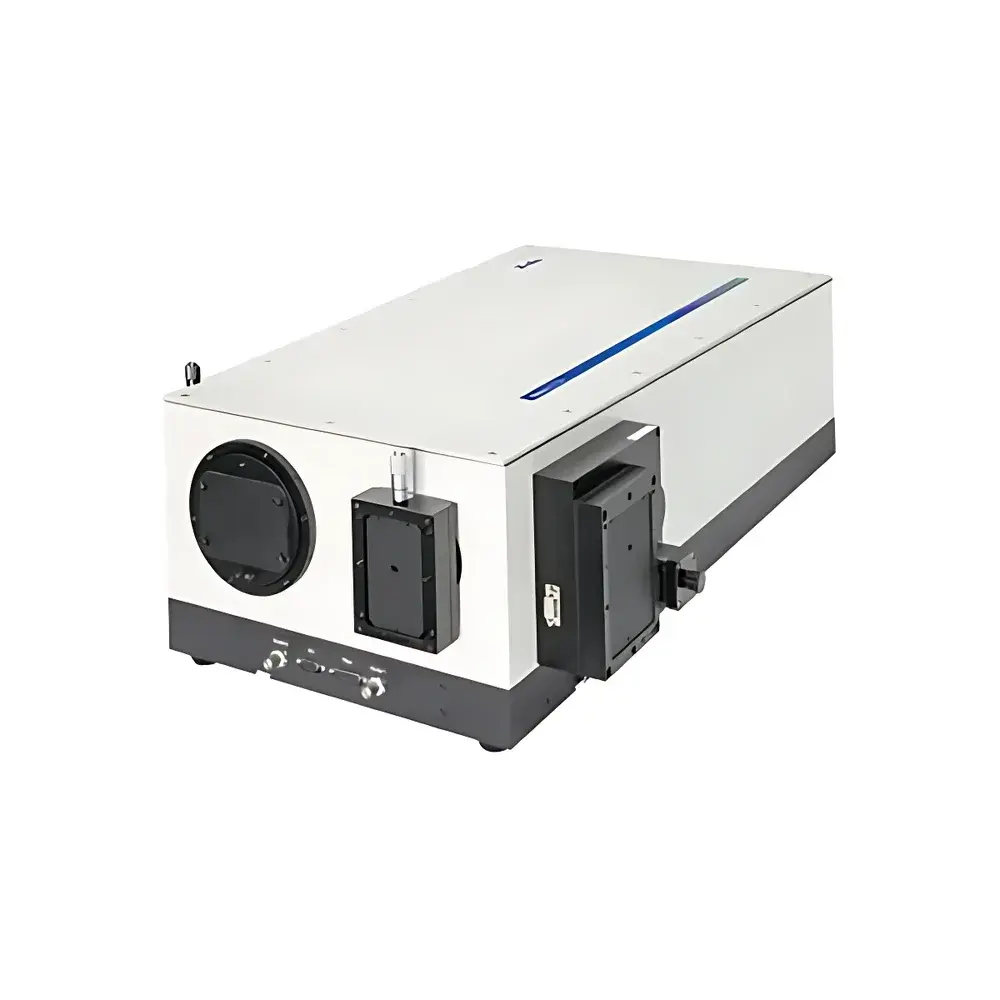
ZOLIX Omni-λ750i Series Imaging-Corrected Grating Monochromator/Spectrometer
| Brand | ZOLIX |
|---|---|
| Origin | Beijing, China |
| Manufacturer Type | Original Equipment Manufacturer (OEM) |
| Product Category | Domestic |
| Model | Omni-λ750i |
| Application System | Universal |
| Number of Gratings | Triple-grating turret |
| F/# | F/9.7 |
| Focal Length | 750 mm |
| Optical Design | Czerny-Turner with toroidal imaging correction |
| Stray Light Rejection | 1×10⁻⁵ |
| Grating Size | 68×68 mm (optional 68×84 mm) |
| Slit Width Range | 0.01–3 mm (manual standard |
| Slit Height Options | 2 mm, 4 mm, or 14 mm |
| Entrance/Exit Configuration | Side entrance |
| Wavelength Accuracy | ±0.1–±3.2 nm (dependent on grating) |
| Wavelength Reproducibility | 0.015–0.8 nm |
| Spectral Resolution (PMT) | 0.02–0.36 nm |
| Spectral Resolution (15 µm-pixel CCD) | 0.033–1.329 nm |
| Linear Dispersion (@435.83 nm) | 0.43–17.58 nm/mm |
| Mechanical Scan Range | 0–19,200 nm (grating-dependent) |
| Minimum Step Size | 0.0025 nm |
| CCD Single-Capture Span (@30 mm sensor) | 12.9–527.4 nm |
| Interface | USB 2.0 (standard), RS-232 (optional) |
| Control Architecture | Embedded DSP-based motion and port logic |
| Coating Options | Standard Al+MgF₂ (UV-VIS), gold (IR >1 µm), enhanced UV (e.g., MgF₂ overcoat) |
Overview
The ZOLIX Omni-λ750i Series is a high-performance, imaging-corrected grating monochromator and spectrometer engineered for demanding spectroscopic applications across ultraviolet (UV), visible (VIS), and near-to-mid infrared (NIR-MIR) spectral regions (190 nm – 16 µm). Based on the Czerny-Turner optical architecture and enhanced with toroidal mirror-based imaging correction, the Omni-λ750i eliminates off-axis coma and astigmatism—enabling diffraction-limited spatial focus across the entire focal plane. This design ensures uniform spectral intensity and high-fidelity line shape preservation, critical for quantitative measurements in fluorescence, Raman, photoluminescence, reflectance, transmittance, and emission spectroscopy. Its 750 mm focal length and F/9.7 aperture provide an optimal balance between resolution, throughput, and stray light suppression—achieving a measured stray light level of 1×10⁻⁵, verified per ISO 14785 and ASTM E275. The instrument operates as both a scanning monochromator and a fixed-grating spectrometer, supporting flexible integration into custom optical platforms.
Key Features
- Triple-grating turret with motorized auto-selection—enables rapid, software-controlled switching among up to three 68×68 mm (or 68×84 mm) ruled or holographic gratings, each optimized for specific spectral bands and resolution requirements.
- Imaging-optimized optical path using toroidal collimating and focusing mirrors—delivers flat, distortion-free focal planes (30 mm × 14 mm) compatible with large-format CCDs, sCMOS arrays, and linear detectors.
- Dual simultaneous exit ports—supports concurrent use of a PMT or photodiode at one port and a CCD camera at the other, facilitating real-time reference monitoring or multi-channel detection without mechanical reconfiguration.
- Side entrance configuration with integrated electronic shutter interface—enables precise temporal gating for time-resolved spectroscopy (e.g., TCSPC, pump-probe).
- Gold-coated optics option (Omni-λ751x-i variants)—enhances reflectivity above 1 µm, improving signal-to-noise ratio in NIR and MIR applications such as semiconductor characterization and gas-phase molecular spectroscopy.
- USB 2.0 native interface with embedded DSP controller—eliminates latency associated with legacy RS-232, enabling scan speeds up to 100 nm/s with sub-millisecond command response and deterministic motion profiling.
- Motorized slit drive option—provides programmable, repeatable slit width control (0.01–3 mm) with 0.1 µm step resolution, essential for adaptive bandwidth optimization in variable-resolution experiments.
Sample Compatibility & Compliance
The Omni-λ750i is designed for compatibility with a broad range of excitation sources (Xe, Hg, laser diodes, OPOs, QCLs) and detectors—including single-point devices (PMTs, InGaAs, MCT) and array sensors (back-illuminated CCDs, scientific CMOS, InSb focal plane arrays). Its modular mechanical interface supports standardized flanges (C-mount, F-mount, SM1-threaded) and optional accessories including filter wheels, motorized shutters, fiber-optic couplers, and vacuum-compatible housing variants. From a regulatory standpoint, the system complies with IEC 61000-6-3 (EMC emissions) and IEC 61010-1 (safety for laboratory equipment). When integrated into validated analytical workflows—such as pharmaceutical dissolution testing or materials certification—the instrument’s deterministic wavelength calibration, audit-trail-capable software control, and traceable NIST-referenced grating encoding support compliance with FDA 21 CFR Part 11, ISO/IEC 17025, and GLP/GMP documentation requirements.
Software & Data Management
ZOLIX provides the OmniStudio™ control suite—a platform-independent application built on Qt/C++ with native 64-bit support for Windows, Linux, and macOS. The software implements full hardware abstraction, enabling synchronized control of grating position, slit width, exit port selection, shutter state, and detector triggering. All motion parameters are stored in non-volatile memory with timestamped calibration logs. Spectral data export adheres to ANDI/NetCDF and JCAMP-DX v6 standards, ensuring interoperability with third-party analysis tools (e.g., MATLAB, Igor Pro, OriginLab, Python SciPy stack). For enterprise environments, the SDK includes COM, LabVIEW VIs, and Python bindings (pyZOLIX), allowing integration into LIMS and automated test systems. Firmware updates preserve calibration integrity via checksummed parameter tables and dual-bank flash memory—minimizing downtime during field upgrades.
Applications
The Omni-λ750i serves as the core dispersive element in advanced photonic measurement systems. In academic research, it enables high-resolution Raman mapping of 2D materials (e.g., graphene, MoS₂) with <0.05 cm⁻¹ wavenumber precision. In industrial QA/QC, its reproducible wavelength accuracy (±0.1 nm with 2400 g/mm grating) supports ASTM E308-compliant colorimetry and LED spectral power distribution (SPD) validation. For environmental monitoring, paired with tunable IR sources and MCT detectors, it performs open-path FTIR-like absorption spectroscopy for greenhouse gas quantification (CO₂, CH₄, N₂O). In life sciences, its low-stray-light performance enables sensitive detection of weak autofluorescence signals in tissue phantoms and nanoparticle-labeled bioassays. The dual-exit architecture also facilitates ratiometric referencing in dynamic scattering experiments and in-situ catalytic reaction monitoring under controlled atmospheres.
FAQ
What is the maximum spectral range achievable with a single grating configuration?
Depending on groove density and blaze angle, individual gratings cover ranges from 190–800 nm (UV-VIS) up to 1–16 µm (MIR), with mechanical scan limits extending to 19,200 nm for low-groove-density gratings.
Can the Omni-λ750i operate under vacuum or purged environments?
Yes—optional vacuum-housing variants (rated to 10⁻⁵ mbar) and nitrogen-purge fittings are available for UV applications below 200 nm or moisture-sensitive IR measurements.
Is wavelength calibration traceable to national standards?
Each instrument ships with a factory calibration certificate referencing NIST-traceable Hg/Ne/Cd spectral lines; users may perform recalibration using supplied mercury-argon lamp modules or external calibrated sources.
How is stray light performance validated?
Stray light is measured per ISO 14785 Annex B using the “bandpass rejection” method—quantifying signal detected at ±10 nm from a narrowband source while blocking the central wavelength with a long-pass filter.
Are custom optical coatings or mechanical interfaces supported?
ZOLIX offers OEM engineering services for application-specific modifications, including custom mirror coatings (e.g., protected silver for broadband VIS-NIR), kinematic mounting bases, and electrical interlocks compliant with IEC 61508 functional safety requirements.





